
Red Cat Holdings: Can $46.75M Capital Raise Propel It to $120M Revenue and Drone-USV Dominance?
Red Cat Holdings (NASDAQ: RCAT) has pulled off a strategic capital raise at a critical juncture, securing $46.75 million to fuel its expansion into unmanned systems. The registered direct offering, priced at $7.25 per share, underscores investor confidence in the company's dual-play strategy: scaling production of its military-grade drones and diversifying into maritime drones (unmanned surface vessels, or USVs). With a 2025 revenue target of $80 million to $120 million—85% of which is expected to hit in the second half—the question is whether this capital infusion can bridge the gap between ambition and execution.
The Capital Raise: Validation of Growth Strategy
The $46.75M raise, closing on June 18, 2025, comes at a pivotal moment. Red Cat's shares outstanding rose by ~6.9% to 98.42 million post-offering, a dilution that's relatively modest compared to peers in high-growth tech. Institutional investors participated in the offering, signaling faith in the company's ability to execute its two-pronged plan:
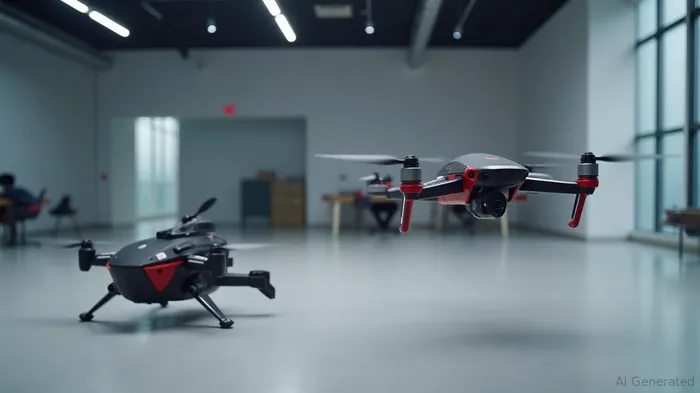
1. Drone Production Ramp-Up: Boosting output of its Black Widow™ and FANG™ drones to 150 units/month by year-end, fueled by a partnership with Empirical Systems Aerospace.
2. USV Diversification: Expanding into maritime drones via its new Edge 130 USV, even though revenue here won't materialize until 2026.
The raise also shores up liquidity. As of Q1 2025, Red Cat held just $9M in cash, supplemented by a $30M raise in April. The June infusion brings total 2025 proceeds to ~$76M, providing a war chest to fund working capital, R&D, and production lines.
Operational Scalability: From Drones to USVs
Red Cat's core strength lies in its military drone contracts. The Black Widow, a U.S. Army SRR (Small Unmanned Reconnaissance) system, is already in production, with orders from both domestic and international buyers. The company's Q1 2025 financials, though not yet reported, likely reflect the initial ramp-up of this program.
The USV division, while still nascent, is a calculated move. The Edge 130 USV—designed for surveillance and logistics—aligns with NDAA compliance trends, as the U.S. military prioritizes domestic suppliers for critical systems. Red Cat's pivot into maritime drones could carve out a niche in a market expected to grow at ~10% annually through 2030.
Revenue Execution: $80M to $120M Target Realistic?
The revenue guidance hinges on two factors:
1. Black Widow Production: Delivering 150 drones/month by year-end would generate ~$50M in annualized revenue (assuming $33K/unit).
2. NDAA-Backed Contracts: The U.S. Army's SRR program alone could contribute significantly, while international sales (e.g., Middle Eastern clients) add a tailwind.
The company's 2025 goal of $80M–$120M is achievable if it meets production targets and secures additional contracts. However, execution risks remain. For instance, delays in scaling production or supply chain hiccups could dent margins. Still, Red Cat's Q1 2蕹 cash position and the June raise provide a buffer.
Institutional Backing and Dilution Impact
While institutional investors participated in the June offering, their identities remain undisclosed. Notably, insider selling (e.g., executives offloading 2.7M shares) has raised eyebrows. However, the dilution impact is manageable: The 6.9% increase in shares outstanding is offset by the operating leverage of higher volume production.
NDAA Compliance and Defense Sector Tailwinds
The 2024 National Defense Authorization Act (NDAA) mandates that 75% of U.S. military drones must be produced domestically by 2026. Red Cat, which assembles its drones in the U.S., is NDAA-compliant. This regulatory tailwind could lock in recurring government contracts, a key moat against foreign competitors.
Risks to Consider
- Execution: Scaling to 150 drones/month requires flawless coordination with Empirical Systems.
- Competition: Boeing and Textron's drone divisions are formidable rivals.
- Market Volatility: Defense stocks often correlate with geopolitical tensions, which are hard to predict.
Investment Takeaway
Red Cat's capital raise is a bullish signal for investors willing to bet on defense tech scalability. At a June 2025 price of ~$7.25/share, the stock trades at ~9x the low end of its 2025 revenue guidance. If Red Cat hits its production targets and secures NDAA-backed contracts, upside could be substantial.
Recommendation: Consider a buy on dips below $7/share, with a 12-month price target of $10–$12. Monitor quarterly production updates and SRR contract wins closely. For cautious investors, wait for proof of Q3 revenue acceleration before scaling into the stock.
Red Cat's move into USVs may still be a story for 2026+, but its drone ramp-up in 2025 could make this a high-reward, high-risk play on defense sector growth.







Comentarios
Aún no hay comentarios