
Reckitt Benckiser's Share Buyback Strategy and Its Implications for Value Creation
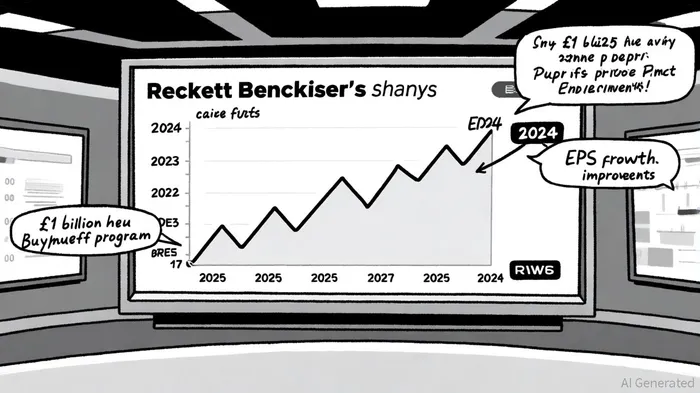
Reckitt Benckiser Group plc's 2025 share buyback program, a £1 billion initiative split into two £250 million tranches, underscores the company's strategic pivot toward optimizing capital allocation and enhancing shareholder value. This move, announced in July 2025 and executed through partnerships with financial institutions like RBC Europe Limited and BNP Paribas, reflects a disciplined approach to capital management amid a broader transformation under CEO Kris Licht's “Fuel for Growth” initiative[1]. By reducing share capital and concentrating earnings per share (EPS), Reckitt aims to align its financial resources with long-term value creation while signaling confidence in its operational resilience.
Strategic Rationale and Capital Allocation Efficiency
The buyback program is a cornerstone of Reckitt's post-divestiture strategy, following the sale of its Essential Home business for up to USD4.8 billion in 2024[2]. This transaction freed capital for reinvestment in high-margin, high-growth “powerbrands” such as Nurofen, Gaviscon, and Dettol, which have driven 4.2% like-for-like net revenue growth in the core business during the first half of 2025[3]. By prioritizing these brands, Reckitt has reduced fixed costs by 190 basis points year-to-date, enabling the company to allocate capital toward initiatives that amplify returns.
The buyback's structure—executed via riskless principal arrangements with banks—ensures cost-effective repurchases while minimizing market volatility. For instance, the first tranche, managed by RBC Europe Limited, commenced on 28 July 2025 and concluded by 31 October 2025, with shares held in treasury until cancellation[4]. This approach not only reduces the share count but also signals to investors that Reckitt views its stock as undervalued, a sentiment reinforced by its upgraded full-year guidance for 2025 (above 4% LFL net revenue growth in Core Reckitt)[5].
Shareholder Value Enhancement: EPS and ROE Dynamics
The buyback's impact on shareholder value is twofold: it enhances EPS through share count reduction and boosts return on equity (ROE) by leveraging retained earnings. While Reckitt has not disclosed precise EPS accretion figures, analysts project modest growth, with an average 2025 EPS estimate of £3.5, reflecting a 0.21% increase year-over-year[6]. This aligns with historical trends, as the company's TTM EPS stood at $2.72 as of the latest reports[7].
ROE, a critical metric for assessing capital efficiency, has shown mixed performance. As of September 2025, Reckitt's ROE was 19.68%, above its five-year average of 11.14% but below the three-year average of 23.21%[8]. However, the buyback is expected to reverse this trend by reducing equity without proportionally decreasing net income. For example, the cancellation of repurchased shares will shrink the denominator in the ROE formula (Net Income/Shareholders' Equity), thereby amplifying the ratio. This dynamic is further supported by Reckitt's 21% ROCE in June 2025, significantly outpacing the 14% industry average[9].
Comparative Analysis and Long-Term Implications
Reckitt's 2025 buyback builds on its 2023 £1 billion program, which demonstrated a consistent commitment to capital returns[10]. However, the 2025 initiative is distinct in its alignment with strategic divestitures and cost discipline. For instance, the sale of Essential Home generated proceeds that could fund the buyback without compromising reinvestment in core brands. This contrasts with past programs, where buybacks were sometimes constrained by operational cash flow.
Emerging markets have also emerged as a catalyst for value creation. These regions contributed 12.8% LFL revenue growth in H1 2025, driving a 270 basis point margin improvement[11]. By pairing geographic diversification with share repurchases, Reckitt is creating a compounding effect: higher margins from emerging markets provide the cash flow to fund buybacks, which in turn enhance EPS and ROE.
Conclusion
Reckitt Benckiser's 2025 share buyback program exemplifies a capital allocation strategy that balances short-term shareholder returns with long-term operational strength. By leveraging riskless principal arrangements, focusing on high-margin brands, and capitalizing on emerging market growth, the company is positioning itself to deliver superior ROE and EPS accretion. While the absence of granular financial metrics introduces some uncertainty, the broader narrative of disciplined capital management and strategic reinvestment remains compelling. For investors, this initiative signals a company that is not only responsive to market dynamics but also proactive in shaping its value trajectory.







Comentarios
Aún no hay comentarios