
Recession Risks in the Eurozone and Implications for Global Equity Markets
The Eurozone's economic trajectory in Q3 2025 reveals a fragile balance between resilience and vulnerability. While industrial production rose 0.3% month-on-month in July 2025, driven by non-durable consumer goods growth of 6.6%, the manufacturing PMI fell to 49.5 in September 2025, signaling a renewed contraction, according to Trading Economics. This divergence underscores the complexity of recession risks, which hinge on sectoral performance, trade policy shifts, and monetary policy adjustments. For global equity markets, the Eurozone's industrial indicators and sectoral exposures offer critical insights into systemic vulnerabilities and strategic opportunities.
Leading Industrial Indicators: A Mixed Signal
Eurostat data shows that the Eurozone's industrial production grew 1.8% annually in July 2025, but this masks sectoral imbalances. Energy production declined 2.9% in the euro area, while intermediate goods rose 0.5%, according to a CIJ Europe report. The manufacturing PMI contraction, driven by a sharp drop in new orders and job cuts, suggests weakening demand despite stable domestic consumption and a robust labor market, per Trading Economics. This duality-strong labor markets versus softening manufacturing-reflects the Eurozone's reliance on domestic demand amid global trade headwinds.
Trade tensions, particularly U.S. tariffs on European steel and aluminum (projected to reach 50%), amplify risks for export-dependent economies like Germany and Italy, according to J.P. Morgan Research. S&P Global estimates these tariffs could reduce Eurozone GDP growth by up to 1.1%, compounding the drag from weak new orders in manufacturing, as the CIJ Europe report notes. For investors, this highlights the need to differentiate between sectors: energy and industrial exporters face near-term headwinds, while defense and technology firms may benefit from EU policy shifts.
Sectoral Exposure and Strategic Rebalancing
The Eurozone's industrial base is increasingly polarized. Energy-intensive sectors, already reeling from the 2022-2023 energy crisis, face renewed pressure as energy production declines, according to the CIJ Europe report. Conversely, non-durable consumer goods-driven by resilient domestic demand-show robust growth, suggesting households remain a buffer against recession.
Defense investment, however, emerges as a counterweight. The EU's €1.065 billion allocation to the European Defence Fund in 2025 and NATO members' pledge to raise defense spending to 2.04% of GDP signal a strategic pivot, according to the Equiti outlook. This sectoral reallocation could mitigate trade-related losses, particularly if geopolitical tensions persist. For equity markets, defense and cybersecurity firms may outperform, while energy and industrial exporters face valuation pressures.
Monetary Policy and Global Equity Spillovers
The ECB's policy stance remains pivotal. While the central bank paused rate cuts in September 2025, maintaining the deposit rate at 2.0%, J.P. Morgan Research anticipates three 25-basis-point cuts by year-end, targeting a terminal rate of 1.5%. This dovish pivot aims to offset trade uncertainties and support growth, but its efficacy depends on the pace of inflation normalization. With core inflation stable at 2.3%, according to Equiti, the ECB's flexibility could stabilize equity valuations in the short term.
However, global equity markets face indirect risks. A Eurozone recession, even if shallow, could dampen multinational earnings in sectors like automotive and machinery. German manufacturing PMI at 49.5 in September 2025-despite record output growth-illustrates this fragility, per J.P. Morgan Research. Investors should monitor cross-border supply chains and currency flows, as a weaker euro could exacerbate import costs for non-Eurozone firms.
Conclusion: Navigating Divergence
The Eurozone's Q3 2025 data paints a picture of divergent risks: industrial contraction and trade tensions offset by strong labor markets and defense investment. For global equity investors, the key lies in sectoral positioning. Energy and industrial exporters face near-term headwinds, while defense, technology, and consumer staples offer relative safety. As the ECB navigates a delicate balance between inflation control and growth support, equity markets must brace for volatility-particularly if U.S.-EU trade negotiations stall.
In this environment, a barbell strategy-hedging against Eurozone weakness while capitalizing on domestic resilience-may prove optimal. The coming months will test the Eurozone's ability to adapt, and global investors must remain agile in response.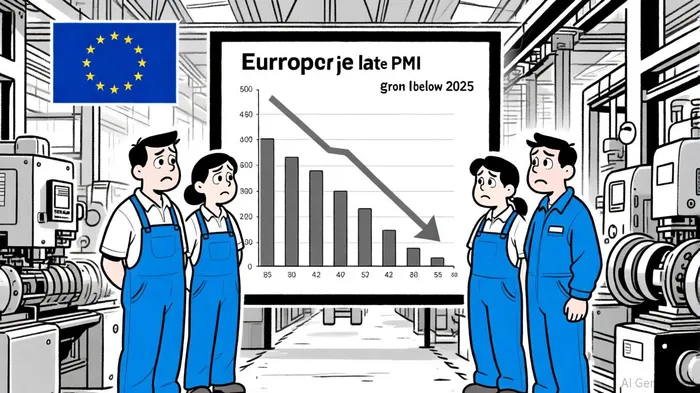







Comentarios
Aún no hay comentarios