
The Rebound in Indian Equities: A Strategic Entry Point Amid Global Macro Shifts?
The Indian equity market has experienced a mixed but resilient performance in late 2025, with the Sensex and Nifty indices reaching record highs amid a complex interplay of domestic and global factors. While the rally has been driven by strong domestic inflows, favorable macroeconomic conditions, and optimism over earnings recovery, concerns about valuations and external risks persist. This analysis examines the catalysts and sustainability of the recent rally, assessing whether the current environment offers a strategic entry point for investors navigating global macroeconomic shifts.
Drivers of the Rally: Domestic Momentum and Policy Tailwinds
The recent surge in the Sensex and Nifty has been underpinned by four key factors. First, domestic institutional and retail investor participation has cushioned the market against global uncertainties, with inflows from local investors offsetting outflows from foreign institutional investors (FIIs). Second, India's macroeconomic fundamentals remain robust, characterized by stable inflation, healthy foreign exchange reserves, and steady manufacturing activity. Third, Indian corporates have shown resilience in Q2 FY26 earnings, with several sectors reporting double-digit profitability growth. Finally, easing valuations-though still above historical averages-have provided some breathing room for investors.
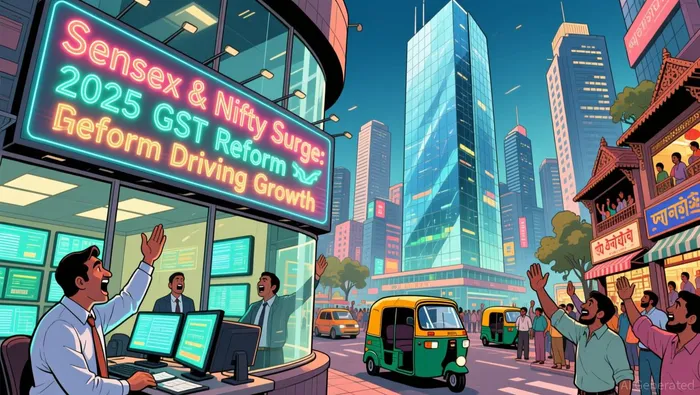
A critical catalyst has been the implementation of the 2025 Goods and Services Tax (GST) overhaul, which simplifies the tax structure by introducing a two-tier system (5% for essentials and 18% for aspirational goods). This reform is expected to boost disposable income and stimulate demand in consumption-driven sectors such as automobiles, fast-moving consumer goods (FMCG), and healthcare. For instance, lower GST rates on small cars and two-wheelers are projected to enhance affordability in rural and semi-urban markets, benefiting automakers like Maruti Suzuki and Hero MotoCorp. Similarly, reduced taxes on household goods and life-saving drugs are likely to drive revenue growth for FMCG and healthcare firms.
Valuation Concerns and Earnings Projections
Despite the positive momentum, valuation metrics remain a point of caution. As of mid-2025, the Nifty 50 traded at a forward price-to-earnings (P/E) ratio of 21.0 times, slightly above its 10-year average of 20.4 times. Analysts project modest earnings per share (EPS) growth of around 11% for Nifty constituents in FY26, which could support further gains if realized. However, high valuations and slow earnings growth have contributed to India's stock market being labeled the worst performer globally in 2025.
The sustainability of the rally will depend on the transmission of fiscal and monetary benefits to corporate earnings. Rajiv Batra of J.P. Morgan notes that the positive momentum from GST reforms and monetary easing may partially offset the adverse impact of U.S. tariffs, supporting a potential equity market rally in the second half of 2026. Neeraj Chadawar of Axis Securities adds that the benefits of these reforms are expected to be visible in corporate earnings from Q3 FY26 onward, potentially attracting FIIs back to the market by the second half of FY27.
Global Macro Risks: Tariffs and Trade Uncertainty
The Indian equity market faces significant headwinds from global macroeconomic shifts, particularly U.S. tariffs. These tariffs are projected to reduce India's growth by up to 40 basis points in FY26 and weigh on export-oriented sectors like textiles and manufacturing. However, policymakers have taken proactive steps to mitigate these risks. The GST overhaul, combined with monetary easing by the Reserve Bank of India (RBI), is expected to stimulate domestic demand and redirect manufacturing output toward the domestic market. A potential trade deal with the U.S. could further alleviate trade uncertainties and enhance access to key sectors such as agriculture and technology.
Sectoral Impact and Long-Term Outlook
The GST reforms are anticipated to have a differential impact across sectors. Autos, FMCG, healthcare, and insurance are expected to benefit most from lower tax rates and increased affordability. For example, the insurance sector may see higher penetration due to GST exemptions on health and life insurance premiums. Conversely, sectors like aviation and metals have underperformed in recent weeks, with the Sensex declining by 0.14% on 8 December 2025 amid weakness in these areas.
India's economy is currently in a "Goldilocks" phase, with cooling inflation and robust GDP growth around 8%. This environment allows for reduced interest rates, easing borrowing costs and supporting liquidity. Deloitte projects baseline economic growth of 6.7% to 6.9% in FY26, driven by direct tax exemptions, continued GST reforms, and accommodative monetary policy. EY similarly raised India's FY26 growth outlook to 6.7%, citing the positive impact of GST 2.0 reforms and monetary easing.
Strategic Entry Point: Balancing Opportunities and Risks
The question of whether the current environment represents a strategic entry point hinges on a nuanced assessment of risks and opportunities. On the one hand, India's macroeconomic fundamentals remain strong, with favorable monsoons, low crude oil prices, and structural reforms supporting consumption-driven growth. On the other hand, valuations remain elevated relative to global peers, and external risks such as U.S. tariffs could persist into 2026.
A staggered investment approach is recommended to navigate this volatility while participating in long-term growth. Investors should focus on sectors poised to benefit from GST reforms-such as autos, FMCG, and healthcare-while remaining cautious about overvalued large-cap stocks. The market breadth remains constrained, with only 40% of Nifty 500 stocks trading above their 50-day moving average, indicating that gains are concentrated in a few names.
Conclusion
The recent rally in the Sensex and Nifty reflects a mix of domestic resilience and policy-driven optimism, but its sustainability will depend on the successful implementation of reforms, improved earnings visibility, and a more favorable external environment. While global macro risks like U.S. tariffs pose near-term challenges, India's "Goldilocks" phase and structural reforms offer a compelling case for selective, disciplined investing. For investors with a medium-term horizon, the current environment may present a strategic entry point-provided they remain mindful of valuation risks and sectoral divergences.







Comentarios
Aún no hay comentarios