
Reassessing Westpac's Valuation in a High-Risk 2026 Outlook
The Australian banking sector stands at a crossroads in 2025, with Westpac Banking Corporation emerging as a focal point of debate among investors and analysts. Morgan Stanley’s recent downgrade of Westpac to its “least preferred” among the big four banks—coupled with a 15% downside target—has sparked renewed scrutiny of its valuation and strategic risks. Yet, contrasting insights from Pendal Group on consumer spending and rate outlooks suggest a more nuanced picture. This analysis dissects the tension between execution risks and macroeconomic tailwinds, offering a risk-adjusted framework to evaluate Westpac’s prospects in a sector grappling with high valuations and uncertain growth.
Morgan Stanley’s Cautious Stance: Execution Risks and Earnings Headwinds
Morgan Stanley’s bearish assessment hinges on Westpac’s aggressive strategy to reclaim market share in mortgages and business banking, a move the firm warns could exacerbate cost pressures and earnings volatility. Richard Wiles, the bank’s analyst, underscores that “the costs of regaining market share may outweigh the benefits, particularly in a low-growth environment” [1]. This skepticism is compounded by broader macroeconomic uncertainties, including the Federal Reserve’s potential rate cuts by mid-2026, which could erode net interest margins (NIMs) and amplify execution risks [2].
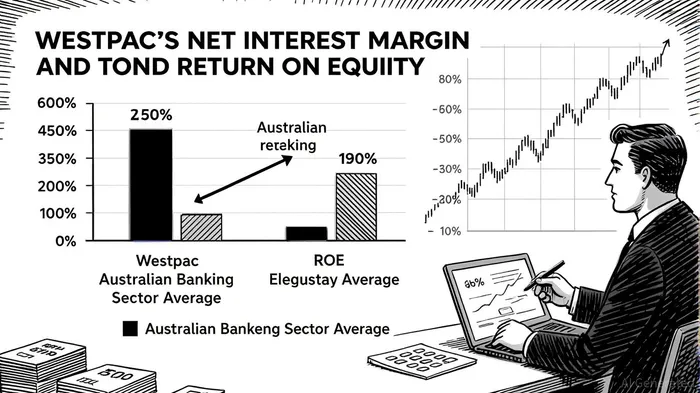
Westpac’s financials reflect these challenges. While its Q3 2025 NIM of 2.01% showed resilience, it lags behind the sector average of 181 basis points for the big four banks [3]. Similarly, its projected ROE of 3.83% pales in comparison to the industry’s 11.18% [4]. These metrics highlight a valuation gap that Morgan StanleyMS-- argues is unsustainable, particularly as rising operational costs and competitive pressures from fintechs and non-traditional players like Macquarie Group intensify [5].
Pendal’s Optimism: Consumer Spending and Rate Cuts as Tailwinds
Contrasting Morgan Stanley’s caution, Pendal Group’s analysis paints a more optimistic outlook for Westpac. Recent data reveals a rebound in Australian consumer spending, with discretionary categories driving growth and the household saving rate declining to 4.2% [6]. This trend aligns with Pendal’s view that the Reserve Bank of Australia (RBA) will cut rates three times in 2025—targeting a cash rate of 3.35% by year-end—to stimulate demand [7].
Such rate cuts could provide a lifeline for Westpac’s NIMs, particularly if the bank manages to balance cost discipline with market share gains. Pendal’s Tim Hext notes that “services inflation has cooled to within the RBA’s target range, creating a window for accommodative policy” [7]. This dovish stance contrasts with Morgan Stanley’s focus on global trade tensions and income uncertainty, suggesting that Westpac’s valuation may yet benefit from a more favorable domestic environment.
Risk-Adjusted Valuation: A Sector in Transition
The Australian banking sector’s valuation dynamics further complicate the analysis. While the big four banks reported combined profits of $15.5 billion in 1H25, their earnings growth remains muted, with consensus forecasts projecting 1-2% annual EPS growth over five years [8]. Westpac’s current P/E ratio of 18.1x and 2026 target of 17.9x [9] appear expensive in this context, especially given its underperformance relative to peers like Commonwealth Bank of Australia (CBA), which has delivered 40% total returns in 2024 [8].
However, the sector’s vulnerability to reversion—highlighted by Northcape Capital’s warnings about rich valuations—adds another layer of risk [8]. For Westpac, the path forward depends on its ability to navigate execution risks while capitalizing on rate-driven tailwinds. A key question is whether its cost-over-income ratio can improve to match industry averages, a challenge given its recent strategic overhauls.
Conclusion: Balancing Act for Investors
Westpac’s valuation in 2026 hinges on a delicate balance between macroeconomic tailwinds and execution risks. Morgan Stanley’s bearish thesis, rooted in cost pressures and global uncertainties, contrasts with Pendal’s optimism about consumer spending and rate cuts. For investors, the critical takeaway is the need for a risk-adjusted approach: Westpac’s shares may offer upside if the RBA’s easing cycle supports NIMs and cost discipline improves, but downside risks remain significant if execution falters or global headwinds intensify.
Source:
[1] ShareCafe, [Westpac Share Price Target Lowered by Morgan Stanley], https://www.sharecafe.com.au/2025/09/09/westpac-share-price-target-lowered-by-morgan-stanley/
[2] Mitrade, [Wall Street giants now expect 3 rate cuts from the Fed...], https://www.mitrade.com/insights/news/live-news/article-3-1101187-20250906
[3] KPMG, [Big four banks' half year results 2025], https://kpmg.com/au/en/insights/industry/big-four-major-banks-australia-half-year-results-2025.html
[4] Marketscreener, [Financials Westpac Banking Corporation OTC Markets], https://www.marketscreener.com/quote/stock/WESTPAC-BANKING-CORPORATI-192765008/finances/
[5] S&P Global, [Investors in Australia's biggest banks face muted 2025...], https://www.spglobal.com/market-intelligence/en/news-insights/articles/2025/1/investors-in-australia-s-biggest-banks-face-muted-2025-after-strong-gains-86839076
[6] Pendal Group, [Aussies are spending again...], https://pendalgroup.com/blogs/article/aussies-are-spending-again-but-what-does-it-mean-for-rate-cuts
[7] Pendal Group, [Tim Hext: Inflation data shows Australia is in pretty good...], https://pendalgroup.com/blogs/article/tim-hext-australian-economy-can-be-optimistic-in-2025
[8] Investor Daily, [High valuations position Aussie banks as the most vulnerable...], https://www.investordaily.com.au/markets/56309-high-valuations-position-aussie-banks-as-the-most-vulnerable-sector-in-2025
[9] Marketscreener, [Financials Westpac Banking Corporation OTC Markets], https://www.marketscreener.com/quote/stock/WESTPAC-BANKING-CORPORATI-192765008/finances/





Comentarios
Aún no hay comentarios