
Reassessing Poverty Metrics in the Age of Cost-of-Living Inflation: Implications for Middle-Class Stability
The American middle class, long the backbone of economic stability, now faces a crisis rooted in the disconnect between outdated poverty metrics and the realities of modern economic life. Traditional measures of poverty, developed in the 1960s, fail to account for the compounding pressures of inflation, rising living costs, and the evolving nature of essential expenses. As a result, policymakers and investors alike risk misjudging the scale of financial strain on households, particularly as cost-of-living inflation has eroded purchasing power over the past five years.
The Flawed Foundations of Traditional Poverty Metrics
The official U.S. poverty measure, devised by Mollie Orshansky in the 1960s, was based on a rudimentary calculation: tripled the cost of a minimum food diet to approximate total living expenses. This approach, while groundbreaking for its time, has since become obsolete. It excludes non-cash benefits like SNAP, housing subsidies, and the EITC, which now play a critical role in alleviating poverty. Moreover, it does not adjust for regional cost-of-living disparities or modern expenses such as healthcare and digital access according to data. The Supplemental Poverty Measure (SPM), introduced in 2011, attempts to address these gaps by incorporating post-tax income, in-kind benefits, and work-related expenses. 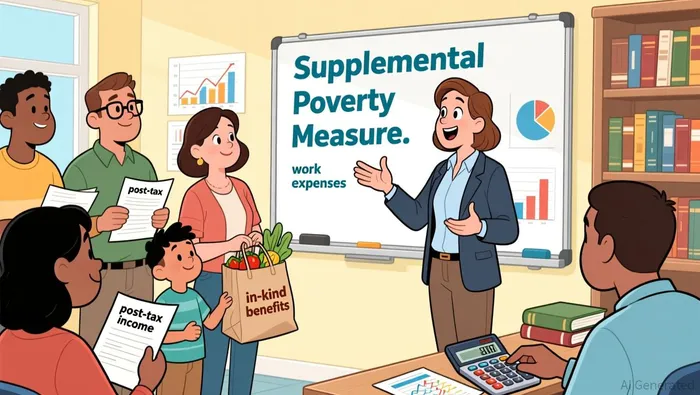 Yet, even the SPM struggles to capture the full scope of financial hardship in an era where housing and healthcare costs dominate household budgets according to analysis.
Cost-of-Living Inflation: A Middle-Class Crisis
From 2020 to 2025, the financial stability of middle-class households has been severely tested. According to a 2025 analysis by the Brookings Institution, one-third of the American middle class cannot afford basic necessities, a figure exacerbated by inflation and stagnant wages. Essentials like groceries, gas, and utilities remain 30% higher than in early 2021, forcing families to dip into savings and rely on credit cards, or delay retirement contributions. Racial disparities compound these challenges: 50% of Latino or Hispanic middle-class families report unaffordable living conditions, compared to 27% of white families according to research.
The Consumer Price Index (CPI), the standard metric for inflation, understates the true burden on lower- and middle-income households. The True Living Cost (TLC) index, which includes health insurance premiums and essential technology, reveals that the cost of living for these groups has risen 1.4 times faster than the CPI since 2001. This discrepancy highlights a critical flaw in how policymakers and investors assess economic well-being.
Policy Implications and the Path Forward
The mismatch between income growth and essential costs has created a long-term affordability crisis, particularly in high-cost urban areas with restrictive zoning laws. Outdated poverty metrics obscure this reality, leading to misaligned social programs and inadequate wage adjustments. For instance, the official poverty rate appears stagnant since the 1960s, even as non-cash benefits have significantly reduced hardship. This disconnect undermines efforts to design effective interventions.
Investors and policymakers must prioritize updated metrics like the TLC to better reflect the lived experiences of middle-class households. Incorporating regional cost-of-living differences, essential technology, and healthcare expenses into poverty calculations would provide a more accurate picture of economic vulnerability. Additionally, expanding access to financial guidance-such as professional advisors-has proven to improve resilience, with middle-income families more likely to maintain emergency savings and reduce debt according to findings.
Conclusion
The erosion of middle-class financial stability is not merely a symptom of inflation but a systemic failure to modernize how we measure poverty. As cost-of-living pressures persist, the urgency to revise outdated metrics becomes ever clearer. For investors, this means recognizing the long-term risks of a strained middle class to consumer spending and economic growth. For policymakers, it demands a reimagining of poverty metrics to align with the realities of 2025 and beyond.







Comentarios
Aún no hay comentarios