
Reassessing U.S. Manufacturing Exposure: Strategic Shifts in a Tech-Driven Era
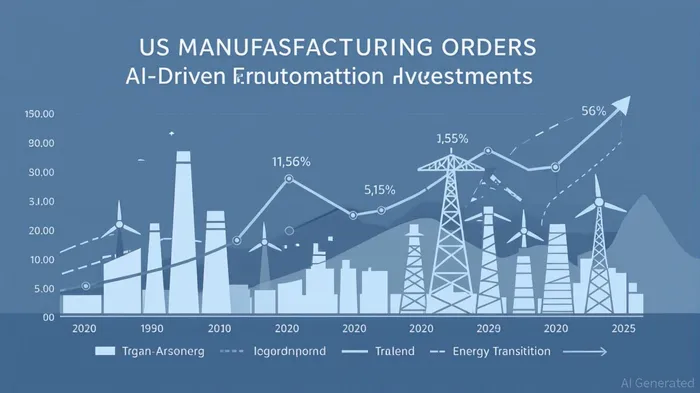
The U.S. manufacturing sector, long a cornerstone of economic resilience, is facing an inflection point. Recent data from the Institute for Supply Management (ISM) reveals a sustained contraction in manufacturing orders, reflecting broader economic fragility amid global trade fragmentation and rising economic nationalism[1]. With U.S. President Donald Trump's aggressive tariff policies reshaping global trade dynamics, manufacturers now operate in a landscape marked by volatility and uncertainty. For investors, this signals a critical juncture: the need to reassess exposure to traditional manufacturing equities and reallocate capital toward innovation-driven sectors and supply chain-adjacent defensive positions.
Quantifying the Contraction: A Sector in Retreat
The ISM's 2025 Purchasing Managers' Index (PMI) underscores a troubling trend: manufacturing activity has contracted for six consecutive quarters, with new orders declining at a pace not seen since the 2008 financial crisis[1]. This contraction is not isolated to the U.S. but part of a global slowdown, as trade barriers and geopolitical tensions disrupt traditional supply chains. The World Economic Forum (WEF) notes that trade policy uncertainty—driven by protectionist measures—has become the top risk for global chief economists, with 97% identifying it as a critical challenge[1]. For U.S. manufacturers, this means navigating a dual threat: shrinking demand and a fragmented global market.
The Automation Imperative: Tech as a Lifeline
Amid this contraction, technology-driven operational resilience is emerging as a critical differentiator. Automation and data analytics are no longer optional upgrades but survival strategies. The WEF's Physical AI white paper highlights how intelligent robotics and AI systems are addressing labor shortages and operational bottlenecks in manufacturing[3]. For instance, Foxconn's shift to an “AI-powered robotic workforce” has reduced cycle times by 30% and error rates by 40%, demonstrating the tangible benefits of automation in cost efficiency and scalability[3].
However, this technological pivot is not without trade-offs. While AI and robotics enhance productivity, they also accelerate job displacement in traditional roles. The Future of Jobs Report 2025 notes that 86% of employers anticipate AI-driven labor market shifts, with roles like machine operators being replaced by robot technicians and data analysts[2]. For investors, this underscores a broader trend: the manufacturing sector is evolving from labor-intensive to capital-intensive, favoring firms that can integrate advanced technologies.
Rebalancing Capital: Innovation and Defensive Positions
The case for rebalancing capital toward innovation-driven sectors is compelling. AI is projected to cut content production costs in consumer industries by 60% and boost conversion rates by 20%, according to WEF analysis[1]. Beyond cost savings, AI is reshaping entire value chains, from predictive maintenance in supply chains to AI-driven demand forecasting. Sectors poised for growth include:
- AI and Machine Learning: With 86% of employers anticipating sector-wide transformation, demand for AI specialists and software developers is surging[2].
- Energy Transition: Advancements in energy storage and distribution are creating long-term tailwinds, particularly as U.S. policy incentives accelerate decarbonization.
- Supply Chain Resilience: Cybersecurity, logistics automation, and nearshoring infrastructure are gaining traction as businesses prioritize risk mitigation[2].
Defensive positions in supply chain-adjacent investments further strengthen this strategy. As global trade networks diversify—China redirecting exports to Europe, for example—U.S. firms are reshoring operations and adopting hybrid supply chain models[1]. This shift creates opportunities in logistics tech, cybersecurity, and industrial IoT, which enable real-time monitoring and risk mitigation.
Strategic Risk Mitigation: A Path Forward
For investors, the key lies in aligning portfolios with structural shifts rather than cyclical downturns. While U.S. manufacturing equities face near-term headwinds, the sector's long-term viability hinges on its ability to adopt innovation. However, given the current environment of tariff volatility and geopolitical uncertainty, overexposure to traditional manufacturing may amplify downside risk.
A strategic reallocation toward AI-driven sectors and supply chain resilience not only mitigates risk but also positions portfolios to capitalize on the next phase of industrial evolution. As the WEF emphasizes, the future belongs to businesses that can adapt to “physical AI” and energy transition imperatives[3]. For investors, this means prioritizing agility over legacy exposure.







Comentarios
Aún no hay comentarios