
Reassessing INX Token's Attraction in a Bearish Crypto Market
The crypto market in 2025 remains entrenched in bearish conditions, with volatility and liquidity risks dominating investor sentiment. Amid this backdrop, INX Token-a regulated security token and the first to IPO on the blockchain-has emerged as a unique case study. This article evaluates INX's valuation responsiveness and liquidity risk, drawing on recent market data and strategic developments to assess its appeal in a risk-averse environment.
Valuation Responsiveness: Compliance as a Buffer
INX Token's compliance-driven framework positions it as a potential safe haven in a bearish market. As a regulated security token, it operates under full regulatory oversight, attracting institutional and retail investors seeking compliance in uncertain times. Its deflationary supply of 200 million tokens is another structural advantage, theoretically supporting long-term value retention.
Price projections for 2025 suggest a range between $0.182563 and $0.203091, with a 12.50% 24-hour gain as of November 17, 2025, but a 25% 7-day decline. While this volatility aligns with broader market trends, technical indicators like RSI and MACD signal bearish momentum in the short to intermediate term. However, INX's compliance edge may mitigate downside risks compared to unregulated tokens, particularly as regulatory scrutiny intensifies.
Liquidity Risk: A Double-Edged Sword
Liquidity risk remains a critical concern for INX. As of November 2025, the token's 24-hour trading volume stood at $37.32K, a modest figure that raises questions about its ability to sustain large trades without slippage. While INX's platform has expanded into tokenized real-world assets (RWAs) and stablecoins, the lack of official 2025 annual trading volume data across all exchanges complicates risk assessment .
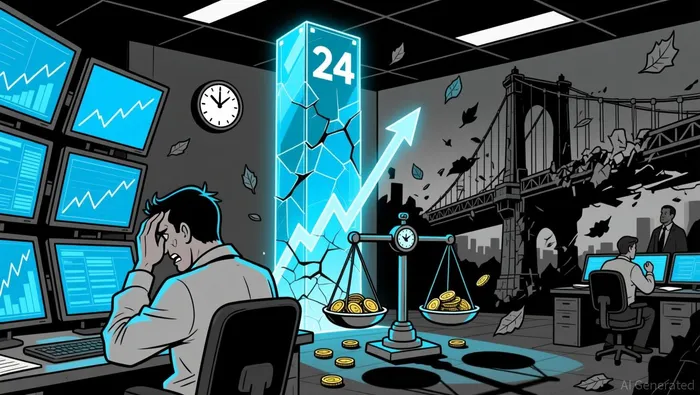
The October 2025 Black Friday crash, which saw billions in crypto positions liquidated, underscores systemic liquidity vulnerabilities . Regulated platforms like INX, which prioritize transparency, are increasingly viewed as safer alternatives. However, INX's own financials reveal challenges: Q2 2025 trading and transaction fees totaled $52K, a 50% decline from $104K in Q2 2024 . This suggests waning trading activity, potentially exacerbating liquidity risks.
Strategic Positioning: Growth Amid Constraints
INX's strategic moves aim to counter these challenges. The company's acquisition by Republic is expected to unlock growth in regulated digital asset infrastructure . Additionally, INX has expanded its crypto asset pool to include emerging tokens like SolanaSOL-- and PEPEPEPE-- Coin, broadening its appeal .
The platform's role in RWA tokenization-enabling trading of tokenized stocks and treasuries-positions it at the intersection of traditional and digital finance . This innovation could drive long-term demand for INX, particularly as tokenization markets grow. However, INX's net operating losses of $4.2 million in Q2 2025 highlight operational fragility , a red flag for investors prioritizing stability.
Conclusion: A Calculated Bet
INX Token's appeal in a bearish market hinges on its compliance advantages and RWA-driven innovation. While its valuation appears resilient relative to unregulated tokens, liquidity risks persist due to low trading volumes and operational losses. For risk-tolerant investors, INX offers exposure to a regulated, infrastructure-focused player in the tokenization boom. However, those prioritizing liquidity should approach cautiously, given the lack of robust volume data and the broader market's fragility.
As the crypto winter deepens, INX's ability to balance regulatory credibility with scalable liquidity will determine its long-term viability.







Comentarios
Aún no hay comentarios