
Reassessing Equity Market Momentum: Trade Tensions Ebb and Earnings Signal Resilience
The global equity market entered 2025 amid a storm of trade tensions, with U.S. tariffs spiking to 50% on steel and aluminum under Section 232 and 50% on semi-finished copper products, according to the Fictiv tariff update. These measures, coupled with China's retaliatory tariffs and India's 50% hike on U.S. imports, created a volatile environment. Yet, by Q2 2025, markets began to stabilize. The S&P 500 and Nasdaq surged 10.6% and 17.7%, respectively, while emerging markets gained 11.0%, according to the Q2 2025 market review. This resilience raises a critical question: How can long-term investors capitalize on a stabilizing global growth environment amid lingering trade frictions?
Trade Tensions: From Escalation to Tactical Adjustments
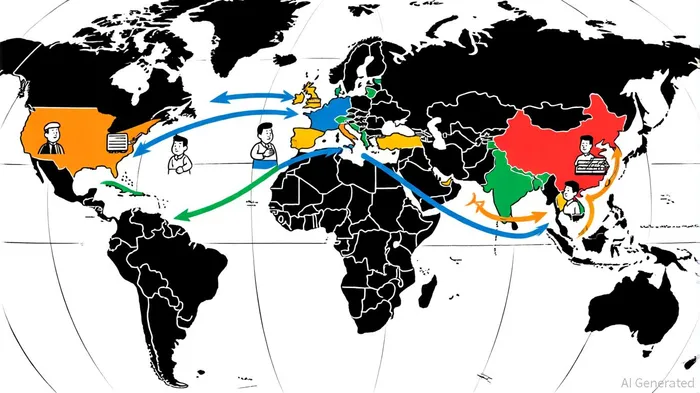
The U.S. baseline 10% tariff in April 2025 initially triggered a sharp market selloff, according to the UNCTAD update. However, subsequent policy shifts-such as the 15% tariff agreement with the EU and Japan-signaled a pivot toward managed competition rather than all-out conflict, as noted in the A&O Shearman analysis. Developing economies, particularly in Southeast Asia, emerged as beneficiaries. China redirected 33% of its exports to ASEAN and the EU, while Indonesia and the Philippines saw increased sourcing from North American and European buyers, according to the QIMA Q2 barometer. This reallocation of trade flows underscores a new equilibrium: global supply chains are diversifying, but not collapsing.
Sectoral Resilience: Winners and Losers in Q2 2025
Q2 earnings revealed stark sectoral divides. Information Technology, Communication Services, and Healthcare outperformed, driven by AI adoption and stable demand, according to the S&P Global review. For example, tech firms leveraged automation to offset rising input costs, while healthcare companies maintained pricing power amid inflation. Conversely, manufacturers like Deere & Company and Tapestry faced $500 million and $160 million in tariff-related losses, respectively, per the Q2 earnings season. These disparities highlight a key investment insight: sectors insulated by technological innovation or domestic demand are better positioned to weather trade turbulence.
Strategic Entry Points: Regions and Sectors to Watch
- Emerging Markets with Trade Diversification: Countries like India and Mexico, which avoided direct U.S. tariff escalation, are attracting capital. India's strategic alignment with U.S. industrial exemptions, noted in the Fictiv tariff update, and Mexico's nearshoring partnerships highlighted in the QIMA Q2 barometer position them as long-term growth hubs.
- Technology and Green Energy: Despite overcapacity in sectors like solar panels-an issue raised in the UNCTAD update-AI-driven tech firms and renewable energy companies with localized supply chains are gaining traction. Investors should prioritize firms with pricing power and R&D agility.
- European and Southeast Asian Manufacturing: The EU's "zero-for-zero" tariff pact with the U.S. and Southeast Asia's role as a re-export hub, observed in the A&O Shearman analysis, suggest opportunities in regional manufacturing. Firms adapting to nearshoring trends-such as those in Germany's industrial machinery sector-could outperform.
The Path Forward: Balancing Caution and Opportunity
While trade tensions remain a drag on global growth, the Fed's 4.25%–4.5% rate hold and UNCTAD's projection of 2.34% global GDP growth, cited in the S&P Global review, indicate a stabilizing environment. For long-term investors, the key is to avoid overexposure to sectors reliant on fragile global supply chains while capitalizing on regions and industries that have demonstrated adaptability.
Conclusion
The 2025 trade landscape is neither a full-blown crisis nor a return to pre-pandemic stability. Instead, it reflects a recalibration of global economic relationships. Investors who focus on sectors with pricing power, regions with strategic trade agreements, and companies with agile supply chains will be best positioned to navigate this new era. As UNCTAD notes, predictability in trade policy remains critical, per the A&O Shearman analysis, but for now, the market's resilience offers a window of opportunity.







Comentarios
Aún no hay comentarios