
Reassessing Amazon's Value: Is It Still a Buy Despite Underperformance?
The Case for Underperformance: Structural Challenges and Market Realities
Amazon's mixed performance since 2020 reflects broader shifts in its business model and market dynamics. While the company thrived during the pandemic-driven e-commerce boom, its North American retail segment now operates on razor-thin margins (around 7%) and faces intensifying competition from Walmart and other rivals. Meanwhile, Amazon Web Services' growth rate has decelerated relative to Microsoft Azure and Google Cloud, with operating margins declining in recent quarters.
The S&P 500's outperformance has also been fueled by a broader market rotation toward high-growth tech stocks and AI-driven innovators. AmazonAMZN--, despite its AI ambitions, has struggled to match the narrative-driven momentum of peers like Nvidia. This has been compounded by its lower Sharpe Ratio (0.46 vs. SPY's 0.95), indicating weaker risk-adjusted returns.
Amazon's Strategic Reinvention: Cost-Cutting, Automation, and AI
Yet beneath the surface, Amazon is executing a multi-pronged strategy to reinvigorate its growth. The company has embarked on aggressive cost-cutting measures, including the layoff of 14,000 corporate employees and plans to automate over 500,000 warehouse jobs. These moves aim to boost operational efficiency and margins, particularly in its e-commerce segment.
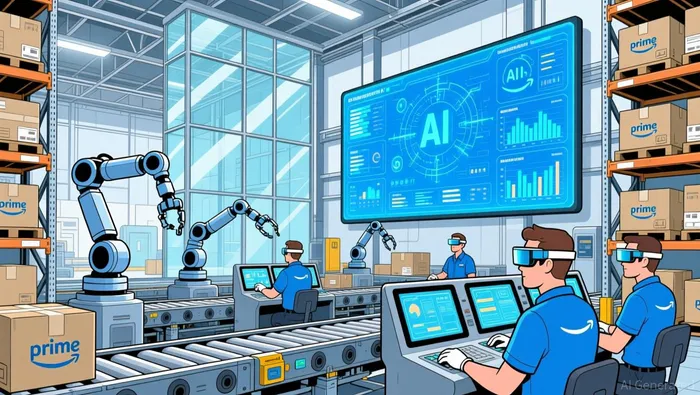
Simultaneously, Amazon is doubling down on AI as a long-term growth engine. AWS's Q3 2025 results underscore its leadership in the cloud-AI space, with revenue jumping 20.2% year-over-year to $33 billion. This growth was driven by demand for AI infrastructure, including custom silicon like Trainium2 and Inferentia, which AWS claims offer 30–40% better price-performance than competing GPUs. The company has also invested $4 billion in Anthropic to leverage its Claude models and expanded its AI capabilities with a $50 billion federal infrastructure project.
Amazon's AI initiatives extend beyond the cloud. Its AI-powered recommendation engine already drives 35% of purchases, and the upcoming Alexa+ assistant promises to unlock high-margin advertising opportunities. These innovations position Amazon to capitalize on the AI revolution, even if its current valuation appears modest compared to peers.
Contrarian Rationale: Buying the Dip in a Durable Business
For contrarian investors, Amazon's underperformance is a feature, not a bug. The stock's 43% five-year return may seem lackluster, but it masks the company's structural strengths: a diversified business model spanning AWS, Prime, entertainment, and physical retail; a fortress-like balance sheet; and a culture of relentless innovation.
Moreover, Amazon's AI investments are beginning to bear fruit. AWS's recent reacceleration in growth-despite heavy capital expenditures-demonstrates the scalability of its cloud infrastructure. The launch of Project Rainier, a 500,000-chip AI cluster, further cements AWS's position as a leader in large-scale AI deployment. While concerns about the AI bubble and Anthropic's valuation linger, Amazon's focus on cost-performance over raw speed gives it a unique edge in enterprise markets.
Risks and Rewards
No investment is without risk. Amazon's reliance on AWS for 50% of its operating profit makes it vulnerable to cloud market saturation or regulatory scrutiny. Additionally, its aggressive automation plans could face pushback from labor groups or disrupt customer experience. However, these risks are largely priced into the stock, and Amazon's track record of navigating challenges-from antitrust lawsuits to supply chain disruptions-suggests it is well-equipped to adapt.
Conclusion: A Buy for the Long-Term
Amazon's underperformance relative to the S&P 500 is a symptom of near-term headwinds, not a reflection of its long-term potential. The company's AI-driven reinvention, cost discipline, and durable competitive advantages make it a compelling buy for investors with a multi-year horizon. While the road to recovery may be bumpy, the rewards for those who recognize Amazon's enduring value could be substantial.







Comentarios
Aún no hay comentarios