
Real-World Assets (RWAs) and Their Path to a $Trillion-Plus Market by 2030
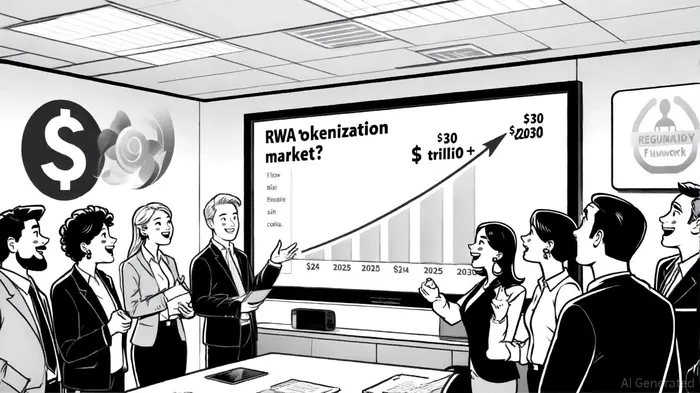
The tokenization of Real-World Assets (RWAs) is no longer a speculative concept but a rapidly maturing financial infrastructure shift. By 2030, the market could range from $2 trillion to $30 trillion, depending on regulatory momentum and technological adoption, according to a Coindesk article and a Genfinity projection. This explosive growth is driven by blockchain-enabled infrastructure and institutional players scaling beyond experimentation into production-grade deployments.
Market Projections and Growth Drivers
According to the Coindesk article, the base-case scenario for RWA tokenization estimates a $2 trillion market by 2030. However, optimistic projections from industry analyses suggest a far more ambitious $30 trillion potential, fueled by advancements in blockchain interoperability, oracle solutions, and institutional-grade security protocols, per the Genfinity projection. As of June 2025, the market had already reached $24 billion, reflecting a 380% increase since 2022, according to a RedStone report. This trajectory underscores the urgency with which traditional finance is embracing tokenization to unlock liquidity in illiquid assets.
Private credit and U.S. Treasuries have emerged as the largest segments, valued at $14 billion and $8.2 billion respectively, per a Coinpedia report. These assets appeal to institutional investors due to their capacity to generate higher yields and offer fractional ownership, which democratizes access to traditionally exclusive markets.
Institutional Adoption: From Pilots to Production
Major financial institutions are no longer testing the waters-they are building entire ecosystems around tokenized RWAs. BlackRock's BUIDL fund, for instance, has amassed $2.9 billion in assets under management, demonstrating the firm's commitment to tokenized real estate and private credit (reported by Coinpedia). JPMorgan and Franklin Templeton have similarly advanced to production-scale deployments, leveraging blockchain to streamline settlement times and reduce counterparty risk, as noted in Coinpedia's coverage.
This shift is not merely about efficiency. Tokenization enables institutions to create programmable financial instruments that can be automated, traded 24/7, and integrated with decentralized finance (DeFi) protocols. For example, platforms like RedStoneRED-- have developed sophisticated pricing oracles to ensure accurate valuation of tokenized assets, bridging the gap between traditional and on-chain finance.
Blockchain Infrastructure: The Backbone of RWA Growth
The infrastructure layerLAYER-- is critical to scaling RWA adoption. EthereumETH--, Plume, and HederaHBAR-- are leading the charge in providing secure, scalable, and interoperable networks for asset tokenization, according to industry reporting. Cross-chain solutions are particularly vital, as they allow institutions to deploy assets across multiple ecosystems while maintaining compliance with jurisdiction-specific regulations.
Projects like Ondo Finance and Provenance Blockchain are expanding their operations across these chains to maximize accessibility. For instance, Ondo's tokenized U.S. Treasuries and real estate debt instruments are now available on Ethereum and Hedera, catering to both DeFi-native and traditional investors. Meanwhile, RedStone's oracle networks provide real-time data feeds for asset valuation, a necessity for institutional-grade transparency.
Regulatory Tailwinds and Global Expansion
Regulatory clarity is accelerating the RWA revolution. The U.S. GENIUS Act, designed to streamline the tokenization of real estate and other assets, has removed key legal ambiguities, as covered by Coinpedia. Similarly, Singapore and Hong Kong have introduced frameworks that encourage tokenized securities, attracting global capital to their markets. These developments are critical in reducing the friction that once hindered institutional participation.
Future Outlook: A New Financial Paradigm
By 2030, RWAs are poised to become a cornerstone of global finance. The convergence of blockchain infrastructure, institutional demand, and regulatory support is creating a self-reinforcing cycle of growth. As platforms like Clearpool and Franklin Templeton's tokenized funds scale, the market will likely see a shift from niche experimentation to mainstream adoption, a trend highlighted in Coinpedia's research.






Comentarios
Aún no hay comentarios