
The Real vs. Virtual Blockchain Investment Landscape: Why BlockDAG's $420M+ Presale Outshines Solaverse's Virtual Land Dreams
BlockDAG: A Foundation of Real-World Traction
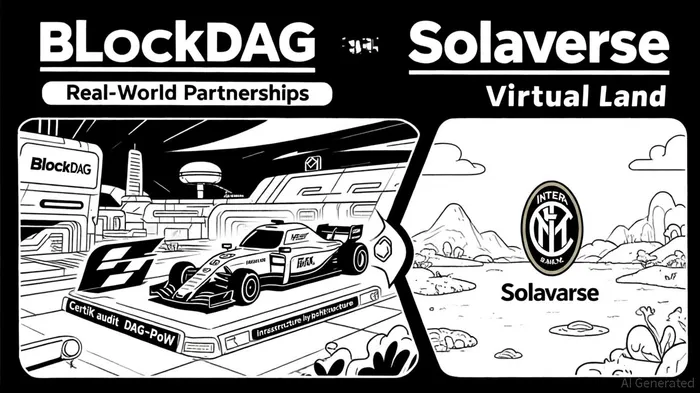
BlockDAG has emerged as a standout project in 2025, leveraging a hybrid Directed Acyclic Graph (DAG) and Proof-of-Work (PoW) architecture to achieve transaction throughput of 2,000–15,000 transactions per second, according to CoinCentral. Its presale success-raising nearly $420 million and selling 27 billion tokens-reflects strong institutional and retail confidence, according to Analytics Insight. Strategic partnerships, such as its multi-year collaboration with the BWT Alpine Formula 1® Team, further validate its real-world integration. This partnership includes fan engagement zones, global hackathons, and on-track simulators, creating recurring touchpoints to mainstream blockchain technology, as noted by Analytics Insight.
Security and scalability are central to BlockDAG's appeal. The project has undergone audits by CertiK and Halborn, Live BitcoinBTC-- News reports, resolving all flagged issues before launch. Its dual-consensus mechanism-combining PoW with Proof-of-Engagement (PoE)-encourages both institutional and retail participation, while mobile mining via the X1 app has attracted 3 million users, according to Crypto Reporter. These factors position BlockDAG as a project with immediate utility, rather than a speculative vision.
Solaverse: The Allure of Virtual Land and AI-Driven Metaverse
Solaverse, built on Solana's high-speed blockchain, markets itself as a decentralized metaverse where users can own virtual land, engage in AI-driven gameplay, and participate in a tokenized economy, according to Disrupt Africa. Its staking rewards of up to 148% APY during the presale have drawn early adopters, while its integration of real-world geographic mapping and DAO governance models adds to its narrative, a point Analytics Insight also highlights. However, the project's execution remains unproven. As of now, Solaverse lacks a live testnet, developer tools, or infrastructure, raising concerns about its ability to deliver on promises, a view noted by CoinCentral.
While Solana's low fees and scalability offer technical advantages, Solaverse's reliance on virtual land-a concept that has seen limited adoption in previous metaverse projects-introduces inherent risks. The metaverse market is projected to grow to $678.8 billion by 2030, but Solaverse's current roadmap lacks concrete milestones or partnerships to differentiate it from competitors, according to Live Bitcoin News.
Comparative Analysis: Execution vs. Vision
The key divergence between BlockDAG and Solaverse lies in their approach to value creation. BlockDAG's $420 million presale is not just a fundraising milestone but a testament to its operational maturity. Its partnerships with global entities like Inter Milan and UFC athlete Alex Pereira enhance brand credibility, while its hybrid architecture addresses scalability challenges faced by traditional blockchains, as CoinCentral reports. In contrast, Solaverse's presale hinges on the speculative appeal of virtual land, a market segment that has historically struggled with user retention and monetization.
Data from 2025 highlights this gap: BlockDAG has attracted 312,000 token holders and 3 million users through its X1 app, whereas Solaverse's user base remains opaque, according to Crypto Reporter. BlockDAG's CertiK verification and dual-consensus model also provide a security edge over Solaverse, which has yet to demonstrate technical readiness, Live Bitcoin News notes.
Conclusion: The Case for Tangible Infrastructure
While both projects aim to capitalize on 2025's crypto boom, BlockDAG's focus on real-world integration, security, and scalable infrastructure positions it as a more credible investment. Solaverse's virtual land model, though ambitious, lacks the execution track record and technical proof to justify its valuation. For investors prioritizing risk-adjusted returns, BlockDAG's $420 million presale and institutional partnerships underscore a project that is not just building for the future but actively shaping it.






Comentarios
Aún no hay comentarios