
Real-Time Access to Tokenized US Stocks via Telegram Wallet: How 24/7 Trading and DeFi Integration Are Reshaping Retail Investor Behavior and Market Liquidity
24/7 Trading: A New Era for Retail Investors
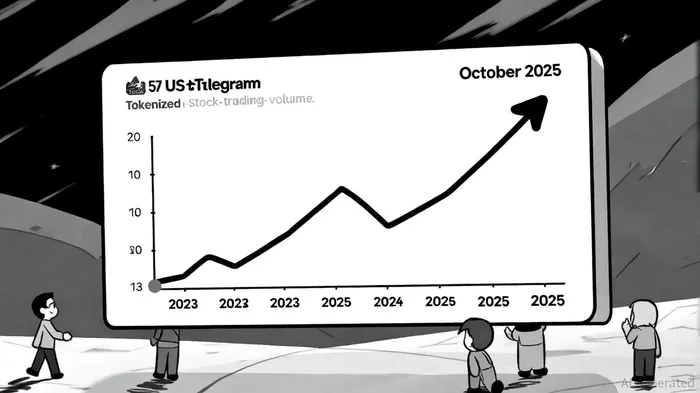
Retail investor behavior is rapidly evolving as 24/7 trading erodes the traditional boundaries of market hours. Data from xStocks indicates that tokenized US stocks have already generated $4.38 billion in trading volume as of September 2025, with on-chain activity surging to $930 million. This growth is driven by the convenience of round-the-clock access, which aligns with the crypto-native habits of younger, tech-savvy investors.
According to a Blockchain News report, retail investors in 2025 have shown remarkable resilience during market corrections, often holding high-beta stocks like Tesla and Nvidia through 30%+ declines. The ability to trade at any time-regardless of geographic or time zone constraints-has amplified this behavior, enabling investors to react instantly to news cycles or algorithmic signals. For example, tokenized assets like TSLATSLA-- and NVDANVDA-- saw renewed buying interest during off-hours, as AI-driven trading tools and social media sentiment analysis fueled speculative activity (the Blockchain News piece noted earlier).
However, 24/7 trading introduces risks. A World Economic Forum analysis warns that liquidity can become fragmented outside traditional hours, leading to wider bid-ask spreads and price inefficiencies. Retail investors, often less equipped to navigate these dynamics, may face higher volatility and execution risks.
DeFi Integration: Expanding Retail Toolkits
DeFi protocols are further democratizing access by enabling novel financial products. Tokenized stocks on platforms like TRON's xStocks allow investors to stake their holdings for yield or lend them to generate passive income (https://www.okx.com/learn/tron-tokenized-stocks-24-7-trading-defi). This contrasts sharply with traditional markets, where such opportunities are largely reserved for institutional players.
For instance, Kraken's tokenized stock offerings now include features like margin trading and automated rebalancing via smart contracts (the Analytics Insight piece cited above). These tools empower retail investors to diversify risk and optimize returns, albeit with increased complexity. A 2025 study by CoinCodex highlights that fractional ownership in tokenized assets has lowered entry barriers, attracting over 100 million registered users to Telegram's Wallet (https://coincodex.com/article/74109/wallet-in-telegram-launches-tokenized-us-stocks-in-partnership-with-kraken-and-backed/).
Yet, DeFi integration also raises regulatory and security concerns. The 1:1 collateralization model ensures transparency, but the lack of standardized governance frameworks for tokenized assets remains a hurdle (the Analytics Insight piece cited above).
Market Liquidity: Opportunities and Challenges
The surge in tokenized stock trading has had a mixed impact on liquidity metrics. On one hand, platforms like xStocks report robust order book depth, with assets under management (AUM) reaching $79.37 million (the xStocks data cited above). On the other, liquidity can dry up during off-peak hours, as seen in the 2025 volatility spikes on Robinhood's tokenized stock platform (the World Economic Forum analysis cited above).
Regulators are grappling with these dynamics. The SEC's recent greenlighting of blockchain-based stock trading signals a shift toward accommodating 24/7 markets (the Blockchain News report cited above). However, as noted by the World Economic Forum, the absence of circuit breakers in continuous trading environments could exacerbate flash crashes (the World Economic Forum analysis cited above).
The Road Ahead
Telegram's 1-billion-user base positions it as a catalyst for mass adoption of tokenized assets. With commission-free trading until year-end 2025 and plans to expand to TON Wallet, the platform is poised to attract retail investors in emerging markets, where traditional brokerage access is limited (the Analytics Insight piece cited above).
Yet, the long-term success of this model hinges on balancing innovation with safeguards. As AI-assisted trading tools proliferate, investors must navigate a landscape where speed and accessibility come with heightened risks.
Conclusion
The convergence of 24/7 trading and DeFi in tokenized US stocks is reshaping retail investor behavior and liquidity dynamics. While the benefits of democratized access and innovative financial tools are clear, the risks of volatility and regulatory uncertainty cannot be ignored. As platforms like Telegram Wallet scale, the market will need to adapt to a new paradigm where speed and inclusivity coexist with prudence.





Comentarios
Aún no hay comentarios