
The Real Market Impact of Ripple's 1 Billion XRP Unlock in 2026
In the world of cryptocurrency, few events generate as much anticipation-and anxiety-as a major token unlock. Ripple's upcoming 1 billion XRPXRP-- release on January 1, 2026, is no exception. For years, XRP's supply dynamics have been a double-edged sword: a predictable escrow system designed to stabilize the market, yet occasionally triggering volatility when large unlocks coincide with weak demand. But in 2026, the context is different. Regulatory clarity post-SEC litigation, a surge in institutional adoption, and a maturing market infrastructure suggest this unlock could be a buying opportunity rather than a risk. Let's break it down.
The SEC Ruling: A Regulatory Tailwind
The SEC vs. Ripple lawsuit, which dragged on for nearly five years, was a black cloud over XRP's legitimacy. The August 2025 dismissal of the SEC's appeal has fundamentally changed the narrative. XRP is no longer a "security" in the eyes of the regulator, and institutions are now free to build products around it. The Roundhill XRP Covered Call ETF, which uses options linked to XRP-based ETFs, is a case in point. This indirect exposure has already attracted $1.9 billion in assets under management, with 60% of inflows coming from institutional investors. The message is clear: XRP is now a regulated asset, not a speculative gamble.
Supply Dynamics: Predictable, Not Disruptive
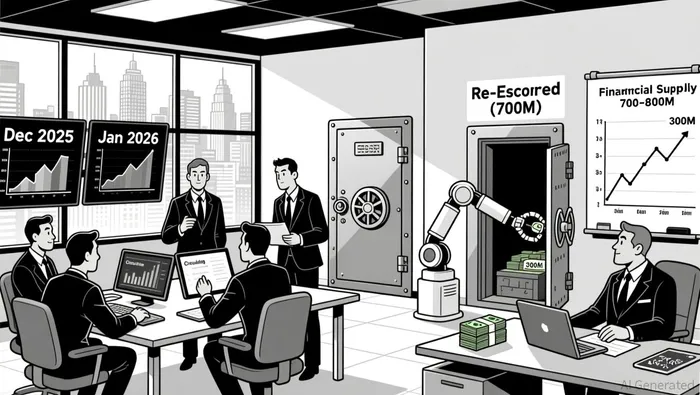
Ripple's escrow system has been a cornerstone of XRP's tokenomics since 2017. Every month, 1 billion XRP is unlocked, but only 20–30% typically enters the market. The rest is re-escrowed or allocated for operational needs. This discipline has prevented supply shocks. For example, in December 2025, Ripple unlocked 1 billion XRP but re-escrowed 700 million, leaving just 300 million in circulation. At the time, XRP's price remained stable around the range of $2.09–$2.13, suggesting the market had already priced in the supply increase.
The 2026 unlock follows the same pattern. Even if 300 million XRP enters the market, it represents less than 0.5% of the total supply. Historical data shows that such incremental supply has minimal impact on price when institutional demand is strong. In Q1 2025, for instance, XRP ETFs attracted $1.9 billion in assets, reducing exchange-held supply by 45%. This tightening of liquidity-combined with Ripple's disciplined re-escrow strategy-creates a scenario where demand outpaces supply.
The real story in 2025 was institutional adoption. Spot XRP ETFs like BlackRock's iShares XRPI and Fidelity's XRPR have turned XRP into a tradable asset for pension funds, endowments, and hedge funds. These products are physically backed by XRP held in Coinbase Custody and BitGo, with daily transparency and a 0.25% fee. The result? Over $1.9 billion in assets under management in less than a month.
This institutional interest is not just about price-it's about utility. Ripple's On-Demand Liquidity (ODL) transactions surged 41% quarter-over-quarter in Q2 2025, proving XRP's value in cross-border payments. Meanwhile, Ripple's RLUSD stablecoin expansion into Japan and its foray into institutional custody services signal a broader integration into the global financial system. For investors, this means XRP is no longer just a crypto asset; it's a tool for real-world financial infrastructure.
Catalysts in 2026: Why This Unlock Matters
The 2026 unlock isn't an isolated event-it's part of a larger wave of catalysts. First, the March 2026 FOMC meeting will clarify macroeconomic conditions, potentially boosting risk-on assets like XRP. Second, BlackRock's rumored XRP ETF filing could further normalize institutional exposure. Third, enterprise budget finalizations in Q1 2026 will likely drive demand for Ripple's payment solutions.
These factors create a "perfect storm" for XRP. The unlock provides liquidity for ETFs and institutional buyers, while regulatory clarity and macroeconomic optimism reduce downside risk. Even if XRP dips post-unlock-as it did in August 2025-the long-term trend remains intact. Whale accumulation data and Ripple's $2.1 billion Q2 2025 revenue suggest smart money is already positioning for 2026.
Risks and Realities
No investment is without risk. XRP's 13% price decline in 2025 was driven by macroeconomic headwinds and competition from faster blockchains. A similar correction in 2026 is possible, especially if the FOMC tightens rates. However, the ETF-driven demand and Ripple's expanding enterprise revenue provide a floor. Additionally, the 2026 unlock is part of a predictable system-unlike a surprise sell-off from a rug-pull or regulatory reversal.
Is This a Buying Opportunity?
The answer hinges on two factors: price and demand. At $1.86, XRP is trading below its 2025 peak of $2.33, but above its 200-day moving average. Analysts project a rise to $5–$8 by 2026, driven by ETF inflows and Ripple's enterprise growth. For investors, the 2026 unlock offers a chance to buy into XRP at a discount to its potential.
But timing is everything. The unlock itself is a neutral event-its impact depends on market conditions. If the FOMC signals rate cuts in March 2026 and BlackRock's ETF is approved, the post-unlock period could see a breakout. Conversely, a rate hike or ETF rejection might delay the rally. For now, the data supports a bullish case: predictable supply, growing institutional demand, and a regulatory environment that's finally catching up to XRP's utility.







Comentarios
Aún no hay comentarios