
RDTE: A Flawed Short-Volatility Vehicle in a Turbulent Market
The Roundhill Russell 2000 0DTE Covered Call Strategy ETF (RDTE) has emerged as a high-yield, volatility-linked vehicle designed to capitalize on the Russell 2000 Index's price movements while generating income through synthetic covered call strategies. However, beneath its attractive dividend yield and active management lies a structural framework riddled with risk-reward imbalances and systemic vulnerabilities. As the market grapples with the growing popularity of zero days to expiration (0DTE) options, RDTE's reliance on these instruments exposes it to sharp volatility, liquidity challenges, and unsustainable income generation—factors that could undermine its long-term viability.
The Allure and the Strategy
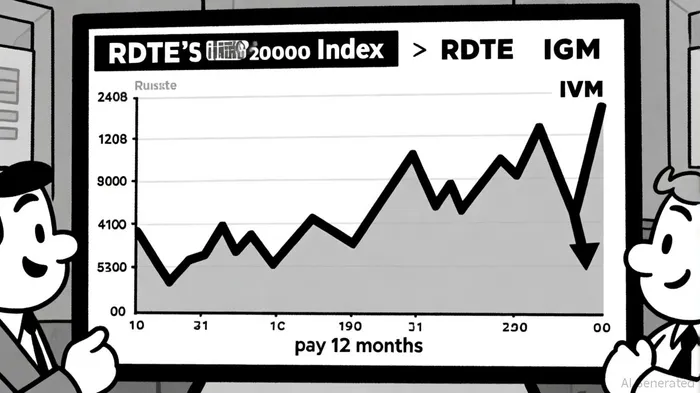
RDTE's core strategy involves selling out-of-the-money 0DTE call options on the Russell 2000 Index while maintaining synthetic long exposure via deep in-the-money FLEX options[1]. This approach aims to generate weekly distributions, with a dividend yield peaking at 41.5% in recent months[2]. On the surface, the fund's performance appears robust: a 12.50% total return over the past year and a 17.59% average annual return since inception[3]. Yet, these figures mask a critical flaw—RDTE's returns have stagnated over three- and five-year horizons, with a compound annual growth rate (CAGR) of 0% during those periods[4].
The fund's high expense ratio of 0.95–0.97% further compounds its challenges, outpacing many traditional ETFs[5]. While Roundhill markets RDTERDTE-- as a “synthetic” alternative to direct Russell 2000 exposure, the reality is that its complex derivatives-based structure introduces layers of risk absent in conventional index funds.
Structural Vulnerabilities in 0DTE Trading
The 0DTE options market, which accounts for over 43% of daily S&P 500 options volume[6], is inherently volatile. These instruments expire daily, making them acutely sensitive to intraday price swings and liquidity shifts. For RDTE, this means that even minor market corrections can trigger sharp losses. A case in point: RDTE's maximum drawdown of 24.91% on April 10, 2025[7], occurred during a period of heightened volatility, underscoring the fragility of its strategy.
Moreover, the liquidity concentration in 0DTE options creates systemic risks. As noted by J.P. Morgan Chase's chief global markets strategist, Marko Kolanovic, the rapid growth of this segment could lead to “sharp market swings” as traders and market-makers scramble to hedge positions[8]. RDTE's synthetic covered call approach, while designed to limit downside risk, does little to mitigate these broader market dynamics.
Risk-Reward Imbalances and Income Sustainability
RDTE's income generation is another area of concern. While the fund's weekly distributions are marketed as a source of reliable income, a significant portion of these payouts—up to 41.5%—constitutes a return of capital rather than actual income[9]. This practice, while legal, raises questions about the fund's ability to sustain distributions during prolonged market downturns.
The risk-reward imbalance is further exacerbated by the economic infeasibility of delta hedging for most investors. High bid-ask spreads and execution costs make it impractical for RDTE to dynamically adjust its options positions in response to market changes[10]. This rigidity leaves the fund exposed to sudden volatility spikes, such as those triggered by Federal Reserve announcements or geopolitical shocks.
A Flawed Model in a High-Volatility Environment
RDTE's performance highlights a broader issue with volatility-linked ETFs: the misalignment between their risk profiles and investor expectations. While the fund's Sharpe Ratio Rank of 32 suggests relatively strong risk-adjusted returns over the past 12 months[11], this metric fails to account for the asymmetric risks inherent in 0DTE trading. For instance, RDTE's price CAGR turned negative (-19.16%) during high-volatility periods, compared to 0% in calmer markets[12]. This stark contrast underscores the fund's vulnerability to market conditions it cannot control.
Conclusion: Proceed with Caution
RDTE's synthetic covered call strategy may appeal to income-seeking investors, but its reliance on 0DTE options and high expense ratio make it a flawed short-volatility vehicle. The structural vulnerabilities of the 0DTE market—liquidity concentration, sensitivity to volatility, and systemic risks—pose significant threats to the fund's long-term stability. While RDTE has outperformed traditional ETFs like IWMIWM-- and RYLD in certain periods[13], its performance is far from guaranteed. Investors should approach RDTE with caution, recognizing that its high yield and active management come at the cost of elevated risk and potential for sharp drawdowns.





Comentarios
Aún no hay comentarios