
RBC's Optimistic Outlook on Canadian Rail and Logistics Stocks: Assessing the Investment Case for CP Rail and CN Rail Amid 2025 Earnings Expectations and Strategic Momentum
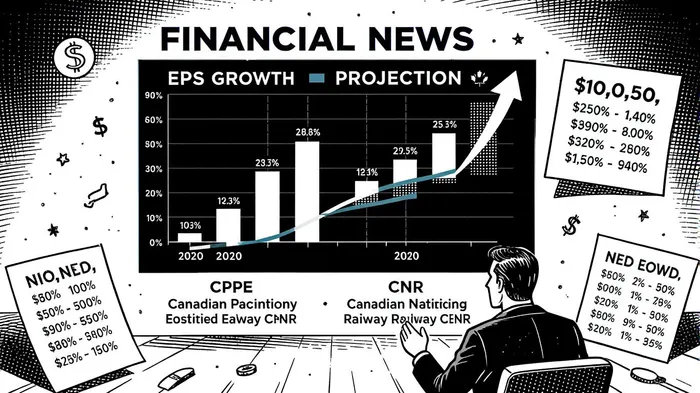
The Canadian rail sector remains a focal point for investors navigating a complex macroeconomic landscape. RBCRBC-- Capital's recent analysis underscores divergent trajectories for the two dominant players—Canadian Pacific Kansas City (CP) and Canadian National RailwayCNI-- (CNR)—as they navigate trade uncertainties, capital expenditures, and earnings expectations in 2025. While CN Rail has tempered its growth forecasts, CP Rail continues to project robust expansion, creating a compelling case for strategic differentiation.
CN Rail: Defensive Valuation Amid Operational Headwinds
Canadian National Railway's 2025 guidance reduction—from 10-15% to mid-single-digit EPS growth—reflects broader macroeconomic pressures, including trade volatility and tariff risks[1]. This downward revision has prompted analysts to cut price targets, with RBC lowering its CNR target to $157 from $161 while maintaining an “Outperform” rating[2]. Despite these challenges, CN's defensive attributes remain compelling. Its trailing P/E ratio of 17.77 is significantly lower than CP's 27.01, offering a more attractive valuation for risk-averse investors[2].
CN's capital allocation strategy further strengthens its long-term appeal. The company has committed CAD$3.4 billion to infrastructure upgrades in 2025, including CAD$80 million in Atlantic Canada and CAD$110 million in Wisconsin, aimed at enhancing capacity and supporting sustainable growth[2]. These investments, coupled with a 5% dividend increase for 2025—the 29th consecutive annual raise—underscore CN's commitment to shareholder returns[3]. RBC analyst Irene Nattel anticipates a “stronger” second half of 2025 for CN, citing improving volume trends and a Q2 2025 EPS estimate of $1.90, reflecting 2.9% year-over-year growth[4].
CP Rail: Aggressive Growth and Operational Resilience
In contrast, Canadian Pacific Kansas CityCP-- has emerged as the sector's growth story. RBC's Walter Spracklin maintains a “Buy” rating for CP with a $127 price target, aligning with a broader analyst consensus of “Strong Buy” and a 14.09% upside potential[5]. CP's Q2 2025 performance—projected at $1.15 EPS, a 9.7% year-over-year increase—highlights its operational resilience, driven by intermodal and bulk commodity strength[4].
CP's 2025 guidance of low-teens adjusted EPS growth contrasts sharply with CN's revised outlook, supported by its expanded network and efficiency gains[2]. Analysts from Stephens and J.P. Morgan have raised price targets to $119–$134.18, citing confidence in CP's long-term potential despite short-term regulatory uncertainties from the Union Pacific/Norfolk Southern merger[5]. While CP's higher valuation metrics (27.01 P/E) may deter some investors, its strong volume growth (7% in the most recent quarter) and earnings momentum justify the premium[1].
Strategic Implications for Investors
The divergent strategies of CP and CN present distinct risk-reward profiles. CN's lower valuation and defensive capital program make it a safer bet in a volatile macroeconomic environment, particularly for income-focused investors. However, CP's aggressive growth trajectory and operational efficiency gains position it as a high-conviction play for those willing to tolerate near-term uncertainties.
RBC's optimism for the sector hinges on the ability of both companies to adapt to evolving trade dynamics and regulatory shifts. For CN, the success of its CAD$3.4 billion investment program will be critical to restoring growth momentum. For CP, maintaining its earnings trajectory amid merger-related disruptions will test its operational agility.
Conclusion
As 2025 unfolds, the Canadian rail sector offers a nuanced investment landscape. CN Rail's defensive positioning and CN's disciplined capital allocation provide stability, while CP Rail's growth-oriented strategy and strong earnings momentum cater to more aggressive investors. RBC's analysis, supported by granular analyst ratings and capital expenditure data, reinforces the sector's long-term potential, even as macroeconomic headwinds persist.







Comentarios
Aún no hay comentarios