
Re-rating Japan: Why EWJ Offers a Strategic Entry Point in 2025
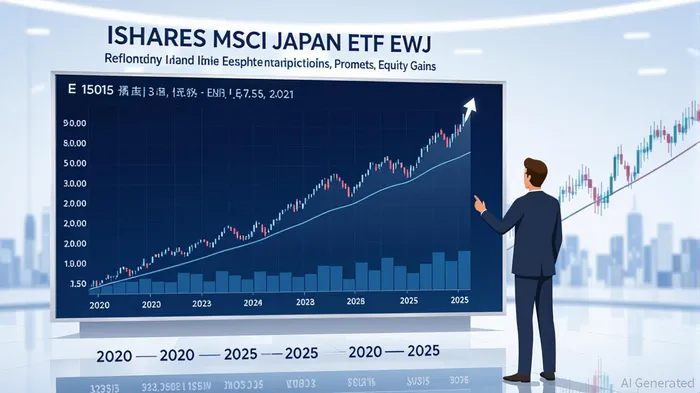
Japan’s economy is at a pivotal inflection pointIPCX-- in 2025, marked by a delicate balance between stubborn inflation, cautious monetary normalization, and a wave of structural reforms aimed at reigniting long-term growth. For investors, the iShares MSCIMSCI-- Japan ETF (EWJ) has emerged as a compelling vehicle to capitalize on this re-rating, with year-to-date returns of 17.56% as of September 2025 reflecting renewed confidence in the country’s economic trajectory [1]. This article argues that EWJEWJ-- offers a strategic entry point in 2025, driven by macroeconomic reflation and structural reforms that are reshaping Japan’s investment narrative.
Macroeconomic Reflation: A New Policy Paradigm
Japan’s central bank, the Bank of Japan (BoJ), has shifted from decades of ultra-loose monetary policy to a more normalized stance. After raising the policy rate to 0.50% in January 2025—the highest in 17 years—the BoJ has signaled a measured approach to further tightening, contingent on inflation trends [2]. Core CPI remains elevated at 3.7% year-on-year in May 2025, driven by wage growth, distorted trade flows from U.S. tariffs, and domestic food inflation [3]. While the BoJ forecasts inflation to ease to its 2% target by March 2026, the path to normalization is being carefully calibrated to avoid stifling a fragile recovery [4].
This reflationary backdrop is critical for EWJ. Unlike the deflationary cycles of the past, Japan’s current environment features rising wages and corporate profitability. Real wages, however, remain under pressure, with consumer spending power declining and growth narrowly avoiding contraction in Q1 2025 [5]. Yet, the BoJ’s pivot toward rate hikes and reduced bond purchases is re-anchoring inflation expectations, creating a more stable environment for equity markets. As noted by Deloitte, Japan’s domestic demand—particularly private consumption and business investment—is now the primary growth driver, a shift that bodes well for large-cap stocks in EWJ’s portfolio [6].
Structural Reforms: Unlocking Productivity and Resilience
Beyond monetary policy, Japan’s structural reforms are addressing deep-seated challenges such as demographic decline and overreliance on China. The OECD highlights that reforms to innovation frameworks, R&D tax credits, and university-SME linkages are critical for long-term productivity [7]. Meanwhile, Japanese firms like Panasonic and ToyotaTM-- are diversifying supply chains into Southeast Asia, reducing exposure to U.S.-China trade tensions [8].
Fiscal consolidation is another pillar of the reform agenda. The government plans to increase public investment in disaster mitigation and defense spending, while also prioritizing fiscal prudence to manage its high public debt [9]. These measures are complemented by corporate governance reforms, including reduced cross-shareholdings and incentives for share buybacks and dividends [10]. As Eastspring Investments notes, these structural changes are redefining Japan as a “structural alpha opportunity,” with improved capital efficiency and shareholder returns supporting equity valuations [11].
Historical Parallels: Abenomics and the Case for EWJ
The current reflationary environment draws parallels to the Abenomics era (2013–2020), when aggressive monetary easing and structural reforms drove a 12% gain for EWJ by 2019, outpacing the S&P 500’s 9.3% return [12]. While Abenomics faced challenges in achieving its 2% inflation target, the policy mix of fiscal stimulus, monetary easing, and governance reforms laid the groundwork for a gradual equity market recovery [13].
Today, the BoJ’s normalization of rates and the government’s focus on wage growth and fiscal discipline are creating a more sustainable reflationary cycle. Unlike the early 2010s, Japan’s corporate sector is now characterized by stronger balance sheets and higher profitability, supported by regulatory initiatives that encourage capital deployment [14]. This environment is particularly favorable for EWJ, which tracks large- and mid-cap Japanese equities and benefits from these structural tailwinds.
Risks and Mitigants
Investors must remain mindful of risks, including unresolved U.S. tariffs on Japanese exports and global trade tensions [15]. However, Japan’s strategic shift away from China and its emphasis on domestic demand are mitigating these vulnerabilities. The OECD projects real GDP growth of 0.7% in 2025, with domestic consumption as the key driver [16]. Additionally, the BoJ’s cautious approach to rate hikes ensures that monetary policy remains supportive of growth, even as inflation trends toward its target.
Conclusion: A Strategic Entry Point
The convergence of macroeconomic reflation and structural reforms positions EWJ as a strategic entry point in 2025. With inflation expectations re-anchored, corporate governance improving, and supply chains diversifying, Japan’s equity market is entering a new phase of growth. While volatility remains a factor—historically reflected in EWJ’s 17.48% standard deviation—long-term investors are rewarded by the compounding effects of structural change [17]. As the BoJ continues its normalization path and reforms take hold, EWJ offers a compelling opportunity to participate in Japan’s re-rating.
Source:
[1] iShares MSCI Japan ETF | EWJ, [https://www.ishares.com/us/products/239665/ishares-msci-japan-etf]
[2] Japan economic outlook, July 2025, [https://www.deloitte.com/us/en/insights/economy/asia-pacific/japan-economic-outlook.html]
[3] Japan outlook Q3 2025 - Equiti, [https://www.equiti.com/jo-en/news/global-macro-analysis/japan-outlook-q3-2025/]
[4] BOJ turns less gloomy on economy, keeps rate-hike chance alive, [https://www.reuters.com/business/boj-turns-less-gloomy-economy-keeps-rate-hike-chance-alive-2025-07-31/]
[5] Japan A structural alpha opportunity, [https://www.eastspring.com/insights/deep-dives/japan-a-structural-alpha-opportunity]
[6] OECD Economic Outlook, Volume 2025 Issue 1: Japan, [https://www.oecd.org/en/publications/2025/06/oecd-economic-outlook-volume-2025-issue-1_1fd979a8/full-report/japan_cc84dbee.html]
[7] OECD Economic Outlook, Volume 2025 Issue 1: Japan, [https://www.oecd.org/en/publications/2025/06/oecd-economic-outlook-volume-2025-issue-1_1fd979a8/full-report/japan_cc84dbee.html]
[8] 3 Economic Challenges Facing Japan in 2025, [https://www.investopedia.com/articles/investing/123015/3-economic-challenges-japan-faces-2016.asp]
[9] Monthly Economic Report Executive Summary (July 2025), [https://www5.cao.go.jp/keizai3/getsurei-e/2025jul.html]
[10] Japan A structural alpha opportunity, [https://www.eastspring.com/insights/deep-dives/japan-a-structural-alpha-opportunity]
[11] Japan A structural alpha opportunity, [https://www.eastspring.com/insights/deep-dives/japan-a-structural-alpha-opportunity]
[12] Jumping for an Old Japan ETF (EWJ), [https://www.investopedia.com/news/jumping-old-japan-etf-ewj/]
[13] An Assessment of Abenomics: Evolution and Achievements, [https://www.researchgate.net/publication/353335332_An_Assessment_of_Abenomics_Evolution_and_Achievements]
[14] Japan A structural alpha opportunity, [https://www.eastspring.com/insights/deep-dives/japan-a-structural-alpha-opportunity]
[15] OECD Economic Outlook, Volume 2025 Issue 1: Japan, [https://www.oecd.org/en/publications/2025/06/oecd-economic-outlook-volume-2025-issue-1_1fd979a8/full-report/japan_cc84dbee.html]
[16] OECD Economic Outlook, Volume 2025 Issue 1: Japan, [https://www.oecd.org/en/publications/2025/06/oecd-economic-outlook-volume-2025-issue-1_1fd979a8/full-report/japan_cc84dbee.html]
[17] iShares MSCI Japan ETF (EWJ): Historical Returns, [https://www.lazyportfolioetf.com/etf/ishares-msci-japan-etf-ewj/]





Comentarios
Aún no hay comentarios