
U.S. Rate Cuts and Their Global Market Implications: Assessing the Interplay Between Fed Easing and Bond Yield Dynamics
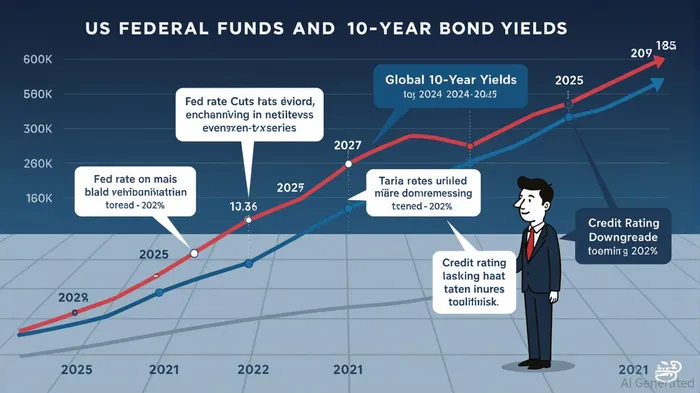
The Federal Reserve’s gradual easing path in 2025 is reshaping global bond markets, creating a complex web of capital flows, currency movements, and yield dynamics. As the Fed projects a median federal funds rate of 3.9% by year-end 2025—a 50-basis-point reduction from its June 2025 target range of 4.25%–4.5%—investors are recalibrating expectations for risk assets and safe-haven alternatives [2]. This shift, however, is occurring against a backdrop of structural challenges, including U.S. fiscal sustainability concerns and divergent monetary policies in Europe and Asia.
Fed Projections and the U.S. Yield Conundrum
The Federal Open Market Committee (FOMC) has signaled a cautious approach to rate cuts, with J.P. Morgan Research forecasting three 25-basis-point reductions in 2025, bringing the target range to 3.25%–3.5% by early 2026 [5]. Despite these cuts, U.S. 10-year Treasury yields have remained rangebound between 4.2% and 4.6% since April 2025, reflecting a tug-of-war between easing expectations and persistent inflationary pressures from tariffs and fiscal expansion [1]. This “yield conundrum” underscores a key paradox: lower policy rates have not translated into lower long-term yields, as investors demand higher compensation for risks tied to U.S. debt sustainability. The loss of the U.S.’s AAA credit rating in May 2025 further exacerbated this trend, pushing term premiums higher [4].
Global Yield Divergence and Capital Reallocation
While U.S. yields hover near multiyear highs, global bond markets are diverging sharply. The European Central Bank (ECB) and Bank of Japan (BOJ) have initiated aggressive rate-cutting cycles, with 10-year Bund yields projected to fall below 2.25% and JGB yields to dip toward 1.50% by year-end 2025 [2]. This divergence is driving capital flows toward higher-yielding emerging markets and alternative safe-haven assets like gold and the Swiss franc [1]. For instance, the U.S. dollar has depreciated against the euro and yen, with the latter benefiting from BOJ’s dovish stance and Japan’s fiscal stimulus. Meanwhile, U.S. Treasuries, once the gold standard of safe assets, are losing their allure as foreign investors gradually reduce holdings, shifting toward shorter-duration bonds and diversified portfolios [1].
Currency Movements and Cross-Market Correlations
The Fed’s easing trajectory is also reshaping currency dynamics. A weaker dollar, priced into markets since September 2025, has boosted non-U.S. developed markets by 11.8% in Q2 2025, as capital flocked to undervalued equities and bonds [1]. However, this trend faces headwinds from Trump-era tariffs, which have introduced volatility into trade-sensitive sectors and delayed Fed action [3]. Cross-market correlations are further complicating the picture: U.S. Treasuries are no longer reliably offsetting equity drawdowns, while the yen and Swiss franc have emerged as new safe-haven magnets [1].
Implications for Investors
For fixed-income investors, the key takeaway is a shift toward “regime-aware” strategies. Long-duration U.S. bonds remain vulnerable to fiscal risks, while short-duration and inflation-linked securities offer better protection. In global markets, the ECB’s and BOJ’s rate cuts present opportunities in European and Japanese bonds, though liquidity constraints persist. Equities in non-U.S. developed markets, particularly those with exposure to dollar depreciation, could outperform in a Fed-easing environment.
The Fed’s 2025 easing cycle is not a panacea for global markets but a catalyst for reallocation. As Chair Powell emphasized in Jackson Hole, the Fed’s path will remain data-dependent, with inflation and labor market risks dictating the pace of cuts [3]. Investors must navigate this uncertainty by balancing duration, currency exposure, and diversification—principles that will define the next chapter of global bond dynamics.
**Source:[1] Federal Reserve issues FOMC statement [https://www.federalreserve.gov/monetarypolicy/monetary20250730a.htm][2] Fixed Income Survey 2024-2025: Cautious Optimism [https://russellinvestments.com/content/ri/us/en/insights/russell-research/2024/11/fixed-income-survey-2024-2025-cautious-optimism.html][3] Market navigator: week of 8 September 2025 [https://www.ig.com/en/news-and-trade-ideas/weekly-market-navigator--8-sep-2025-250908][4] Global fixed income markets - Summer 2025 [https://www.rbcgam.com/en/ca/article/global-fixed-income-markets-summer-2025/detail][5] What's The Fed's Next Move? | J.P. Morgan Research [https://www.jpmorganJPM--.com/insights/global-research/economy/fed-rate-cuts]







Comentarios
Aún no hay comentarios