
Rare Earths: The Geopolitical and Economic Lever in U.S.-China Trade Dynamics
In the intricate dance of global trade, rare earth elements (REEs) have emerged as both a vulnerability and a weapon. These 17 chemically similar metals-critical for electric vehicles, wind turbines, semiconductors, and defense systems-are now central to the U.S.-China rivalry. China's near-monopoly over REE processing and mining, coupled with its strategic export controls, has forced nations to rethink supply chains. For investors, this tension presents both risks and opportunities, demanding a nuanced understanding of resource control, trade policy, and demand trends.
China's Dominance: A Strategic Fortress
China's grip on the rare earth sector remains unshakable. By 2025, it controls 90% of global refining capacity and over 63% of mine output, a position fortified by state-led consolidation under entities like the China Rare Earth Group and China Northern Rare Earth, according to Rare Earth Exchanges. Recent regulatory moves have further tightened its leverage: export controls now extend to downstream materials, components, and technologies, including those used in semiconductors and lithium batteries. Foreign firms must now secure licenses for products containing even minimal traces of Chinese-origin REEs, with applications for military or defense-related uses typically denied, according to CNN.
This dominance is not accidental. China's vertically integrated supply chain-from mining to magnet production-allows it to manipulate prices and access. For instance, Rare Earth Exchanges reported that China Northern Rare Earth raised its rare earth concentrate prices by 1.51% in Q3 2025, reflecting upstream cost pressures and growing demand for magnet-grade materials. Analysts project that even with international efforts to diversify, China's refining capacity will remain at 76% by 2035, an analyst report projects.
U.S. Counterstrategies: Diversification and Domestic Resilience
The United States, acutely aware of its vulnerability, has adopted a multi-pronged approach. Domestically, MP Materials' Mountain Pass mine produced 1,300 tonnes of neodymium-praseodymium (NdPr) oxide in 2024, with new magnet production facilities expected to come online. The Trump administration's One Big Beautiful Bill Act (OBBBA) allocated $2 billion for National Defense Stockpile purchases and $5 billion for the Industrial Base Fund, aiming to bolster domestic processing, Carnegie Endowment noted.
However, a purely domestic solution is constrained. The U.S. lacks reserves for many critical minerals and faces structural challenges in mining competitiveness. To address this, the U.S. has turned to friendshoring-partnering with allies like Australia, Japan, and Ukraine. For example, Australia's Lynas Rare Earths and Arafura Rare Earths are expanding processing capacities, while the U.S. Department of Energy's AI-powered tool has identified a major rare earth deposit in Wyoming's Brook Mine, the Department of Energy said.
A pivotal moment came in June 2025, when a U.S.-China trade agreement temporarily eased export restrictions, allowing China to resume rare earth exports to the U.S. in exchange for a 55% tariff on Chinese imports. While this provided short-term relief, the agreement's terms-such as six-month license validity and high tariffs-suggest a fragile truce, a CSIS analysis observed.
Global Demand and Diversification Efforts
Global demand for REEs is surging, driven by clean energy adoption. Neodymium and praseodymium, essential for high-strength magnets in EVs and wind turbines, are projected to see demand quadruple by 2050, Business News Today reports. This has spurred international efforts to diversify supply chains. The European Union's Critical Raw Materials Act mandates strategic reserves and diversified sourcing, while Japan has invested in refining partnerships outside China, Rare Earth Exchanges reported.
Central Asia and Southeast Asia are emerging as key regions. Untapped reserves in the Tien Shan and Pamir mountain ranges could attract investment, though environmental and geopolitical hurdles persist. Meanwhile, sustainability concerns-such as radioactive byproducts and water consumption in mining-are pushing companies toward green technologies and urban mining, as noted by The Observer.
Strategic Investment Opportunities
For investors, the rare earth sector offers high-risk, high-reward opportunities. Key areas include:
1. Domestic U.S. Producers: Companies like MP MaterialsMP-- and Energy Fuels are scaling processing capacities, supported by federal incentives. Energy Fuels' White Mesa Mill, for instance, plans to scale to 6,000 tons of NdPr oxide annually by 2028, Discovery Alert reported.
2. International Partnerships: Firms in Australia (Lynas Rare Earths) and Canada (Neo Performance) are positioning themselves as alternatives to Chinese supply.
3. Technology Innovation: AI-driven exploration tools and low-impact extraction methods could redefine the industry's environmental footprint.
Conclusion: Navigating the New Geopolitical Landscape
The rare earth sector is a microcosm of the broader U.S.-China rivalry. China's strategic controls and the West's push for diversification will continue to shape trade dynamics, creating volatility but also opportunities for those who invest in resilience. For investors, the path forward lies in balancing exposure to high-growth regions with a focus on sustainability and geopolitical agility. As the world electrifies and decarbonizes, rare earths will remain a cornerstone of both economic and strategic power.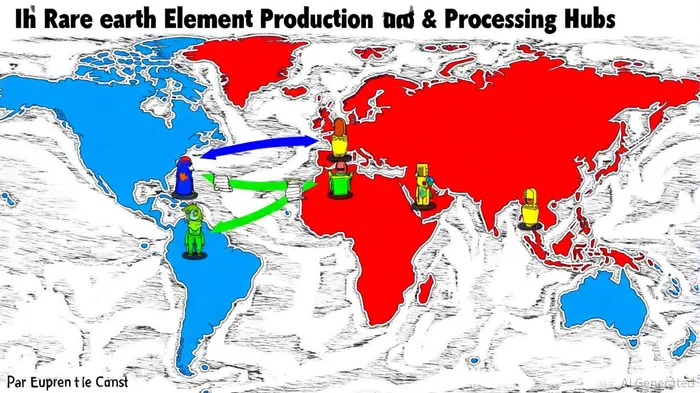





Comentarios
Aún no hay comentarios