
The Rare Earth Revolution: How Wyoming's Brook Mine Could Redefine U.S. Supply Chain Sovereignty
The U.S. has long been vulnerable to geopolitical and economic risks tied to its reliance on foreign sources of critical minerals. Now, Wyoming's Brook Mine project—led by Ramaco ResourcesMETC-- (NASDAQ: METC)—is poised to disrupt this dynamic. This rare earth minerals mine, the first of its kind in over seven decades, could transform America's strategic autonomy while offering investors a leveraged play on the energy transition. But will its promise outweigh its risks?
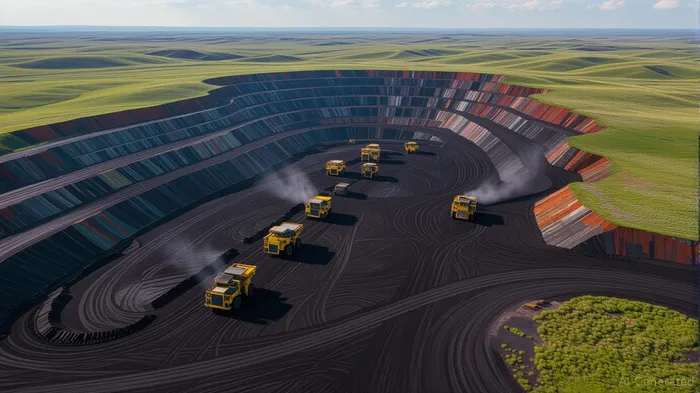
Geopolitical Tipping Point: Breaking China's Rare Earth Monopoly
China currently dominates 87-94% of global rare earth refining, separation, and magnet production—a chokehold that impacts everything from electric vehicles (EVs) to military hardware. The Brook Mine's PEA, conducted by Fluor CorporationFLR--, reveals its potential to supply 3-5% of U.S. permanent magnet demand and over 30% of defense-related requirements. This is no small feat: rare earth elements like neodymium and dysprosium are irreplaceable in high-strength magnets used in EV motors and wind turbines.
The mine's uniqueness lies in its ability to extract rare earths from coal, a process that avoids the high costs and radioactive waste of traditional hard-rock mining. With an NPV of $1.2 billion (8% discount rate) and a 38% IRR, the project's economics are compelling. More importantly, its success would mark a strategic pivot toward domestic critical mineral independence—a priority under the Biden administration's $52 billion Critical Minerals Act.
Ramaco's stock surged 91% YTD through July 2025 amid PEA validation and geopolitical tailwinds, outperforming the S&P 500 by 200%.
The Stock Surge: A Market Signal or Speculative Bubble?
Ramaco's stock has been a rollercoaster, rising 66% in one month following the PEA announcement but dropping 24% on its release due to initial investor skepticism. The volatility reflects two narratives:
Bull Case: The Brook Mine's scalability (42-year mine life with <4% of reserves tapped) and its alignment with U.S. supply chain resilience goals justify a valuation multiple expansion. Analysts at Benchmark and B. Riley have raised price targets to $14-$20, citing its “strategic necessity” for industries from semiconductors to defense.
Bear Case: Execution risks loom large. The $500 million capital requirement, regulatory hurdles (e.g., subsidence control appeals), and a payout ratio of -9,680% (funded by debt) raise red flags. Even with a Wyoming grant and federal funding talks, delays could strain liquidity.
Investors must weigh the project's strategic value against its financial fragility. A $14 price target implies 60% upside from current levels, but downside risks include permit delays or a China trade détente reducing urgency for U.S. alternatives.
Environmental Crossroads: Can Rare Earth Extraction Coexist with Sustainability?
The Brook Mine's environmental controversies—centered on subsidence risks and permit transparency—are a microcosm of broader tensions. Critics argue that highwall mining could destabilize land, while RamacoMETC-- counters that the deposit's “soft clay” geology avoids radioactive waste issues common in other projects.
Demand for rare earths is projected to grow 12% annually through 2030, driven by EV adoption (40% of demand) and defense spending.
Critically, the mine's carbon footprint is mitigated by its coal-to-rare earth process, which avoids the energy-intensive steps of traditional mining. Furthermore, its output of scandium and gallium could accelerate advancements in next-gen solar panels and semiconductors—key to clean energy adoption.
Investment Thesis: Playing the Long Game
For investors willing to accept volatility, Ramaco offers a leveraged position in two megatrends:
1. Critical Minerals Supercycle: As EV adoption accelerates (IDTechEx forecasts 50% global market share by 2030), rare earth demand will soar. The Brook Mine's unique resource base positions it to capture premiums in this market.
2. Infrastructure Plays: The mine's success could catalyze ancillary investments in processing facilities, railways (to transport minerals), and renewable energy projects in Wyoming.
Actionable Insights:
- Buy METC: For aggressive investors, accumulate shares at current levels ($10-$12), targeting $14-$16 with a stop-loss below $7.50.
- Hedge with ETFs: Pair exposure to the Global X Rare Earth & Strategic Metals ETF (REMX) to diversify risk.
- Monitor Permitting: A final green light from Wyoming's EQC by Q4 2025 would be a bullish catalyst.
Conclusion: A Risky Bet on Strategic Necessity
The Brook Mine is more than a mining project—it's a geopolitical gambit to reclaim control over the minerals powering the 21st-century economy. While execution risks are real, the stakes are existential for U.S. supply chain resilience. Investors with a 5+ year horizon and tolerance for volatility may find this a generational opportunity to profit from the rare earth revolution.
Final thought: In the race for critical minerals dominance, the U.S. needs its own “Saudi Arabia of rare earths.” Wyoming's Brook Mine might just be it.







Comentarios
Aún no hay comentarios