
The Rare Earth Revolution: How Automakers Are Rethinking Supply Chains Amid China's Export Curbs
The global automotive industry is at a crossroads. China's April 2025 export restrictions on seven rare earth elements (REEs) and related magnets—critical for electric vehicle (EV) motors, batteries, and advanced drivetrain components—have exposed a glaring vulnerability: automakers remain shackled to Chinese supply chains. With inventories depleting and production halts looming, the race is on to diversify sourcing and innovate alternatives. This crisis isn't just a hiccup—it's a seismic shift demanding urgent investment in strategic supply chain resilience.
China's Stranglehold on Rare Earths
China's dominance is staggering: it produces 60% of global rare earth minerals and controls 90% of refining capacity, including 99% of heavy REEs like terbium and dysprosium. These materials are indispensable for high-performance neodymium-iron-boron (NdFeB) magnets, which account for 30% of an EV motor's weight. The April restrictions, requiring export licenses for seven critical elements, have triggered chaos. European automakers report only 25% of license applications approved, while U.S. defense firms face direct sanctions.
The stakes are existential. A single F-35 jet requires 900 pounds of REEs, and a Virginia-class submarine needs 9,200 pounds. For automakers, the crunch is immediate: Tesla has already cut Q2 2025 production by 15%, and Suzuki halted its Swift model due to shortages.
The Urgency of Diversification
The crisis has two clear pathways for investors: alternative sourcing and recycling innovation.
1. Greenland and Canada: The Next Frontiers
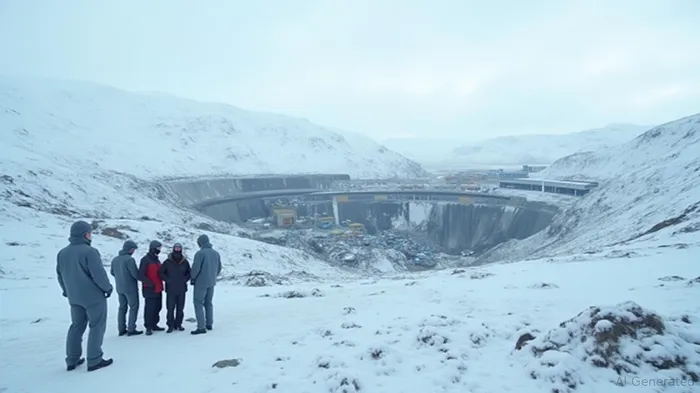
Greenland's Kvanefjeld project, despite regulatory hurdles, holds 6.6 million tons of REOs, including heavy REEs. While its development is stalled by a ban on uranium mining, the EU's 2023 Critical Raw Materials Act has fast-tracked projects like Greenland's Kringlerne deposit, which could produce 85,000 tons of REOs annually.
Canada's Sarfartoq project, owned by Neo Performance Materials, targets 214,200 tons of REOs, focusing on neodymium and praseodymium. Meanwhile, Quebec's Dumont Nickel Project, backed by the EU, could supply 1 billion tons of nickel—a battery critical mineral—while diversifying supply chains.
2. Recycling: The Hidden Goldmine
Recycling rare earths from end-of-life EVs and electronics offers a near-term solution. Companies like Redwave Metals (US) and Umicore (Belgium) are scaling up recovery processes, aiming to meet 30% of global demand by 2030. Recycling reduces costs by 40–60% compared to mining, while sidestepping geopolitical risks.
Investment Plays to Watch
- MP Materials (MP): The U.S.'s largest rare earth producer, with plans to expand magnet manufacturing. Its partnership with the DOD to build a domestic supply chain could pay dividends as tariffs escalate.
- Lynas Corporation (LYC): Australia's only rare earth refiner, with a $1.2 billion expansion to meet EV demand. Its oxide-to-magnet capacity could make it a cornerstone of Asia-Pacific diversification.
- Redwave Metals (RWAV): A pioneer in rare earth recycling, targeting $2 billion in revenue by 2030 from scrap recovery.
The Clock Is Ticking
The June 2025 deadline for compliance with China's restrictions is a pivotal moment. Automakers with no alternatives risk production collapses, while early movers in greenfield projects or recycling could dominate the post-crisis landscape. The EU's Critical Raw Materials Act and U.S. Inflation Reduction Act—allocating $10 billion for domestic production—are accelerants.
Investors should prioritize firms with low-cost recycling tech, proximity to refining infrastructure, or strategic government partnerships. The era of relying on China's rare earth monopoly is ending—but the winners will be those who act now.
In conclusion, the rare earth crisis isn't just about scarcity—it's about control. Automakers and investors must pivot to alternatives before China's chokehold tightens further. The next decade will reward the bold.





Comentarios
Aún no hay comentarios