
Raoul Pal's Analysis of Historic Crypto Liquidation Events and Their Implications for Institutional Investors: Navigating Systemic Risk and Rebalancing Opportunities in a Post-Liquidation Market
The crypto market's volatility has long been a double-edged sword for institutional investors. While sharp liquidation events-such as the 2022 crash that saw over $1.65 billion in leveraged BitcoinBTC-- positions wiped out in 24 hours, according to CoinEdition-pose systemic risks, they also create rebalancing opportunities for those who understand macroeconomic cycles. Raoul Pal, a macroeconomic analyst and former hedge fund manager, has built a framework to navigate these dynamics, emphasizing liquidity-driven supercycles and hyper-concentration in scarce digital assets. For institutional investors, his insights offer a roadmap to mitigate systemic risk while capitalizing on the next phase of crypto adoption.
Systemic Risk Mitigation: The Liquidity-Driven Supercycle
Pal's thesis hinges on the idea that global liquidity expansion-driven by central banks' 8% annual increase in money supply to manage debt-is creating a "hidden debasement" of fiat currencies, as argued by Mooloo. This debasement, he argues, forces investors to seek assets that outperform inflation, with Bitcoin and EthereumETH-- emerging as the only viable candidates. Unlike traditional assets, which Pal deems obsolete in the face of structural monetary policy shifts, crypto's scarcity and decentralized nature position it to absorb liquidity injections.
The 2022 liquidation event, for instance, was not a failure of crypto but a symptom of misaligned risk management. Pal warns that overleveraging and short-term trading exacerbate systemic risks, as forced liquidations during drawdowns amplify volatility, as MarketAcad notes. To counter this, he advocates for a hyper-concentrated portfolio-allocating 80–90% to major cryptocurrencies like Bitcoin and Sui-while avoiding speculative altcoins, a stance detailed by CoinEdition. This approach reduces exposure to volatile, low-liquidity assets and aligns with the macroeconomic reality of a liquidity-driven supercycle.
Rebalancing Opportunities: Timing the Cycle with Macro Indicators
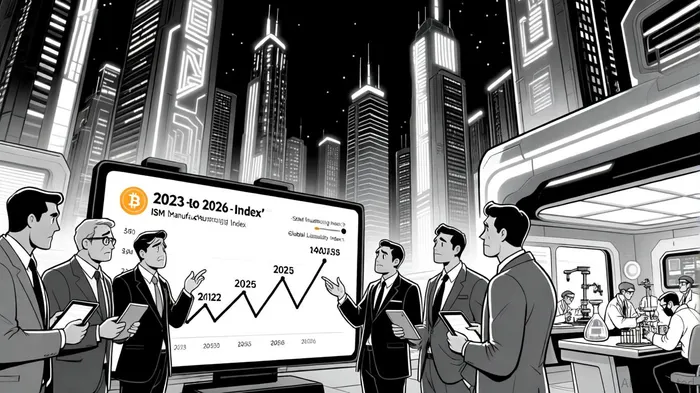
Pal's framework for rebalancing post-liquidation events relies on synchronizing portfolio adjustments with macroeconomic signals. The ISM Manufacturing Index, for example, acts as a proxy for global risk appetite. When the index rises above 57, Pal predicts a migration of capital from Bitcoin to Ethereum and other Layer 1 blockchains, reflecting the real economy's growth phase; he has even outlined a $450,000 Bitcoin scenario, according to TradingView. Similarly, DeMark signals and liquidity proxies help identify inflection points in the cycle, allowing investors to adjust allocations without reacting to short-term noise, as Cointelegraph reports.
Institutional investors can leverage these tools to maintain long-term exposure while avoiding premature exits. Pal's own portfolio, which includes 98% allocation to crypto, exemplifies this strategy. By holding Bitcoin as "pristine collateral" and pivoting to high-performance altcoins like SuiSUI--, he captures compounding gains from liquidity expansion and network adoption. This disciplined approach contrasts with traditional diversification, which Pal dismisses as a "dead" strategy in an era of structural debasement, as discussed by Mooloo.
The Road Ahead: A Prolonged Bull Run into 2026
Pal anticipates the current bull cycle extending into Q2 2026, driven by synchronized liquidity expansion and a weakening U.S. dollar; Cointelegraph has covered his views on the timing around a Q1 2026 market top. The Dollar Index (DXY) has already fallen 8.995% since 2025's start, reinforcing his thesis, a trend MarketAcad has documented. For institutional investors, this timeline provides a window to rebalance portfolios without succumbing to panic selling. Pal advises maintaining patience, as routine 20–30% drawdowns are part of the cycle and should not trigger forced liquidations, a point MarketAcad also emphasizes.
Moreover, regulatory developments-such as Europe's MiCA initiative and U.S. efforts to formalize crypto frameworks-are validating digital assets as a mainstream asset class, a theme Mooloo highlights. This institutional validation, combined with generational shifts (millennials and Gen Z embracing crypto as a legitimate investment), suggests adoption is accelerating, according to CoinEdition. Sovereign wealth funds in the Middle East, for instance, are not only adopting Bitcoin as a reserve asset but also building blockchain infrastructure, signaling deeper integration into global economies, as Mooloo reports.
Conclusion: A New Paradigm for Institutional Investing
Raoul Pal's analysis challenges institutional investors to rethink traditional paradigms. By aligning with liquidity cycles, hyper-concentrating in high-beta assets, and adopting a long-term horizon, investors can mitigate systemic risks while capitalizing on rebalancing opportunities. The 2025–2026 cycle, with its potential for a $450,000 Bitcoin peak, discussed on TradingView, underscores the importance of strategic positioning. As Pal notes, the future of investing lies in embracing digital assets as the infrastructure layer of a new financial system-one where patience, discipline, and macroeconomic alignment replace short-term speculation.






Comentarios
Aún no hay comentarios