
Ranpak's Medline Partnership: A Scalable Play on Healthcare Supply Chain Automation
Ranpak's partnership with MedlineMDLN-- is a high-visibility, scalable case study that validates its technology in a high-value, regulated market. This multi-year enterprise agreement is a direct play on the company's automation penetration strategy, demonstrating its ability to secure deals with critical sector players. The deployment scale is substantial: Medline is rolling out Ranpak's systems across as many as 14 distribution centers, with one facility already handling more than 10,000 cartons per day after integration.
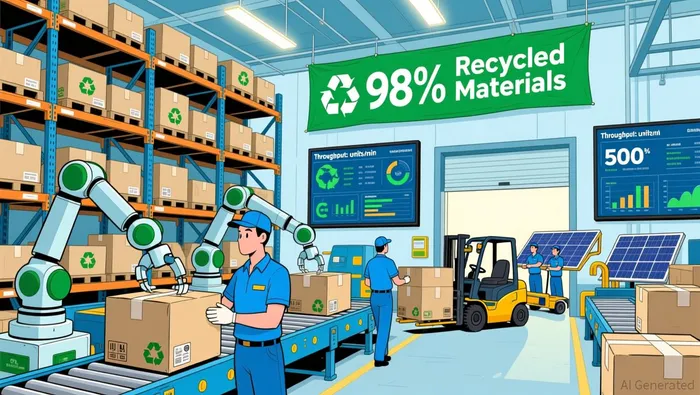
The operational gains are significant. The core of the solution is intelligent rightsizing, which allows Medline to reduce its carton assortment from 18 SKUs to just four. This dramatic simplification streamlines inventory, reduces waste, and accelerates throughput. The material efficiency is a key sustainability win, aligning with Medline's own goals to increase the sustainability profile of its shipments. For RanpakPACK--, this is a blueprint for capturing recurring revenue, as each automated unit placed is expected to consume a significant volume of paper annually.
Strategically, this deal is a major step forward. It moves Ranpak beyond its established e-commerce partnerships with giants like Amazon and Walmart into the complex, high-stakes healthcare supply chain. This sector demands precision, speed, and regulatory compliance-exactly the operational imperatives Ranpak's automation addresses. The partnership directly advances the company's mission to displace plastic packaging with paper-based, automated systems. For a growth investor, the Medline case shows the scalability of Ranpak's model: a single enterprise agreement can drive multi-year revenue and cement a foothold in a sector where automation is becoming an operational necessity.
Market Sizing and Growth Trajectory
The numbers paint a clear picture of a market on the move. The global automated packaging solutions market is projected to nearly double, growing from $80.6 billion in 2025 to approximately $162.2 billion by 2035. That's a compound annual growth rate of 7.2% over the next decade, a steady climb driven by industrial automation and efficiency demands. For Ranpak, this isn't just a tailwind; it's the foundational runway for scaling its business.
North America is the engine of this growth, leading the global packaging automation market. Its dominance is fueled by robust demand across key sectors like healthcare, retail, and food-precisely the verticals Ranpak is targeting. This regional leadership creates a favorable landscape for the company's expansion, concentrating its sales and installation efforts where the market is most active and receptive.
Within this large market, the healthcare distribution segment stands out as a high-margin niche. It's a natural fit for Ranpak's technology, which excels at streamlining complex, high-volume operations while ensuring precision and sustainability. The Medline partnership is a direct bet on this segment's growth, leveraging automation to simplify inventory and reduce waste in a sector where those gains translate directly to operational savings and environmental compliance. For a growth investor, the opportunity is twofold: capture a share of the broad market's 7%+ annual expansion, while also targeting the premium growth within healthcare logistics. The TAM is vast, and Ranpak's strategy is to build its share by proving its solution in high-value, scalable cases like this one.
Financial Impact and Scalability Metrics
The Medline partnership is a critical piece of Ranpak's growth engine, but its financial impact is best understood within the broader context of the company's scaling trajectory. In the third quarter, automation sales drove a robust 63% year-over-year growth, which was the primary force behind an 8% overall net sales increase to nearly $100 million. This demonstrates the outsized contribution of the automation segment to the top line. The deal with Medline, which is part of this enterprise push, directly contributes to that momentum by expanding the installed base of high-volume, paper-consuming units.
Yet the path to profitability remains capital-intensive. Despite the strong sales growth, Ranpak posted a net loss for the quarter of $10.4 million, which widened from $8.1 million a year prior. This loss underscores the significant upfront investment required to deploy systems across multiple distribution centers and the associated costs of scaling operations, R&D, and sales efforts. For a growth investor, this is a familiar trade-off: heavy reinvestment today for the promise of recurring revenue and market share tomorrow.
The real scalability lies in the template the Medline case sets. The partnership is a multi-year enterprise agreement to deploy systems across as many as 14 facilities, with one site already processing more than 10,000 cartons per day. This blueprint is designed for replication. The success in healthcare logistics-a sector demanding precision, speed, and sustainability-provides a clear model for targeting other regulated, high-volume distribution networks, from pharmaceuticals to industrial goods. The company's focus on serving large enterprises, as highlighted by its eight-year tie-up with Amazon and the projected $700 million in potential spend from Walmart over the next decade, shows a deliberate strategy to build a portfolio of such scalable, long-term contracts. Each new deployment not only adds revenue but also deepens the recurring paper consumption from each automated unit, fueling the business's growth flywheel.
Catalysts, Risks, and What to Watch
The path forward for Ranpak hinges on executing its enterprise playbook and demonstrating that its capital-intensive model can translate into durable, profitable growth. The near-term catalysts are clear and tied directly to the partnerships that form the core of its scaling strategy.
The most immediate test arrives with the ramp of Walmart spend in 2026. The company projects the retail giant could spend $700 million in the next decade, with impact expected to begin in the fourth quarter and accelerate through the year. This is a critical validation of the partnership's scalability. Each automated unit placed with Walmart is expected to consume over $100,000 of paper per year, creating a solid recurring revenue stream. A successful, visible rollout into Walmart's next-generation facilities will prove the model works at the scale of the world's largest retailer, providing a powerful reference for other potential enterprise customers.
Simultaneously, investors must monitor execution on the Medline deployment and any follow-on orders. The multi-year agreement to deploy systems across as many as 14 distribution centers is a blueprint for the healthcare supply chain automation market. The early results are promising, with one facility already handling more than 10,000 cartons per day. The key watchpoint is whether this initial success leads to additional orders from Medline or other healthcare distributors. Any expansion would signal that the healthcare niche is becoming a material growth vector, moving beyond a single case study to a replicable segment.
The dominant risk to the growth thesis is the business's inherent capital intensity. Despite strong sales growth, Ranpak posted a net loss for the quarter, and the path to profitability requires significant reinvestment. The company must demonstrate a clear trajectory for improving its EBITDA margins, which are likely below those of established industrial automation leaders. The high upfront costs of deploying systems across multiple distribution centers and scaling operations create pressure on cash flow. For a growth investor, the question is whether the recurring revenue from paper consumption and long-term contracts can eventually outweigh these costs, turning the current loss into a sustainable profit engine. The next few quarters will show if the company is managing this trade-off effectively.







Comentarios
Aún no hay comentarios