
Ralph Lauren's Q1 Earnings and Strategic Momentum: Assessing Margin Expansion and Long-Term Growth in a Competitive Luxury Market
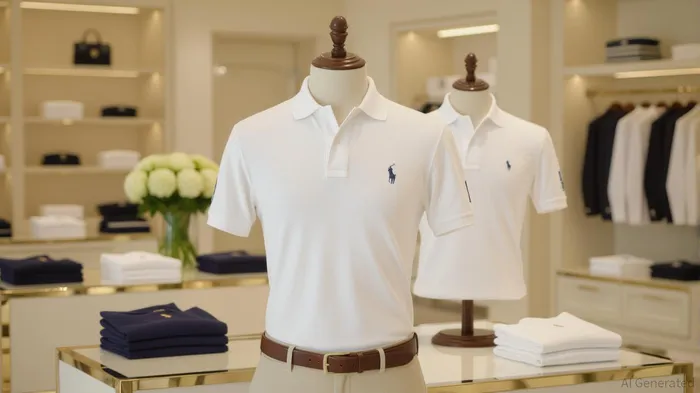
Ralph Lauren's Q1 2025 earnings report underscores the brand's resilience in a fragmented luxury market, marked by macroeconomic headwinds and shifting consumer priorities. With revenue rising 1% to $1.5 billion (3% in constant currency) and operating margins expanding by 90 basis points to 14.3%, the company has demonstrated a disciplined approach to profitability. However, the sustainability of this margin expansion—and its long-term growth potential—hinges on its ability to navigate a competitive landscape increasingly defined by personalization, sustainability, and regional diversification.
Margin Expansion: A Product of Strategic Leverage
Ralph Lauren's Q1 gross margin surged 170 basis points to 70.5%, driven by favorable product and geographic mix, lower cotton costs, and a 6% increase in average unit retail (AUR) across its direct-to-consumer (DTC) channels. This outperformance was particularly pronounced in Europe and Asia, where operating margins hit 25.2% and 27.4%, respectively. The company's inventory reduction by 13% year-over-year further highlights its operational discipline, a critical factor in maintaining margin health amid rising input costs.
Comparatively, peers like Richemont and LVMH have also prioritized DTC strategies, with Richemont's DTC sales accounting for 70% of revenue. However, Ralph Lauren's margin expansion is more asset-light, relying on its strong brand equity and efficient supply chain. For instance, its North American DTC segment saw a 1% rise in comparable store sales, despite a 4% overall revenue decline, suggesting that its retail footprint remains a competitive advantage.
Competitive Dynamics: Balancing Tradition and Innovation
The luxury sector is undergoing a strategic reset, with brands recalibrating their value propositions to align with Gen Z and millennial expectations. Ralph Lauren's focus on heritage and timeless design positions it well against competitors like Gucci (Kering) and DiorDIOD-- (LVMH), which are grappling with the need to modernize without diluting their legacies. For example, Dior's FY24 operating margin of 23.1% reflects its pricing power, but Ralph Lauren's 14.3% margin in Q1 2025 suggests a more conservative yet stable approach.
However, the brand faces challenges in North America, where wholesale declines and timing shifts (e.g., Easter) hurt Q1 performance. This contrasts with Richemont's strong Q1 results in Europe and the Americas, where it leveraged regional diversification to offset weaker Asian markets. Ralph Lauren's reliance on international growth—particularly in China, where sales rose high-single digits—will be critical to sustaining its momentum.
Sustainability and Long-Term Growth: A Double-Edged Sword
Sustainability is no longer a peripheral concern but a core driver of brand loyalty. While Ralph LaurenRL-- has not disclosed specific ESG initiatives in its Q1 report, its inventory reduction and focus on premium pricing align with circularity principles. Competitors like Richemont have made measurable progress, achieving 97.7% renewable electricity usage and a 10% revalorization of leather/textile stock. For Ralph Lauren, embedding sustainability into its supply chain and product lifecycle will be essential to retaining value-conscious consumers.
The luxury market's shift toward experiences also poses a challenge. While Ralph Lauren's DTC strategy and digital commerce growth (9% in Asia) are strengths, it must compete with LVMH's and Richemont's investments in immersive, hyper-personalized client engagement. For instance, Yves Saint Laurent's AI-driven beauty solutions and H&M's metaverse experiments highlight the sector's pivot toward digital-first experiences.
Investment Implications: A Calculated Bet
Ralph Lauren's Q1 results suggest a company that is both agile and disciplined. Its margin expansion, driven by cost optimization and strategic pricing, is sustainable in the short term, particularly in high-growth regions like Asia. However, long-term success will depend on its ability to:
1. Maintain DTC momentum: Expanding its digital commerce footprint in China and other emerging markets could offset North American headwinds.
2. Adopt sustainability at scale: Aligning with industry leaders like Richemont will be critical to retaining ESG-conscious consumers.
3. Differentiate its value proposition: Leveraging its heritage while innovating in product design and client engagement will ensure relevance in a market increasingly defined by personalization.
For investors, Ralph Lauren represents a balanced opportunity: a brand with strong margin leverage and a resilient international presence, but one that must adapt to evolving consumer expectations. Its current valuation, supported by a 14.3% operating margin and a $225 million shareholder return in Q1, suggests undervaluation relative to peers like LVMH and Richemont. However, risks remain in North America and the broader luxury sector's normalization of growth.
In conclusion, Ralph Lauren's Q1 performance validates its strategic direction, but its long-term trajectory will hinge on its ability to innovate without compromising its core identity. For those willing to bet on a brand that balances tradition with calculated modernization, the next 12–18 months could offer compelling upside.





Comentarios
Aún no hay comentarios