
Rafale Fighter Jet Program and Dassault Aviation's Growth Potential: A Strategic Analysis of Defense Sector Tailwinds and Contract Visibility
The Dassault Aviation Rafale program has emerged as a cornerstone of France's aerospace ambitions, with its global appeal and strategic positioning in a rapidly evolving defense sector. As of September 2025, Dassault has secured firm orders for 533 Rafale aircraft, including 26 Marine variants for India under a $7.4 billion inter-governmental agreement (Delivery of the 300th Rafale). With 233 aircraft remaining undelivered and the production rate ramping up to four units per month, the program's long-term visibility is robust. This analysis explores how defense sector tailwinds, geopolitical shifts, and financial performance position Dassault for sustained growth.
Global Demand and Contract Backlog: A Foundation for Growth
The Rafale's export success is underscored by contracts with high-potential markets. Indonesia's 42-aircraft order, Serbia's 12, and the UAE's 80 F4-standard variants reflect the jet's versatility and cost-effectiveness. By December 2024, Dassault reported a backlog of 220 units, including 164 for export, with 30 new export contracts secured in 2024 alone. These orders are structured with long-term logistical support and upgrade provisions, often spanning decades, ensuring recurring revenue streams.
The program's scalability is further bolstered by the Rafale F5, a next-generation variant designed to challenge the U.S. F-35 in stealth and sensor fusion while offering lower lifecycle costs. With operational deployment slated for 2030, the Rafale F5 aims to capitalize on European and Asian markets seeking alternatives to U.S.-dominated systems. This innovation aligns with a broader trend of nations prioritizing operational sovereignty, a key selling point for Dassault's open-architecture platform.
Financial Performance and Margin Resilience
Dassault's financials reflect the program's momentum. In H1 2025 results, the company generated EUR 1,751 million in defense net sales, driven by seven Rafale deliveries. Annual revenue guidance of EUR 6.5 billion for 2025, supported by a record EUR 48.3 billion backlog, underscores its scalability. While adjusted operating margins dipped to 6.3% and net margins to 13.6% in H1 2025, these figures remain resilient given a one-time EUR 67 million tax surcharge.
The defense sector's tailwinds are equally compelling. Asia and the Middle East, two of Dassault's key markets, are projected to grow at CAGRs of 4.4% and 5.83%, respectively, from 2025 to 2030, according to an Aerospace & Defense market analysis. This growth is fueled by military modernization, rising tensions in the South China Sea, and Middle Eastern volatility, as highlighted in Global defense spending trends. European defense budgets, growing at 6.8% annually through 2035, further reinforce long-term demand for advanced platforms like the Rafale.
Strategic Positioning in a Shifting Geopolitical Landscape
The Rafale F5's emphasis on technological independence and networked combat systems positions Dassault to capture market share in regions wary of U.S. influence. By integrating the nEUROn UCAV and offering country-specific customization, the F5 addresses modern warfare's evolving demands. This strategy is particularly appealing to Asian and Middle Eastern clients, where defense spending is increasingly directed toward AI, hypersonics, and unmanned systems.
However, challenges persist. The F-35's first-mover advantage in stealth technology and Dassault's need to accelerate production to meet its 233-aircraft backlog could test operational efficiency. Yet, the company's EUR 8,075 million order intake in H1 2025, with 96% from exports, suggests strong client confidence.
Conclusion: A Compelling Long-Term Investment
Dassault Aviation's Rafale program is uniquely positioned to benefit from defense sector tailwinds, geopolitical shifts, and its own innovation pipeline. With a EUR 48.3 billion backlog, a next-generation F5 variant, and a 5.83% CAGR in global aerospace and defense spending, the company's growth trajectory is well-supported. For investors, the combination of long-term contract visibility, margin resilience, and strategic alignment with global security trends makes Dassault a compelling play in the high-margin defense sector. 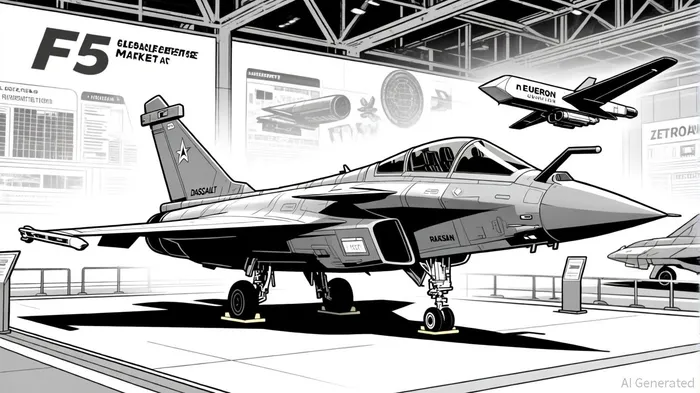







Comentarios
Aún no hay comentarios