
QXO's Strategic Momentum and Acquisition-Driven Growth: Valuing the Catalytic Impact of Apollo's $1.2B Investment
The building products distribution sector is undergoing a seismic shift, driven by consolidation and technological innovation. At the center of this transformation is QXOQXO--, Inc., a company that has leveraged a $1.2 billion investment led by ApolloAPO-- Global Management to accelerate its acquisition-driven growth strategy. This investment, structured as convertible perpetual preferred stock with a 4.75% annual dividend and a conversion price of $23.25 per share, provides QXO with critical capital to pursue both mid-sized and transformational deals through July 2026, with an option to extend. The question for investors is whether this strategic momentum, combined with QXO's EBITDA growth targets and valuation metrics, justifies its current market positioning and creates a compelling case for early entry.
Strategic Catalysts: Apollo's Investment and Acquisition Pipeline
Apollo's $1.2 billion commitment is more than a financial injection-it is a vote of confidence in QXO's ability to reshape the fragmented building materials industry. The investment explicitly funds acquisitions, with a mandate to close at least one deal by July 15, 2026. QXO's CEO, Brad Jacobs, has underscored the company's focus on leveraging technology and disciplined cost management to double the EBITDA of acquired businesses within three to five years. This approach aligns with QXO's broader ambition to reach $50 billion in annual revenue within a decade, a target that hinges on both organic growth and strategic acquisitions.
Recent results highlight QXO's progress. For Q3 2025, adjusted EBITDA reached $301.9 million, with a margin of 11.1%, up from $204.6 million and 10.7% in Q2. This improvement, coupled with a robust acquisition pipeline-including seven potential targets-positions QXO to capitalize on its capital base. The company's first major acquisition, Beacon Roofing Supply, for $11 billion in April 2025, exemplifies its strategy to consolidate traditional distributors into a unified platform. Analysts like William Blair's Ryan Merkel project QXO's revenue to grow to $7.4 billion in 2025 and $11.8 billion in 2026, aligning with its long-term vision.
Valuation Metrics: Justified Optimism or Overreach?
QXO's current valuation metrics raise critical questions. As of January 2026, the company trades at an EV/EBITDA ratio of 52.42 and a Price-to-Sales (P/S) ratio of 3.6x. While the P/S ratio is slightly below the peer average of 3.7x, it is significantly higher than the industry average of 1.2x for the US Trade Distributors sector. This discrepancy suggests that QXO is priced for aggressive growth, with the market seemingly discounting its ability to deliver on EBITDA expansion and revenue targets.
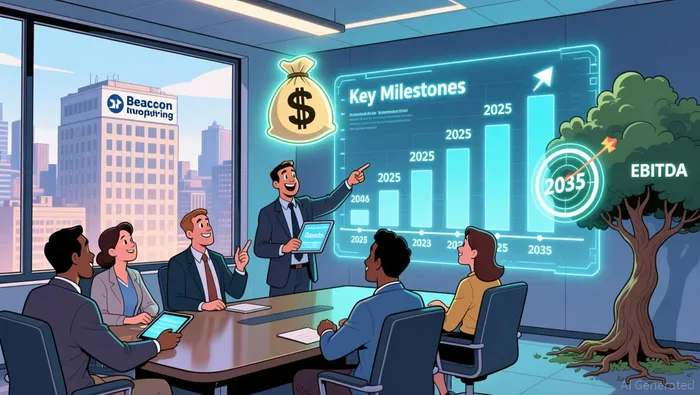
The company's EBITDA growth trajectory appears to support this optimism. QXO's leadership has stated that legacy Beacon's EBITDA is on track to exceed $2 billion organically, while the Apollo-backed acquisition strategy aims to double EBITDA through integration and operational efficiency. If these targets are met, the current EV/EBITDA of 52.42 could appear reasonable, particularly given the sector's historical multiples. However, the risk lies in execution: integrating multiple acquisitions while maintaining margin discipline is a complex endeavor, and any missteps could strain investor confidence.
Acquisition Pipeline and Market Dynamics
QXO's acquisition pipeline further strengthens its case for long-term growth. The company is in advanced talks with seven potential targets, ranging from mid-sized firms with $1 billion to $5 billion in revenue to larger transformational opportunities with $5 billion to $20 billion in revenue. This diversified approach mitigates the risk of overreliance on a single deal and aligns with the sector's consolidation trend. Analysts suggest that QXO's next acquisition could target lumberyards or specialty distributors, reflecting the ongoing shift toward vertical integration.
The Apollo investment also provides flexibility. By extending the deadline for deal execution if a definitive agreement is signed before July 2026, QXO gains additional time to secure the most strategic targets. This flexibility is critical in a competitive acquisition environment, where timing and pricing can significantly impact returns.
Conclusion: A Compelling Case for Early Entry?
QXO's strategic momentum, fueled by Apollo's $1.2 billion investment, presents a compelling narrative for investors willing to bet on its ability to execute its acquisition-driven growth plan. The company's EBITDA growth targets, combined with a robust pipeline and analyst price targets averaging $32.92 (a 31.68% upside from current levels), suggest that the market is pricing in substantial future value creation. However, the high EV/EBITDA ratio and reliance on acquisition success introduce risks that cannot be ignored.
For early entrants, the key consideration is whether QXO's management can deliver on its ambitious EBITDA and revenue goals while maintaining operational efficiency. If the company succeeds in doubling EBITDA for its acquired businesses and achieving its $50 billion revenue target, the current valuation could prove justified. Conversely, any delays or integration challenges could lead to a reassessment of its premium pricing. In a sector characterized by rapid consolidation and technological disruption, QXO's ability to balance growth with execution will determine its long-term shareholder value.





Comentarios
Aún no hay comentarios