
Quince Therapeutics: Assessing Long-Term Growth Potential Post-Investor Day
Quince Therapeutics (QNCX) has positioned itself as a compelling case study in biotech innovation, balancing high-stakes clinical development with disciplined capital management. Following its 2025 Investor Day on October 2, the company's strategic clarity around its lead asset, eDSP, and its financial runway has sharpened the focus for investors evaluating its long-term potential.
Pipeline Strength: A Dual-Pronged Approach to Rare Disease
Quince's pipeline is anchored by eDSP, a groundbreaking drug/device combination designed to deliver chronic corticosteroid therapy without systemic toxicity. The Phase 3 NEAT trial for Ataxia-Telangiectasia (A-T), fully enrolled with 105 patients, represents a critical inflection point. With topline results expected in Q1 2026 and an NDA submission planned for H2 2026, the trial's success could unlock a $200M+ peak annual revenue opportunity, given A-T's orphan drug status and lack of approved therapies, according to Quince's business update.
The company's AIDE technology platform further amplifies its pipeline potential. By encapsulating dexamethasone in autologous red blood cells, QuinceQNCX-- has created a scalable solution for chronic corticosteroid delivery-a $10B+ market segment currently plagued by toxicity and compliance issues. Beyond A-T, eDSP is advancing into Duchenne muscular dystrophy (DMD), with Phase 2 trial designs finalized and a pediatric EU study underway, as noted in the business update. This dual-indication strategy mitigates risk while expanding addressable markets.
Strategic partnerships are accelerating commercial readiness. Quince's collaboration with Option Care Health-a leader in specialty pharmacy services-avoids the need for an in-house sales force, reducing capital intensity during launch, the business update reported. Meanwhile, regulatory tailwinds, including FDA Fast Track and Orphan Drug designations, provide a clear pathway to approval and 7-year market exclusivity, per the business update.
Capital Efficiency: Stretching the Runway Without Dilution
Quince's financial strategy has evolved to prioritize capital efficiency. A June 2025 private placement raised $11.5M upfront, with an additional $10.4M in potential warrant proceeds, extending its cash runway through Q1 2026 and possibly into H2 2026, according to the business update. This compares favorably to its Q2 2025 net loss of $16.1M, driven by $6.6M in R&D expenses for the NEAT trial and $3.3M in G&A costs, as disclosed in the business update.
The company's cash position of $34.7M as of June 30, 2025, reflects a 28% increase from December 2024 ($27.1M), the business update shows, underscoring improved liquidity. Quince has also adopted cost-containment measures, including leveraging third-party partners for trial execution and commercialization. This approach contrasts with peers that often burn through cash on redundant infrastructure, making Quince a standout in an industry where 70% of biotechs fail due to liquidity constraints, according to a BIO report.
Risks and Opportunities
While the NEAT trial's success is pivotal, investors must weigh the 30–40% historical approval rate for Phase 3 trials in rare diseases, as reflected in FDA approval rates. However, Quince's SPA agreement with the FDA-a rare achievement for a first-in-class therapy-reduces regulatory uncertainty. Additionally, the AIDE platform's versatility positions the company to pivot into other indications, such as autoimmune disorders, if A-T/DMD trials face delays.
Conclusion
Quince Therapeutics exemplifies the modern biotech playbook: a differentiated pipeline, strategic partnerships, and a capital-efficient model. Assuming positive Phase 3 results, the company could transition from a speculative biotech to a near-term commercial entity, with eDSP's market potential and AIDE's platform value driving long-term growth. For investors, the key catalysts-Q1 2026 data and H2 2026 regulatory filings-offer a clear roadmap to assess risk-adjusted returns.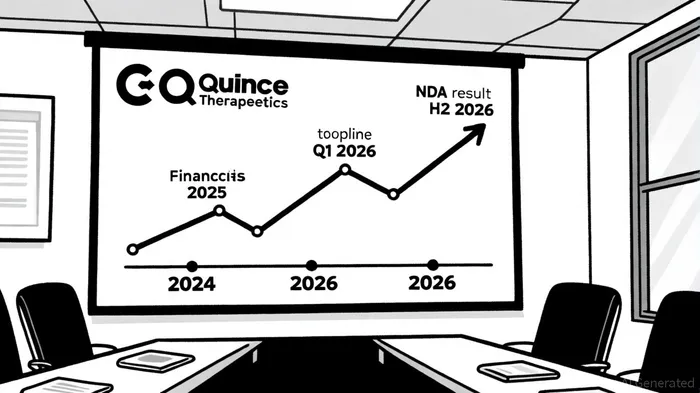





Comentarios
Aún no hay comentarios