
The Quiet Solar Powerhouse: Why Florida's Renewable Energy Surge Outpaces California
The U.S. clean energy landscape is undergoing a seismic shift. For decades, California stood as the gold standard for solar innovation, policy, and capacity. But in 2025, a new player emerged: Florida. The state not only surpassed California in utility-scale solar capacity but did so with a market-driven strategy that has redefined the economics and geopolitics of the energy transition. For investors, this shift marks a pivotal moment—Florida's solar surge offers a faster, more predictable growth path than traditional hubs, with profound implications for the U.S.'s global energy competitiveness.
Florida's Strategic Advantages: Geography, Policy, and Market Forces
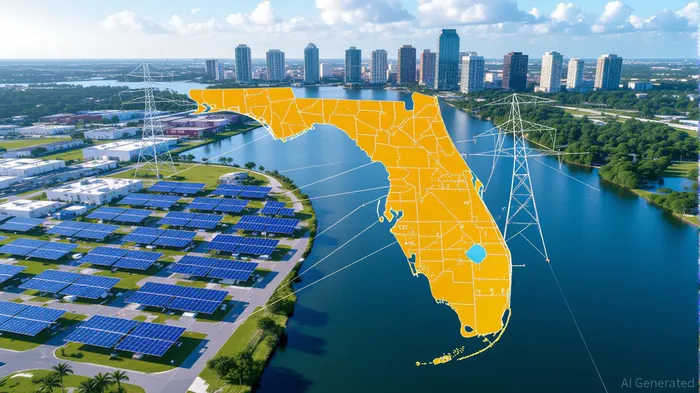
Florida's rise is no accident. The state's geographic endowment as the “Sunshine State” provides a natural head start: over 250 days of sunshine annually, paired with abundant land and a rapidly growing population. But geography alone does not explain Florida's 92% year-over-year increase in solar capacity in 2024. The state's policy environment and corporate demand have been equally critical.
Unlike California, where solar growth has been hampered by regulatory gridlock and high interest rates, Florida has streamlined permitting for projects under 75 megawatts and fostered a utility regulatory framework that prioritizes deployment speed. Florida Power & Light (FPL), the state's largest utility, has been a linchpin in this growth, accounting for 70% of 2024's additions and adding 2.7 gigawatts in Q1 2025 alone. FPL's aggressive expansion of energy storage—targeting 4 gigawatts by 2033—has further solidified Florida's resilience against intermittency, a challenge that has plagued even California's advanced grid.
Florida's corporate demand for decarbonization has also been a game-changer. Power purchase agreements (PPAs) with industries seeking stable, low-cost energy have enabled utility-scale projects to scale rapidly. This contrasts with California's slowdown in residential solar, where 2025's Q1 additions hit a five-year low. Florida's market-driven model, fueled by corporate PPA demand and a regulatory environment that minimizes deployment friction, has created a flywheel of growth that is difficult to replicate.
Geopolitical and Economic Repositioning
The implications of Florida's solar surge extend far beyond state borders. For the U.S., Florida's growth enhances energy independence and national security. By reducing reliance on fossil fuels and out-of-state energy sources, the state insulates its grid from geopolitical shocks—critical in an era of volatile global markets. This aligns with the broader U.S. strategy to diversify its energy mix, a priority underscored by the Inflation Reduction Act (IRA) and its tax credits for clean energy.
Florida's solar expansion also strengthens the U.S.'s global competitiveness in renewable energy. As the third-largest solar market in the U.S., Florida's 20 gigawatts of projected utility-scale capacity by 2030 will require $28.2 billion in investment, spanning transmission upgrades, battery storage, and grid modernization. This creates opportunities for engineering, procurement, and construction (EPC) firms, as well as component manufacturers. For example, the state's 13,261 megawatts of planned solar additions over the next five years could attract capital from firms seeking to capitalize on a market that combines scalability with regulatory certainty.
Challenges and Risks: Navigating Policy Uncertainty
Despite its momentum, Florida's solar sector faces headwinds. The federal One Big Beautiful Bill has accelerated the phase-out of solar tax credits and imposed stricter deadlines, potentially reducing rooftop solar installations by 42% over the next five years. While utility-scale projects remain less affected, grid constraints are emerging as a bottleneck. Utilities are now investing heavily in storage and smart infrastructure to manage intermittency, a trend that could drive up costs for smaller developers.
However, these challenges also present opportunities. The need for grid upgrades and storage solutions opens the door for innovation in energy management technologies. Investors with a long-term horizon can position themselves in firms that specialize in grid modernization or battery storage, sectors poised to benefit from Florida's rapid expansion.
Investment Opportunities: Where to Focus
For investors, Florida's solar boom offers three key avenues:
1. Utility-Scale Developers and EPC Firms: Companies like NextEra EnergyNEE--, which owns FPL, are central to the state's growth. Their ability to secure long-term PPAs and navigate regulatory frameworks makes them low-risk, high-reward plays.
2. Energy Storage and Grid Modernization: As Florida's solar capacity grows, so will demand for battery storage and smart grid technologies. Firms like Enphase EnergyENPH-- or Stem, Inc., which provide residential and commercial storage solutions, could see increased traction.
3. Component Manufacturers and Suppliers: The IRA's domestic content requirements have spurred investment in U.S. solar manufacturing. Florida's pipeline of projects will drive demand for panels, inverters, and other components, benefiting firms like First SolarFSLR-- or SunPower.
The Bigger Picture: A New Energy Frontier
Florida's solar story is more than a regional success—it's a blueprint for how the U.S. can accelerate its energy transition. By combining geographic advantages with market-driven innovation and regulatory efficiency, the state has outpaced even California, the longtime leader in clean energy. For investors, this shift represents a rare alignment of economic and geopolitical tailwinds.
While California's focus on technological innovation and storage will remain vital, Florida's rapid, scalable growth offers a clearer path for immediate returns. As the U.S. seeks to solidify its position in the global renewable energy race, Florida's solar surge is not just a trend—it's a turning point. Investors who recognize this early will find themselves at the forefront of a new energy frontier.





Comentarios
Aún no hay comentarios