
Questcorp's Union Project: A Gold Rush in the Making?
The mining sector has long been a playground for bold bets, and Questcorp Mining Inc. (QQCMF) is making a compelling case for why the La Union Gold and Silver Project in Sonora, Mexico, could be the next big story. With its maiden drill program advancing on track and on budget, the company has completed initial drilling at three of five key targets, each offering tantalizing clues about the project's potential. For investors, the question isn't just whether Questcorp can hit pay dirt—it's whether they're positioning themselves to redefine the Sonoran Gold Belt.
Strategic Drilling: Targeting History and Geology
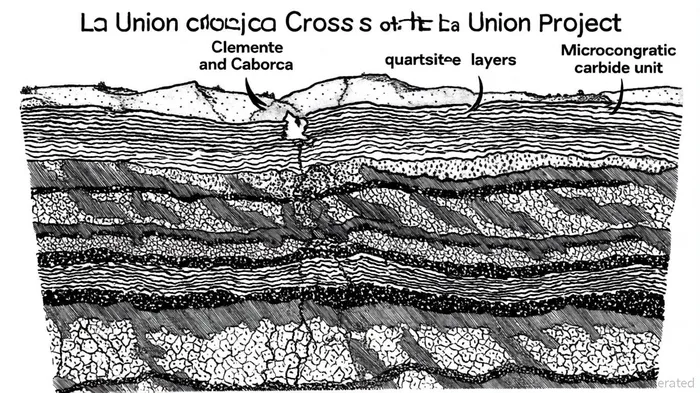
Questcorp's approach at the Union Project is a masterclass in leveraging historical data and geological intuition. The first drill hole at the Union Mine target was deliberately placed beneath historic workings, slicing through the Clemente and Caborca formations—two units that have historically hosted mineralization. This hole ended in the microconglomeratic carbonate unit, a layer that once supported high-grade gold and silver production[1]. By retesting these formations, Questcorp isn't just chasing ghosts; it's validating a model where past success could predict future finds.
The results so far? More quartzite than expected. Quartzite is a double-edged sword: it's tough to mine, but it's a red flag for fracture-controlled mineralization. The presence of hematitic oxides—a sign of oxidized sulfides from supergene weathering—further suggests that gold could be lurking in these fractures[2]. This aligns with historical mining patterns in the district, where oxide zones were exploited, leaving deeper sulfide targets untouched. Questcorp's drilling is now testing those unexplored depths, a move that could unlock a new chapter for the project.
Northward Expansion: El Cobre and North Union Mines
The company's northern push into the and North Union Mine areas has added another layer of intrigue. Drilling here intersected quartzite-rich zones with extensive hematitic oxides, reinforcing the hypothesis that gold mineralization is structurally controlled[3]. The holes were deliberately oriented perpendicular to stratigraphy, targeting interpreted feeder zones along fault structures. This isn't random poking—it's a calculated effort to map out the plumbing of the mineral system.
What's particularly exciting is the evolving geological model. The greater-than-expected quartzite content in the Clemente Formation is pointing toward fracture- and quartz-pyrite veinlet-hosted mineralization, a model that could guide future drilling with surgical precision[4]. For investors, this means Questcorp isn't just collecting core samples; it's building a blueprint for where the next big hit might be.
Famosa: The Sleeping Giant
With the Union Mine and northern targets showing promise, the company has shifted focus to the , a historically productive area with reported gold grades exceeding [5]. This is no minor footnote: grades of that magnitude in archived records suggest Famosa once operated as a high-grade satellite to the main Union Mine. Now, Questcorp is testing beneath and along strike from historic workings, aiming to intersect steeply west-dipping fault structures that could host sulfide zones[6].
The strategic significance here can't be overstated. If Famosa delivers even a fraction of its historical potential, it could transform the Union Project from a regional player into a district-scale operation. And with Questcorp planning to integrate assay results with induced polarization (IP) surveys and refined geological models, the company is setting itself up for a data-driven expansion phase[7].
Risks and Rewards: A High-Stakes Game
Of course, this isn't a sure thing. Drilling is inherently speculative, and the absence of final assay results means much of the current optimism is based on geological inference. However, Questcorp has mitigated some risks by working under the oversight of R. , P. Geo (BC), a Qualified Person who has approved the technical content of their updates[8]. This adds a layer of credibility, ensuring the company's claims aren't just hype.
Moreover, the project's location in the —a region with a long history of gold and silver production—provides a geological and logistical tailwind. The belt's carbonate replacement deposit (CRD) model, which includes polymetallic veins and shear zones, has a proven track record of hosting large deposits[9]. If Questcorp's drilling aligns with this model, the implications could be transformative.
The Bottom Line: A Bet on Geology and Execution
For investors, the key takeaway is that Questcorp isn't just drilling—it's methodically testing a hypothesis that combines historical data, geological logic, and modern exploration techniques. The company's ability to integrate assay results, surface programs, and geophysical surveys will be critical in the coming months[10]. If the Famosa target delivers, and if the quartzite-hosted models hold up, the Union Project could evolve from a speculative exploration play into a near-term resource with meaningful scale.
This is a high-risk, high-reward scenario, but in the world of junior miners, that's the name of the game. Questcorp has laid out a clear path: validate historical models, expand into new targets, and leverage geophysics to refine its focus. If the next set of results matches the geological promise, the market may look back on this phase of drilling as the moment the Union Project's potential began to crystallize.







Comentarios
Aún no hay comentarios