
QuantumScape's Strategic Partnership With Murata Manufacturing: A Catalyst for Solid-State Battery Commercialization and Shareholder Value
The race to commercialize solid-state batteries has entered a critical phase, with QuantumScapeQS-- (QS) emerging as a front-runner through its strategic alliance with Murata Manufacturing, a global leader in ceramic technology. This partnership, formalized in October 2025, marks a pivotal step toward scaling production of QuantumScape's proprietary ceramic separators-a cornerstone of its solid-state battery design-and has significant implications for the company's commercialization timeline, cost structure, and long-term shareholder value.
A Strategic Alliance for Scalability
QuantumScape's collaboration with Murata builds on months of technical alignment, beginning in February 2025, when the two companies confirmed Murata's expertise in ceramic material formulation, sheet forming, and firing could address key bottlenecks in scaling production, according to Murata's announcement. Murata's global capabilities in ceramics manufacturing are now being leveraged to develop a high-volume production process for QuantumScape's separators, a critical component that enables the stability and safety of solid-state batteries, as described in a GuruFocus article. This partnership is not merely a technical collaboration but a strategic move to establish a robust global supply chain, as QuantumScape CEO Siva Sivaram described it to CoinCentral.
The joint development agreement also includes exploring a business model for commercialization, signaling QuantumScape's intent to transition from R&D to mass production. Murata's President, Norio Nakajima, underscored the partnership's potential to "advance the production of solid-state batteries for electric vehicles," aligning with QuantumScape's broader vision to disrupt the EV market.
Market Dynamics and Competitive Positioning
The solid-state battery market is projected to grow at a compound annual growth rate (CAGR) of 36.4% from 2024 to 2032, driven by demand for higher energy density and faster-charging solutions, according to a TS2 analysis. QuantumScape's QSE-5 batteries, with an energy density exceeding 800 Wh/L and the ability to charge from 10% to 80% in under 15 minutes, position the company to capture a significant share of this expanding market. A recent demonstration of its technology in a Ducati electric motorcycle prototype-showcasing 844 Wh/L energy density and 12-minute charging-further validated its competitive edge (reported in Murata's announcement and industry coverage).
However, QuantumScape faces stiff competition. Industry giants like Toyota and Nissan are targeting commercialization by 2027–2029, while startups such as Solid Power and SES are advancing prototypes. Despite this, QuantumScape's partnerships with Corning Inc. and Murata have bolstered its credibility, with analysts noting that "each collaboration adds a layer of industrial validation."
Financial Implications and Shareholder Value
QuantumScape's stock has surged by approximately 170% in 2025, closing at $15.92 on October 3, 2025, near a 52-week high (as reported in Murata's announcement). This rally reflects investor optimism about the company's technological milestones and strategic alliances. However, skepticism persists. Most analysts maintain "Sell" or "Hold" ratings, citing concerns over QuantumScape's lack of product revenue and execution risks. The company's market cap of over $9 billion hinges on its ability to deliver scalable, cost-competitive batteries by 2025.
The partnership with Murata is expected to address production cost challenges. By leveraging Murata's expertise, QuantumScape aims to reduce unit costs through economies of scale, a critical factor in achieving profitability. Analysts note that "cost reduction in ceramic separators could be the linchpin for commercial viability," as these components currently represent a significant portion of total battery costs.
Risks and the Road Ahead
While the partnership with Murata accelerates QuantumScape's commercialization timeline, challenges remain. The company has yet to generate revenue from its battery technology, and its financials-marked by a negative EPS of -0.86-highlight operational risks. Additionally, competitors like Toyota are advancing parallel strategies, including in-house production capabilities.
Nevertheless, QuantumScape's ability to secure partnerships with industry leaders and demonstrate real-world applications (e.g., the Ducati prototype) suggests a growing ecosystem of support. Institutional investors, including the Teacher Retirement System of Texas, have recently acquired shares, signaling cautious confidence.
Conclusion
QuantumScape's alliance with Murata Manufacturing represents a transformative step in the commercialization of solid-state batteries. By addressing scalability and cost barriers, the partnership enhances the likelihood of meeting 2025 production targets and capturing a leadership position in the EV battery market. For shareholders, the key will be monitoring progress on cost reduction, production timelines, and revenue generation. While risks persist, the strategic alignment with Murata-and the broader industry shift toward solid-state technology-positions QuantumScape as a compelling, albeit high-risk, long-term investment.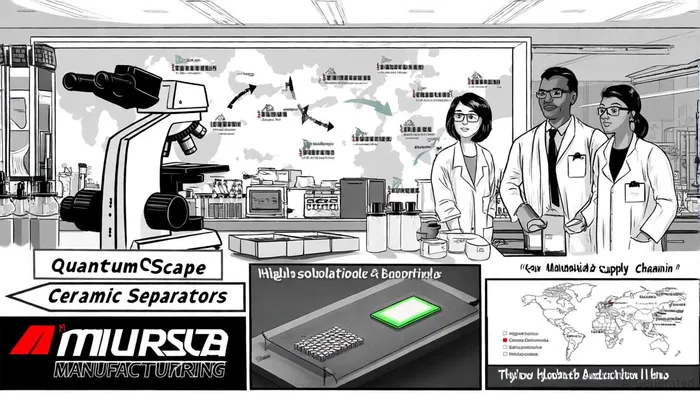





Comentarios
Aún no hay comentarios