
QuantumScape Insider Selling: A Sign of Caution or a Misread Red Flag?
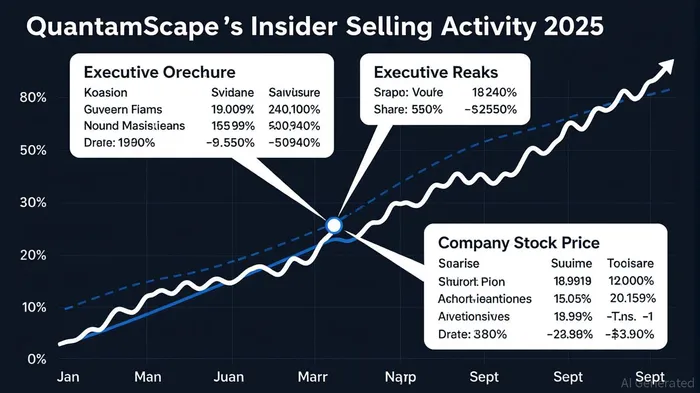
QuantumScape’s 2025 insider selling activity has sparked intense debate among investors and analysts. Over the past six months, key executives and directors—including Chief Technology Officer Timothy Holme, Chief Development Officer Mohit Singh, and Director Fritz Prinz—have offloaded millions of dollars’ worth of shares under structured Rule 10b5-1 trading plans. While proponents argue these transactions reflect prudent financial planning and adherence to corporate governance standards, skeptics view them as a troubling signal of waning confidence in the company’s long-term prospects.
Corporate Governance: Structured Compliance or Passive Indifference?
QuantumScape’s insider transactions are governed by Rule 10b5-1 trading plans, which require pre-established, non-discretionary schedules for buying or selling shares. These plans are designed to insulate insiders from accusations of market timing based on material nonpublic information. For instance, Timothy Holme executed two major sales in late September 2025—selling 176,352 Class A shares at $7.5486 and 23,244 shares at $9.627—under a plan adopted on June 5, 2025 [1]. Similarly, Director Fritz Prinz sold 1,000,000 Class A shares on July 25 at $11.6175, while retaining substantial Class B shares with voting rights [2].
The company’s DEF 14A proxy statement further underscores its commitment to transparency, stating that its Insider Trading Policy “promotes compliance with insider trading laws and ethical standards” [3]. By disclosing weighted-average prices, conversion mechanics, and retained ownership levels in SEC filings, QuantumScapeQS-- appears to meet regulatory requirements. However, critics argue that structured selling does not inherently guarantee confidence in the company’s fundamentals. As one analyst noted, “Rule 10b5-1 plans are a legal safeguard, but they don’t preclude executives from selling because they believe the stock is overvalued” [4].
Investor Sentiment: Market Reactions and Valuation Concerns
The timing of QuantumScape’s insider sales has amplified investor skepticism. For example, Holme’s September 4 transactions coincided with a post-earnings stock price drop of 7.03% in after-hours trading, despite a slight EPS beat [1]. Meanwhile, Mohit Singh’s August sales—intended to cover tax obligations on RSUs—occurred amid a broader rally in the stock, which trades at a forward price-to-sales ratio exceeding 100, far above peers like TeslaTSLA-- or Panasonic [5].
According to a report by TechI, these sales have been interpreted as a “negative signal,” particularly given the lack of corresponding share repurchases by insiders [5]. The report highlights that Director Fritz Prinz reduced his ownership by over 85% in 2025, while Singh sold 465,000 shares in early July. Such activity, the report argues, “raises questions about the sustainability of QuantumScape’s valuation amid ongoing R&D costs and competitive pressures.”
Yet, not all interpretations are uniformly negative. The company’s recent partnership extension with Volkswagen’s PowerCo and its improved cash runway through 2029 provide a counter-narrative of strategic optimism [5]. Additionally, Holme and Prinz retain significant indirect ownership through trusts and unvested RSUs, suggesting continued alignment with long-term shareholder interests [1].
A Balancing Act: Caution vs. Red Flag
The debate ultimately hinges on context. Structured insider selling is a common practice in public companies, particularly for executives managing personal wealth or tax liabilities. QuantumScape’s adherence to Rule 10b5-1 plans and transparent disclosures supports the argument that these transactions are routine and compliant. However, the sheer volume of sales—spanning multiple executives and directors—coupled with a high valuation and mixed financial results, creates a narrative of caution.
Investors must weigh these factors against the company’s technological progress and strategic partnerships. While QuantumScape’s solid-state battery technology remains a compelling long-term bet, the market’s sensitivity to insider sentiment underscores the fragility of its current valuation. As one market commentator observed, “Insider selling isn’t inherently bearish, but when it occurs without a clear rationale or offsetting confidence signals, it becomes a red flag worth investigating” [5].
Conclusion
QuantumScape’s insider selling in 2025 reflects a complex interplay of corporate governance, personal finance, and market psychology. While the company’s structured approach to compliance mitigates some concerns, the lack of insider buying and the timing of sales during a valuation peak warrant scrutiny. For investors, the key takeaway is to view these transactions not in isolation but as part of a broader assessment of the company’s fundamentals, competitive landscape, and long-term execution risks.
Source:
[1] [Form 4] QuantumScape CorporationQS-- Insider Trading Activity [https://www.stocktitan.net/sec-filings/QS/form-4-quantum-scape-corporation-insider-trading-activity-0aa75d0a27a8.html]
[2] [Form 4] QuantumScape Corporation Insider Trading Activity [https://www.stocktitan.net/sec-filings/QS/form-4-quantum-scape-corporation-insider-trading-activity-7c8667f2543b.html]
[3] QS DEF 14A & SEC Filings [https://ca.finance.yahoo.com/sec-filing/QS/0000950170-25-058125_1811414/]
[4] QuantumScape Stock Faces Insider Selling & Valuation Risks [https://www.techi.com/quantumscape-stock-insider-selling-valuation-risk/]
[5] QuantumScape Shares Drop: What Next? [https://stockstotrade.com/news/quantumscape-corporation-qs-news-2025_07_30/]







Comentarios
Aún no hay comentarios