
Quantum Winter: Preparing Your Crypto Portfolio for the Post-Quantum Era
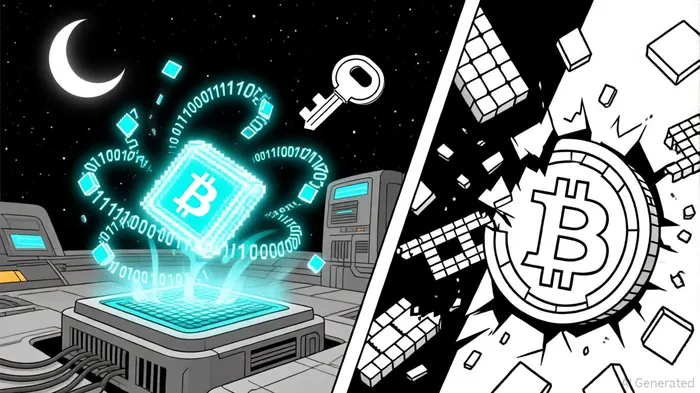
The crypto world is facing a silent existential threat: quantum computing. While Bitcoin's cryptographic foundations—Elliptic Curve Digital Signature Algorithm (ECDSA) and SHA-256—have long been considered unbreakable, quantum algorithms like Shor's and Grover's could render them obsolete within a decade. For investors, this isn't just a theoretical risk—it's a ticking clock demanding proactive portfolio adaptation.
The Quantum Threat to Bitcoin: A Timed Countdown
Bitcoin's security relies on ECDSA for key generation and SHA-256 for hashing. A sufficiently powerful quantum computer could use Shor's algorithm to derive private keys from public keys in polynomial time, enabling mass theft of funds [1]. Grover's algorithm, meanwhile, could reduce SHA-256's 256-bit security to 128 bits, though this remains computationally prohibitive for now [2].
The timeline for this threat is contentious. A 2025 report by Analytics Insight estimates a 25% chance of a full-scale quantum attack within 5–10 years, with a 75% probability by 2040 [3]. The “harvest now, decrypt later” strategy—where adversaries store public keys for future decryption—poses an immediate risk, particularly for legacy wallets with exposed keys (e.g., Satoshi's 1 million BTC) [4].
Post-Quantum Cryptography: The New Frontier
Post-quantum cryptography (PQC) offers a lifeline. The U.S. National Institute of Standards and Technology (NIST) has standardized algorithms like CRYSTALS-Dilithium (lattice-based) and SPHINCS+ (hash-based) to replace vulnerable systems [5]. However, integrating PQC into Bitcoin's protocol is no small feat. Larger key sizes and slower transaction verification times could strain the network, requiring a hard fork and global consensus [6].
Ethereum, meanwhile, is ahead of the curve. The EthereumETH-- Foundation has allocated $32.6 million to quantum-resistant upgrades, including zero-knowledge (ZK) protocols and STARKs, which are inherently quantum-resistant [7]. This underscores a critical lesson: adaptability, not just security, will define the next era of crypto.
Quantum-Resistant Cryptocurrencies: A New Asset Class Emerges
For investors, the solution isn't waiting for BitcoinBTC-- to upgrade—it's diversifying into quantum-resistant (QR) cryptocurrencies. These projects are already implementing PQC to future-proof their networks:
- Quantum Resistant Ledger (QRL): Uses XMSS (eXtended Merkle Signature Scheme) to secure transactions. QRL's market cap of $45.93M and price of $0.6762 reflect growing institutional interest [8].
- Algorand: Integrates NIST-approved FALCON (Fast Practical Signature Algorithm) for quantum-safe signatures. Its $1.2B market cap highlights mainstream adoption [9].
- Hedera Hashgraph: Employs SHA-384, a hash-based algorithm resistant to quantum attacks. Its $1.8B market cap underscores confidence in its security model [10].
- Nervos (CKB): Combines Proof-of-Work with PQC to secure its layer-1 infrastructure. At $0.01284, CKBCKB-- offers a low-cost entry point for risk-tolerant investors [11].
Strategic Adaptation: Beyond Asset Selection
Proactive adaptation requires more than picking QR coins. Investors should:
- Migrate to quantum-resistant addresses: Use QR wallets like QRL or IOTAIOTA-- to store legacy BTC/ETH.
- Monitor PQC adoption: Track projects integrating NIST-approved algorithms (e.g., Ethereum's STARKs, Algorand's FALCON).
- Diversify across PQC technologies: Lattice-based (Dilithium), hash-based (SPHINCS+), and code-based (McEliece) algorithms each offer unique trade-offs.
Institutional players are already moving. SEALSQLAES-- Corp's $30M cryptocurrency fund, for instance, includes QAIT, HederaHBAR--, and Bitcoin, hedging against quantum risks while retaining exposure to legacy assets [12].
The Bottom Line: Quantum Winter Is Coming
Quantum computing isn't a distant sci-fi threat—it's a $1.2 trillion global R&D effort with real-world implications for crypto. While Bitcoin's 10–20 year timeline offers breathing room, the “harvest now” risk demands urgency. Investors who ignore PQC today may find their portfolios obsolete tomorrow.
The path forward is clear: diversify into quantum-resistant assets, advocate for PQC adoption, and embrace crypto-agility. As the saying goes in the quantum age: “The best time to plant a tree was 20 years ago. The second-best time is now.”






Comentarios
Aún no hay comentarios