
Quantum Risks and Bitcoin Security: Is Now the Time to Act?
The Quantum Threat: A Looming Cryptographic Crisis
Bitcoin's security relies on elliptic curve digital signature algorithms (ECDSA), which are vulnerable to Shor's algorithm-a quantum method capable of breaking public-key cryptography in polynomial time, according to Post-Quantum. This means a sufficiently powerful quantum computer could derive private keys from public keys, enabling theft of funds and undermining trust in the network. While Grover's algorithm poses a less immediate threat to Bitcoin's SHA-256 hashing, it still reduces the effective security of symmetric encryption, necessitating proactive measures, as Post-Quantum notes.
The "harvest now, decrypt later" strategy further amplifies the risk. Attackers could already be storing Bitcoin transaction data, waiting to exploit quantum breakthroughs to reverse engineer private keys, as Deloitte notes. This underscores the need for quantum-resistant upgrades not as a hypothetical exercise, but as a race against time.
Willy Woo's SegWit 7-Year Strategy: A Stopgap, Not a Solution
Willy WooWOO-- has proposed a 7-year strategy to mitigate quantum risks by encouraging Bitcoin holders to store funds in SegWit (Segregated Witness) addresses. These addresses hide a user's public key until a transaction is broadcasted, offering temporary protection, according to Bitdegree. While this approach buys time, it is not foolproof. Critics like Jonas Schnelli argue that public keys are still exposed in the mempool during transactions, leaving funds vulnerable, as Yahoo Finance reports.
Woo's strategy reflects a pragmatic, incremental approach-prioritizing immediate action while acknowledging the need for longer-term solutions. However, it also highlights the tension within the Bitcoin community: should the network adopt a "wait and see" stance, or prioritize a hard fork to quantum-resistant algorithms like ML-DSA (Module-Lattice Digital Signature Algorithm) sooner, as Yahoo Finance suggests?
Investment Implications: Preparing for the 2030 Deadline
For investors, the transition to quantum-safe cryptography is both a risk and an opportunity. Deloitte's scenario analysis warns that businesses unprepared for quantum threats could face competitive disadvantages, particularly if quantum computing scales faster than expected, as Deloitte notes. By 2030, institutions that have adopted hybrid cryptographic systems-combining classical and post-quantum algorithms-will likely dominate the market, according to Deloitte.
Retail investors should prioritize holding Bitcoin in quantum-safe addresses or diversified portfolios that include quantum-resistant assets. Meanwhile, institutional players must engage with protocol upgrades and allocate resources to cryptographic agility. The cost of transition is non-trivial: estimates suggest organizations may need to allocate 2.5% to 5% of annual IT budgets for post-quantum upgrades, as BCG notes.
The Roadmap to Quantum Safety: BTQ's Aggressive Timeline
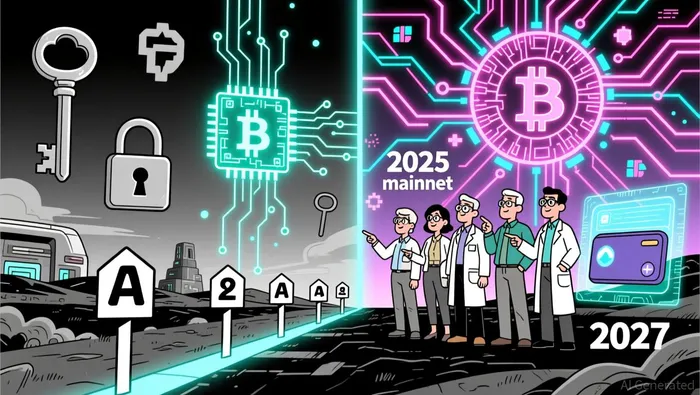
The BTQ Foundation has outlined an aggressive roadmap to quantum-safe Bitcoin, including a testnet launch in Q4 2025, enterprise pilot programs in Q1 2026, and a mainnet rollout by Q2 2026, as Morningstar reports. This timeline aligns with NIST's post-quantum cryptography standards and aims to integrate quantum-resistant signatures (e.g., ML-DSA) into the Bitcoin transaction lifecycle, as Morningstar notes.
However, community consensus remains fragmented. While A16z estimates $750 billion of Bitcoin is currently in quantum-vulnerable addresses, as Yahoo Finance reports, figures like MicroStrategy's Michael Saylor argue the threat is decades away, as Yahoo Finance reports. This divergence underscores the need for a coordinated, protocol-level upgrade by 2026 to avoid last-minute panic.
Conclusion: The Countdown Has Begun
The quantum threat to Bitcoin is not a distant hypothetical but a strategic imperative. Whether through SegWit stopgaps, hybrid cryptographic systems, or full-scale post-quantum upgrades, the Bitcoin ecosystem must act decisively. For investors, the message is clear: prepare now, or risk being left behind in a post-quantum world. As the countdown to 2030 accelerates, the question is no longer if to act-but how to act.






Comentarios
Aún no hay comentarios