
Quantum-Resistant Cryptography and Zero-Knowledge Proofs: Early Retail Access as a Strategic Inflection Point
The blockchain and cybersecurity landscapes are undergoing a seismic shift, driven by two transformative technologies: Zero-Knowledge Proofs (ZKP) and quantum-resistant cryptography. While these innovations have long been the domain of institutional players and enterprise-grade applications, a critical development is reshaping the narrative-early retail access is emerging as a strategic inflection point for ZKP adoption and quantum readiness. This shift notNOT-- only democratizes participation but also positions retail investors to capitalize on a future where privacy, scalability, and quantum resilience converge.
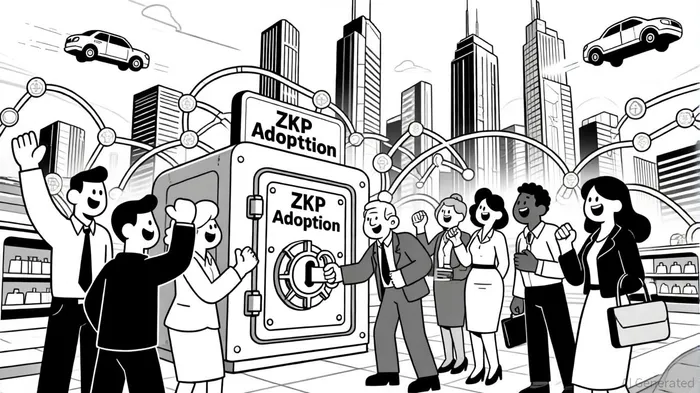
ZKP Adoption: Retail-First, Enterprise-Ready
Zero-Knowledge Proofs, a cryptographic protocol enabling privacy-preserving verification, have traditionally been adopted by institutions due to their complexity and high barriers to entry. However, the recent launch of a ZKP-based project's retail-first whitelist has flipped this script. For the first time, everyday investors are securing entry at ground-level pricing before institutional demand accelerates valuation, according to Tekedia. This approach fosters a distributed user base, enhancing network resilience and aligning retail participants with governance decisions before large-scale corporate integration, as CoinCentral reports.
ZKP's appeal lies in its dual utility: it addresses privacy paradoxes in public blockchains while meeting institutional demands for compliance and scalability. Features like zk-rollups, zero-knowledge KYC, and modular upgrades make it a viable infrastructure solution for finance, healthcare, and supply chains, as LiveBitcoin News notes. Notably, ZKP integrates post-quantum cryptographic techniques, ensuring its security against future quantum computing threats-a critical advantage as quantum advancements accelerate, as explained by Techopedia.
Quantum-Resistant Cryptography: A Market in Hypergrowth
The quantum-resistant cryptography market is surging, driven by the urgent need to counter quantum computing's threat to traditional encryption. By 2030, the market is projected to grow at a 38.3% CAGR, reaching USD 4.6 billion, with BFSI leading adoption due to its 35% market share, according to Grand View Research. Institutions like JPMorgan Chase are already testing quantum key distribution (QKD) systems, while governments-led by the U.S. National Institute of Standards and Technology (NIST)-are standardizing post-quantum algorithms like ML-KEM and SLH-DSA, as reported by Business Research Insights.
Despite this momentum, challenges persist. High implementation costs and integration complexity hinder SMEs, while a shortage of skilled professionals slows adoption. However, the rise of hybrid cryptographic frameworks and AI-driven quantum security solutions is bridging these gaps, with the post-quantum cryptography market alone expected to grow from USD 0.4 billion in 2024 to USD 1.2 billion by 2033, per Global Growth Insights.
Strategic Synergy: ZKP as a Quantum-Ready Infrastructure
The integration of quantum-resistant cryptography into ZKP projects is not accidental-it's a strategic imperative. ZKP's architecture inherently supports lattice-based algorithms and hash-based signatures, aligning with NIST's post-quantum standards, as noted by Forbes. This makes ZKP a dual-purpose asset: a privacy-centric infrastructure for individuals and a quantum-ready solution for enterprises. For example, ZKP's confidential DeFi platforms and private smart contracts are already being tested in sectors requiring both regulatory compliance and data secrecy, according to Rapid Innovation.
Retail investors who secure early access to ZKP projects are not just buying tokens-they're participating in a network poised to become the backbone of a quantum-secure future. This is particularly significant given that 78% of organizations now prioritize post-quantum solutions, according to Meegle, and ZKP's early adopters will have first-mover advantage in shaping governance and use-case development.
Investment Implications: A Retail-Driven Paradigm Shift
The convergence of ZKP adoption and quantum readiness creates a unique investment opportunity. Early retail access allows individuals to:
1. Secure entry-level pricing before institutional demand inflates valuations.
2. Influence governance in a network designed for enterprise-grade applications.
3. Hedge against quantum risks by investing in infrastructure that is inherently future-proof.
This paradigm shift is rare in blockchain history. Traditionally, institutional players have dominated early allocations, leaving retail investors to chase speculative gains. ZKP's retail-first approach flips this dynamic, creating a community-driven ecosystem that strengthens the network before institutional integration, according to MEXC. For investors, this means aligning with a project that balances speculative potential with real-world utility-a combination that is increasingly scarce in the crypto space.
Conclusion
The early retail access to ZKP and quantum-resistant cryptography marks a pivotal moment in the evolution of blockchain and cybersecurity. By democratizing participation in a privacy-centric, quantum-ready infrastructure, retail investors are not only securing financial upside but also contributing to a more resilient and inclusive technological future. As institutions and governments race to adopt these innovations, the first-mover advantage of retail participants in ZKP projects will become a defining narrative of the next decade.







Comentarios
Aún no hay comentarios