
Quantum Frequency Conversion: The Catalyst for Quantum Internet Commercialization
The quantum revolution is no longer confined to theoretical physics labs. As the global quantum technology market hurtles toward a projected value of $99.34 billion by 2035[1], one technology stands out as a linchpin for real-world integration: quantum frequency conversion (QFC). By enabling the transmission of quantum information over existing fiber optic networks, QFC is bridging the gap between experimental quantum systems and scalable, commercial quantum internet infrastructure. This breakthrough, driven by companies like IonQIONQ--, RigettiRGTI--, and Qunnect, is redefining the timeline for quantum networking and reshaping the investment landscape.
The Technical Breakthrough: From Lab to Fiber
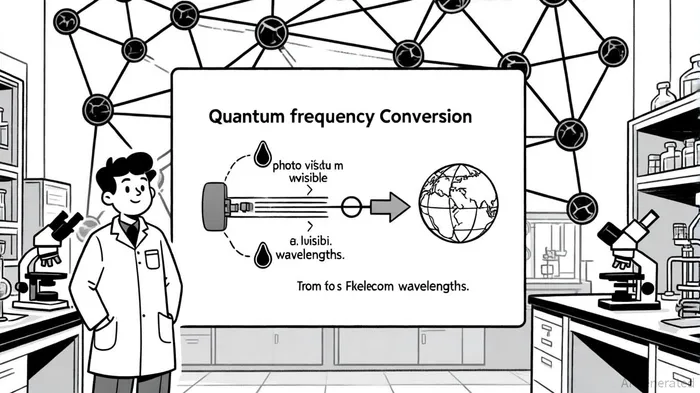
Quantum frequency conversion addresses a critical challenge: most quantum computing systems operate at visible or ultraviolet wavelengths, which are incompatible with the telecom wavelengths (e.g., 1,550 nm) used in global fiber networks. In 2025, IonQ demonstrated a proof-of-concept system that converts quantum information from trapped-ion systems into telecom wavelengths, enabling long-distance transmission[2]. This achievement, developed in collaboration with the Air Force Research Lab (AFRL), marks a pivotal step toward distributed quantum computing and secure communication. By leveraging existing infrastructure, quantum networks can avoid the exorbitant costs of building new systems, accelerating adoption.
Similarly, Rigetti and QphoX secured a $5.8 million AFRL contract to advance superconducting quantum networking, focusing on converting microwave signals into optical photons[4]. These efforts underscore a broader industry shift: quantum systems are no longer isolated islands but nodes in a connected ecosystem.
Market Dynamics: A $72 Billion Opportunity by 2035
The commercialization of QFC is part of a larger quantum technology boom. According to the QED-C 2025 State of the Global Quantum Industry Report, the quantum computing market alone is forecasted to grow from $1.07 billion in 2024 to up to $72 billion by 2035[3]. This exponential growth is fueled by private and public investments, with Q1 2025 alone seeing over $1.25 billion in quantum tech funding[4].
The competitive landscape is intensifying. Over 50% of quantum computing firms now rely on standardized hardware and control platforms, signaling a maturing ecosystem[4]. IonQ's strategic acquisitions of Oxford Ionics and ID Quantique, for instance, position it as a leader in both computing and quantum-safe security[4]. Meanwhile, companies like PsiQuantum and Quantinuum dominate venture funding, capturing 50% of 2024 investments[5]. This consolidation reflects the high capital intensity of quantum R&D and the race to commercialize fault-tolerant systems by the late 2020s[5].
Real-World Pilots: From Berlin to New York
Quantum frequency conversion is not just a theoretical enabler—it is already being deployed in pilot projects. Deutsche Telekom and Qunnect demonstrated high-fidelity entanglement distribution over 30 kilometers of commercial fiber, maintaining 99% fidelity for 17 days[5]. This experiment, conducted at T-Labs in Berlin, validates the feasibility of quantum key distribution (QKD) for ultra-secure communications.
In the U.S., Qunnect is deploying quantum networking equipment in New York, supported by the Department of Energy, to leverage entangled photons for secure infrastructure[6]. These projects highlight how QFC is transforming quantum internet from a scientific curiosity into a strategic asset for telecom giants and governments alike.
The Road Ahead: Challenges and Opportunities
While the trajectory is promising, hurdles remain. NVIDIA's CEO recently cautioned that full quantum commercialization may take over 20 years[5], emphasizing the need for sustained investment in error correction and modular architectures. However, early applications—such as quantum-secure financial transactions and distributed optimization—could emerge as early as 2030[4].
For investors, the key lies in identifying firms that combine technical leadership with strategic partnerships. IonQ's roadmap to 2 million qubits by 2030[1], coupled with its QFC breakthroughs, positions it as a prime candidate. Similarly, startups like QuEra and Quantum Machines, which raised $230 million and $170 million respectively in Q1 2025[4], exemplify the sector's innovation-driven growth.
Conclusion
Quantum frequency conversion is the unsung hero of the quantum internet. By aligning quantum systems with existing telecom infrastructure, it reduces costs, accelerates deployment, and unlocks new applications in security, finance, and logistics. As the market grows at a compound annual rate of 36–48%[5], investors who prioritize QFC-enabled platforms will be well-positioned to capitalize on the next frontier of digital transformation.





Comentarios
Aún no hay comentarios