
Quantum Corp (QMCO): Can a Restructuring Strategy Salvage a Deteriorating Financial Outlook in a High-Pressure Market?
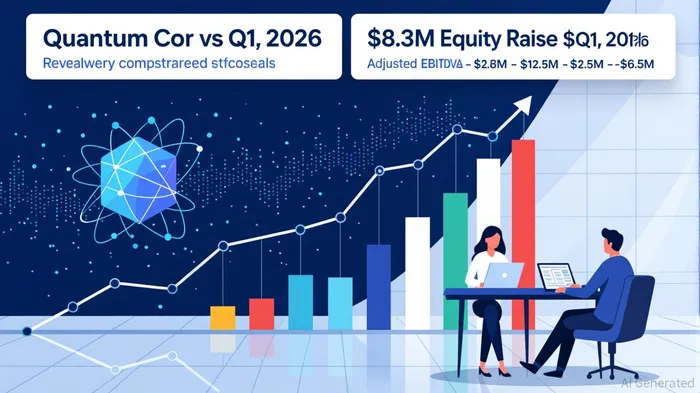
Quantum Corp (QMCO) is facing a stark reality: its Q1 2026 earnings report revealed a 11.1% year-over-year revenue decline to $64.3 million and a widening adjusted EBITDA loss of $6.5 million, compared to -$2.2 million in Q1 2025 [1]. These numbers, coupled with a recent $83 million equity raise that diluted existing shareholders, raise urgent questions about the company's ability to navigate a fiercely competitive market. Yet, amid the red flags, there are glimmers of hope—namely, a strengthened cash position, strategic leadership changes, and a broader industry tailwind in quantumQMCO-- technology. This analysis weighs the risks and opportunities to determine whether QMCOQMCO-- can recover in a high-pressure environment.
A Financial Freefall, But Not All Is Lost
Quantum's Q1 2026 results underscore a deteriorating financial position. Revenue fell to $64.3 million from $72.3 million in the prior-year period, while adjusted EBITDA swung to a $6.5 million deficit [1]. The company's cash reserves, however, rose to $37.5 million from $17.5 million, driven by the equity raise under a standby purchase agreement [1]. This lifeline, while critical, comes at a cost: dilution of existing shareholders' stakes, which could erode long-term value.
The company's guidance for Q2 2026—$61 million in revenue and near-breakeven adjusted EBITDA—suggests a challenging path to profitability [1]. Yet, management's emphasis on cost-cutting and restructuring, led by newly appointed CEO Hugues Meyrath, signals a pivot toward operational discipline. Meyrath, a storage industry veteran, has a track record of streamlining operations, which could stabilize the business in the short term [2].
Strategic Moves in a Crowded Quantum Market
Quantum's core challenge lies in its competitive environment. The company faces giants like NetAppNTAP--, Pure StoragePSTG--, and hyperscalers (AWS, Azure, Google Cloud) that dominate data management and cloud infrastructure [3]. Meanwhile, in the quantum computing niche, rivals such as IBMIBM--, MicrosoftMSFT--, and IonQIONQ-- are racing to commercialize scalable solutions [4].
Despite these headwinds, Quantum has made strides in positioning itself for long-term growth. The company's recent debt restructuring—selling its $51 million term debt to Dialectic Capital—provides financial flexibility to invest in AI-driven data management solutions [5]. Additionally, Quantum's focus on building a “quantum ecosystem” (hardware, software, and applications) aligns with the industry's trajectory toward integrated systems [6].
The quantum sensors market, a key segment for Quantum, is projected to grow at a 5.1% CAGR through 2030, reaching $673.1 million [7]. This growth is fueled by demand in sectors like healthcare and cybersecurity, where Quantum's expertise in cryptography and sensing could carve out a niche.
Risks and Opportunities: A Tug-of-War
The immediate risks are clear. Quantum's reliance on equity financing to fund operations raises concerns about sustainability. The $83 million raise in Q1 2026, while necessary, highlights a lack of organic cash flow and exposes the company to further dilution. Moreover, the chemical and energy industries—key markets for Quantum—are shifting toward sustainability and digitalization, requiring significant R&D investment [8].
On the flip side, the quantum technology market is on a trajectory to reach $97 billion by 2035, driven by government and private sector investments [9]. Quantum's partnerships with institutions like the Japanese Research Informatics Institute and a European retailer demonstrate its ability to secure high-value contracts [5]. These deals could serve as proof points for its AI and data management capabilities, which are increasingly critical in an era of exponential data growth.
Verdict: A High-Risk, High-Reward Proposition
Quantum Corp's Q1 2026 results paint a bleak picture, but the company's strategic initiatives and market tailwinds suggest a path to recovery. The key question is whether Meyrath's restructuring efforts can reverse the revenue decline and turn adjusted EBITDA positive within the next 12–18 months. If the company can leverage its quantum expertise to capture a niche in AI-driven data management or post-quantum cryptography, it may yet justify its current valuation.
However, investors should proceed with caution. The equity dilution, competitive pressures, and technical hurdles in scaling quantum systems remain significant headwinds. For now, QMCO appears to be a speculative bet—a company with a compelling long-term vision but a fragile near-term financial foundation.
Historical data on QMCO's earnings events from 2022 to 2025 reveals mixed signals for investors. While short-term price action (1–5 trading days) around earnings releases showed no statistically significant edge, a pronounced positive drift emerged from day 7 onward, with several windows (day-7, day-8, day-23, day-25–30) registering statistically significant excess returns over the benchmark. The median best-holding horizon for gains lies between 7–10 trading days post-announcement, though large positive moves extended to ~30 days. Notably, the win rate for earnings events hovered around 45%, suggesting a “few big winners” distribution rather than consistent outperformance.







Comentarios
Aún no hay comentarios