
Quantum Computing's Valuation Bubble: A 2026 Crash Looms as Hype Outpaces Reality
The quantum computing sector has become one of the most hyped investment opportunities of the 2020s, with valuations soaring to stratospheric levels despite minimal revenue and unproven commercial viability. As 2025 draws to a close, the industry's rapid growth-driven by speculative fervor and aggressive venture capital infusions-has raised urgent questions about sustainability. With market capitalizations of firms like IonQIONQ-- ($24.5 billion) and Quantinuum ($10 billion) dwarfing their actual earnings, the parallels to the dot-com bubble are impossible to ignore.
The Hype vs. the Hard Numbers
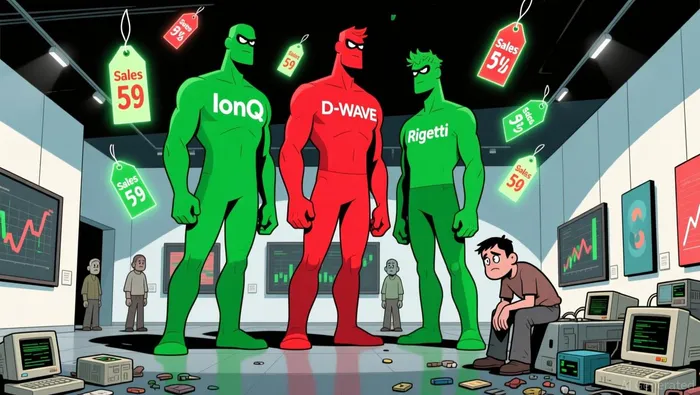
Quantum computing firms have attracted over $2 billion in venture capital in 2024 alone, with 2025 seeing a 50% year-over-year increase in funding. Public companies like IonQ and Quantum Computing Inc.QUBT-- (QUBT) have seen their stock prices surge by over 3,000% in some cases, despite generating less than $100 million in annual revenue. For context, IonQ's 2025 revenue projection of $82–$100 million contrasts starkly with its $24.5 billion market cap, yielding a price-to-sales (P/S) ratio of over 245. Similarly, D-Wave trades at 325 times sales, while Rigetti Computing's P/S ratio exceeds 1,000. These metrics far exceed the speculative heights of the dot-com era, where companies like Pets.com and Webvan collapsed under similarly inflated valuations.
The disconnect between valuation and fundamentals is further underscored by the sector's reliance on speculative revenue projections. While McKinsey & Company forecasts quantum computing could generate $97 billion in revenue by 2035, current commercial revenue from quantum firms in 2024–2025 is estimated at $650 million to $1 billion. Even leading firms like PsiQuantum ($7 billion valuation) and SandboxAQ ($5.75 billion) lack scalable revenue streams, with most of their value tied to future potential rather than present performance.
Technological Realities: A 15–30 Year Timeline?
The core challenge lies in the technology itself. Most quantum computing systems today-Noisy Intermediate-Scale Quantum (NISQ) devices-remain limited to 50–1,000 qubits and lack fault tolerance, rendering them incapable of executing transformative algorithms like Shor's factoring algorithm. Nvidia CEO Jensen Huang has bluntly stated that "practical, widely useful quantum computing is likely still 15 to 30 years away," with 20 years being the most realistic estimate. This timeline contrasts sharply with the aggressive commercialization claims of quantum firms, which often cite niche applications in drug discovery or finance as near-term revenue drivers.
Even optimistic forecasts acknowledge that universal fault-tolerant quantum computing-where quantum advantage becomes a reality-remains a distant goal. Google's recent Willow quantum chip, with 105 qubits and exponential error reduction, is a breakthrough but still far from scalable, error-corrected systems. IBM's roadmap to fault-tolerant computing by 2029 hinges on solving complex engineering challenges, including qubit stability and error correction, which have eluded researchers for decades.
Market Dynamics and Investor Behavior
The quantum computing sector's growth has been fueled by a mix of institutional and retail investor enthusiasm, often driven by social media hype and speculative trading. Quantum Computing Inc. (QUBT), for instance, raised $1.25 billion in Q3–Q4 2025, with its stock price surging despite operating losses of $10.5 million in the same period. This pattern mirrors the dot-com era, where companies like Amazon and Cisco burned through cash while investors ignored profitability in favor of growth narratives.
Government and corporate partnerships have also inflated expectations. Quantum Computing Inc.'s collaboration with NASA on LIDAR data optimization and its first U.S. commercial sale to a top bank are hailed as milestones, yet these represent niche applications rather than scalable business models. Meanwhile, Quantum-as-a-Service (QaaS) platforms from IBM and Microsoft are touted as democratizing access, but they remain early-stage offerings with limited enterprise adoption.
The 2026 Crash: A Historical Parallel?
The parallels to the dot-com bubble are striking. During the 1998–2000 period, overvalued tech stocks traded at P/S ratios exceeding 100, with many companies lacking revenue or clear business models. The NASDAQ's 78% collapse by 2002 wiped out trillions in market value. Today's quantum computing firms trade at multiples orders of magnitude higher, with no proven path to profitability. As one analyst notes, "The quantum computing bubble is being driven by the same forces that fueled the dot-com crash: speculative trading, overhyped narratives, and a lack of financial discipline".
Key indicators of a potential 2026 crash include:
1. Cash Flow Burn: Most quantum firms are hemorrhaging cash, relying on continuous equity financing to sustain operations.
2. Market Sentiment Shifts: Investor enthusiasm may wane if 2026 fails to deliver tangible breakthroughs in error correction or commercial applications.
3. Regulatory Scrutiny: As with the dot-com era, regulators may step in to address market manipulation or misleading claims.
Conclusion: A High-Risk, High-Reward Proposition
Quantum computing's long-term potential is undeniable, with applications in cryptography, materials science, and optimization poised to revolutionize industries. However, the current valuation landscape reflects a market driven by hype rather than hard metrics. For investors, the key question is whether the sector can transition from theoretical promise to commercial reality within the next five years- a timeline that most experts deem unrealistic.
As 2026 approaches, the risk of a market correction looms large. While breakthroughs in error correction or hardware scalability could validate today's valuations, the more likely scenario is a painful recalibration. For now, quantum computing remains a high-risk, high-reward bet-one that demands caution and a critical eye.





Comentarios
Aún no hay comentarios