
Quantum Computing's Quantum Leap in Cybersecurity: IonQ's Strategic Dominance and Market Potential
The quantum computing revolution is no longer a distant promise but a tangible force reshaping cybersecurity. As quantum threats loom over traditional encryption methods, enterprises and governments are racing to adopt quantum-safe infrastructure. At the forefront of this transformation is IonQIONQ--, a leader in trapped-ion quantum computing, which is leveraging strategic acquisitions, partnerships, and product innovations to dominate the quantum infrastructure sector. With its participation in GITEX Dubai 2025 and a clear roadmap to 2 million qubits by 2030, IonQ is positioning itself as a critical player in the $1.7 billion quantum security market, which is growing at a staggering 49% CAGR, according to The Business Research Company.
IonQ's Strategic Moves: From GITEX to Global Infrastructure
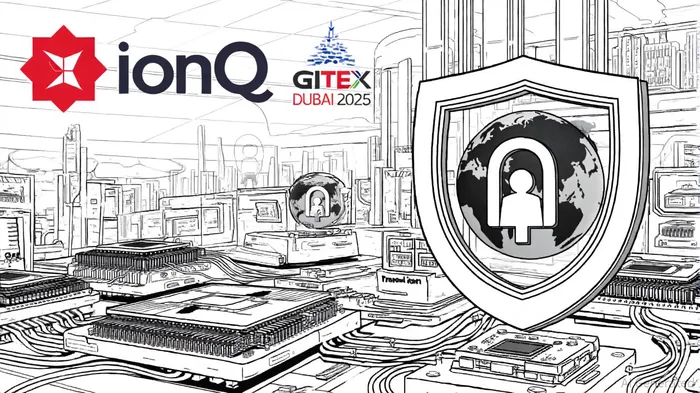
IonQ's presence at GITEX Dubai 2025 underscores its commitment to advancing quantum-safe communication. The company will showcase advancements in secure infrastructure, including quantum-resistant cryptography and platform-as-a-service (PaaS) models, according to BusinessWire. Grégoire Ribordy, CEO of ID Quantique (an IonQ subsidiary), will lead discussions on integrating quantum-safe solutions into global IT systems, a critical step as cyber threats evolve, the BusinessWire release notes. This aligns with IonQ's broader strategy to commercialize quantum technologies, exemplified by its recent acquisition of Oxford Ionics, which brings trapped-ion-on-a-chip technology to scale high-fidelity quantum operations, according to IonQ's blog.
The company's roadmap is equally ambitious. By 2026, IonQ aims to deliver 256-qubit systems with 99.99% fidelity, a milestone critical for applications in cryptography and secure communications, the IonQ blog explains. By 2027, it plans to expand to 10,000 physical qubits, laying the groundwork for fault-tolerant systems. These advancements are not theoretical: IonQ's Forte Enterprise systems already operate at 36 algorithmic qubits (AQ), with 64 AQ projected by 2025, Tickeron reports. Such progress positions IonQ to outpace competitors like IBM and Google, which rely on superconducting qubits and face scalability challenges, as compares.
Market Dynamics: A $1.7 Billion Opportunity and Rising Competition
The quantum cybersecurity market is exploding, driven by the urgent need to future-proof data against quantum decryption. The Business Research Company report found the market grew from $1.14 billion in 2024 to $1.7 billion in 2025, with post-quantum cryptography and quantum key distribution (QKD) leading adoption. Governments account for 57% of purchases, reflecting national security priorities, according to McKinsey. Meanwhile, the broader quantum computing market is forecasted to surge from $1.3 billion in 2024 to $170 billion by 2040, with quantum communication alone projected to reach $14.9 billion by 2035, per the 2025 industry report.
IonQ's competitors are also making strides. IBM emphasizes quantum-safe cryptography and collaborates with NIST on standards, according to IBM, while Google focuses on error correction for fault-tolerant systems, a priority noted in industry coverage. Microsoft integrates post-quantum algorithms into its SymCrypt framework and explores topological qubits, as highlighted by Microsoft's security blog. Amazon, though less vocal, benefits from its Braket service, which democratizes access to quantum hardware, according to ResearchAndMarkets. However, IonQ's unique trapped-ion technology-offering longer coherence times and easier scalability-gives it a distinct edge, industry observers note Panabee.
Financial Strength and Strategic Acquisitions
IonQ's financials reinforce its market leadership. The company commanded a 99.29% market share among publicly traded quantum firms in Q1 2025, dwarfing rivals like Quantum Computing Inc. and Shorepower Technologies, according to CanvasBusinessModel. Revenue surged from $2 million in 2021 to $43.1 million in 2024, with 2025 projections between $75 million and $95 million, per FinancialContent. A recent $2 billion equity offering-the largest in quantum history-further solidifies its position, funding R&D and commercialization efforts, analysts observe in StockWaveInsights.
Strategic acquisitions have been pivotal. The purchase of Oxford Ionics accelerates IonQ's path to fault-tolerant systems, while Vector Atomic's entry into quantum sensing diversifies its portfolio with positioning, navigation, and timing (PNT) applications, per market analysis from PristineMarketInsights. These moves align with the company's vision to create a full-stack quantum platform spanning computing, networking, and sensing, as noted in an IQT report.
Investment Thesis: A Quantum-Driven Future
For investors, IonQ represents a high-conviction bet on the quantum cybersecurity boom. Its technological differentiation, aggressive roadmap, and financial strength position it to capture significant market share as demand for quantum-safe solutions intensifies. While challenges like scalability and technical complexity persist, IonQ's partnerships with cloud giants (AWS, Azure, Google Cloud) and government contracts mitigate risks, the company highlights in IonQ news.
The company's participation in GITEX Dubai 2025 is more than a showcase-it's a signal of its intent to lead the global transition to quantum-safe infrastructure. As the quantum security market accelerates, IonQ's strategic positioning and execution make it a compelling investment for those seeking exposure to the next frontier of cybersecurity.





Comentarios
Aún no hay comentarios