
Quantum Computing's Disruptive Potential in Biotech and Advanced Therapies: Strategic Partnerships Accelerate Commercialization and ROI
The convergence of quantum computing and biotechnology is reshaping the landscape of drug discovery, molecular simulations, and therapeutic innovation. As traditional R&D models struggle with declining productivity and soaring costs, quantum computing offers a paradigm shift by solving complex biological problems at unprecedented speeds. Strategic partnerships between quantum computing firms and biotech companies are now accelerating commercialization timelines and delivering measurable returns on investment (ROI), signaling a transformative era for the sector.
Quantum Computing: A Catalyst for Drug Discovery
Quantum computing's ability to simulate molecular interactions and optimize chemical reactions is revolutionizing early-stage drug development. For instance, Aqemia's quantum-inspired algorithms, deployed in collaboration with Janssen, . Similarly, AstraZeneca's partnership with Amazon Web Services, IonQIONQ--, . These advancements are not theoretical: in 2025, a quantum-powered collaboration identified a promising Alzheimer's treatment candidate overlooked by classical approaches, underscoring the technology's practical value.
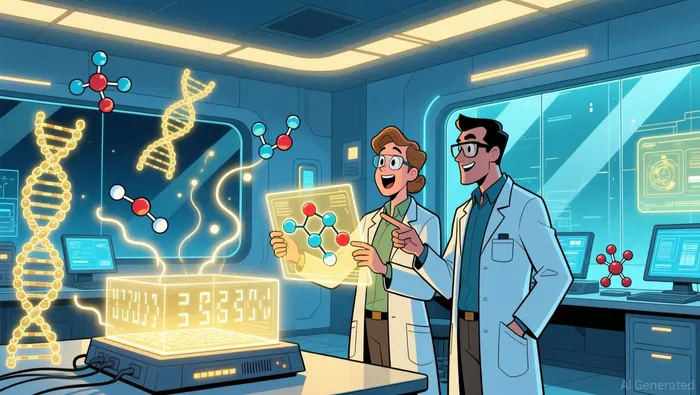
Beyond speed, quantum computing reduces the financial burden of drug discovery. Traditional methods often require a decade or more to bring a drug to market, with failure rates exceeding 90%. Quantum simulations enable precise predictions of drug efficacy and toxicity, minimizing costly trial-and-error phases. For example, Merck KGaA's collaboration with QuEra to model drug candidate activity and Boehringer Ingelheim's partnership with PsiQuantum to calculate metalloenzyme structures highlight how quantum computing mitigates risks and accelerates high-impact discoveries.
Supply Chain and Manufacturing Optimization
Quantum computing's disruptive potential extends beyond the lab. In pharmaceutical manufacturing, it optimizes dynamic processes like crystallization and chemical synthesis, improving yield and efficiency. For instance, quantum algorithms can model supply chain logistics, reducing waste and ensuring timely delivery of therapies. This is critical for advanced therapies such as cell and gene treatments, where production complexity demands real-time adjustments.
Financial ROI and Market Valuation
The economic implications of quantum-biotech partnerships are staggering. By 2035, quantum technologies , driven by reduced R&D costs and faster commercialization. Venture capital investments in quantum startups have surged, with . Meanwhile, .
Quantum computing's market valuation is also soaring. The global quantum computing market is in 2025 to $20.2 billion by 2030, with biotech applications accounting for a significant share. For example, Aqemia's collaboration with Janssen has advanced three cancer-targeting candidates to preclinical trials, with potential clinical trials by 2025, illustrating the direct link between quantum partnerships and revenue generation.
Challenges and the Path Forward
Despite progress, challenges remain. systems face limitations in qubit stability and error correction. However, industry leaders are investing in solutions. The shift toward (QCaaS) is democratizing access, enabling companies to leverage quantum power without owning hardware. Over 4,000 firms are expected to adopt QCaaS by 2030, further accelerating commercialization.
Regulatory frameworks and talent development are also critical. As quantum algorithms generate novel drug candidates, validation protocols must evolve to ensure safety and efficacy. Collaborations like Merck KGaA's with Oxford University and SEEQC-backed by £6.8 million in government grants-demonstrate how public-private partnerships address these hurdles.
Conclusion
Quantum computing is no longer a distant promise but a tangible force reshaping biotech and advanced therapies. Strategic partnerships are the linchpin of this transformation, combining quantum's computational prowess with biotech's domain expertise to deliver faster, cheaper, and more precise solutions. by 2035 and in 2025, the ROI from quantum-biotech collaborations is both immediate and exponential. For investors, the message is clear: the quantum revolution in biotech is not a question of if, but when and how much.





Comentarios
Aún no hay comentarios