
Quantum Computing and Digital Asset Security: Strategic Investments in Post-Quantum Cryptography
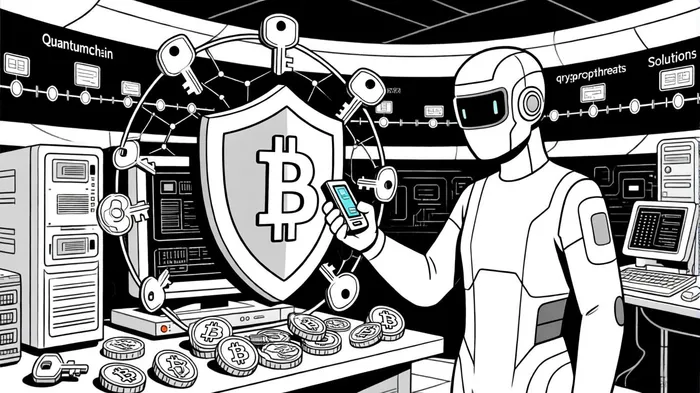
The digital asset ecosystem stands at a crossroads. As quantum computing advances, the cryptographic foundations underpinning blockchain networks—Elliptic Curve Cryptography (ECC) and SHA-256 hashing—are increasingly exposed to existential risks. According to a report by Forbes Business Development Council, quantum algorithms like Shor's and Grover's could break ECC and halve the security of SHA-256 within 5–20 years, with some experts warning of a shorter timeline [1]. This looming threat has triggered a surge in strategic investments and innovations in post-quantum cryptography (PQC), positioning quantum-resistant blockchain infrastructure as a critical frontier for investors.
The Quantum Threat: A Timely Wake-Up Call
Quantum computing's ability to solve complex mathematical problems exponentially faster than classical systems creates a dual threat. Shor's algorithm can derive private keys from public keys, compromising wallet security and transaction integrity, while Grover's algorithm weakens hash functions, reducing the effective security of SHA-256 by half [2]. The “harvest now, decrypt later” model exacerbates this risk: adversaries could collect encrypted data today and decrypt it once quantum computers mature [3].
Though immediate risks remain low—current quantum computers lack the qubit stability and error correction to execute these attacks—proactive measures are essential. A 2025 study by Springer highlights that blockchain components like exposed public keys, smart contracts, and consensus mechanisms are particularly vulnerable [4]. For investors, the lesson is clear: delaying action until quantum threats materialize could result in irreversible losses.
Post-Quantum Cryptography: The Roadmap to Resilience
The U.S. National Institute of Standards and Technology (NIST) has emerged as a pivotal player, finalizing quantum-resistant algorithms like CRYSTALS-Kyber (for key exchange) and CRYSTALS-Dilithium (for digital signatures) in 2024 [5]. These lattice-based schemes, designed to withstand quantum attacks, are now being integrated into blockchain protocols. For instance, QANplatform employs CRYSTALS-Dilithium to secure its quantum-resistant blockchain, while Algorand uses FALCON, another NIST-approved lattice-based algorithm, for quantum-safe verification [6].
However, adoption is not without challenges. PQC algorithms often demand higher computational resources and larger key sizes, which can strain legacy systems and IoT devices. A 2025 benchmark by Markai Code reveals that SPHINCS+, a hash-based signature scheme, reduces Algorand's throughput by 42–68% compared to the more efficient Falcon [7]. Such trade-offs underscore the need for crypto-agility—the ability to seamlessly transition between cryptographic algorithms—as emphasized by the PQC4MED project [8].
Strategic Investments: Leading the Quantum Transition
Corporate and governmental investments are accelerating the shift to quantum resilience. In 2025, the U.S. General Services Administration (GSA) provided federal agencies with acquisition pathways for PQC adoption, while private firms like Project Eleven and QuSecure raised $6 million and $37 million, respectively, to develop quantum-resistant solutions for cryptocurrencies and supply chains [9]. These efforts align with regulatory momentum: the GENIUS Act and CLARITY Act, enacted in 2025, mandate 100% reserve backing for stablecoins and clarify jurisdictional roles for the SEC and CFTC, indirectly incentivizing quantum-safe infrastructure [10].
Blockchain projects are also prioritizing R&D. The Ethereum Foundation allocated $32.6 million in Q1 2025 to support zero-knowledge proofs and post-quantum security, signaling a long-term commitment to resilience [11]. Meanwhile, IOTA's adoption of Winternitz One-Time Signatures (WOTS)—which avoid ECC entirely—demonstrates a proactive approach to IoT security [12].
Visualizing the Quantum Transition
Conclusion: A Call for Proactive Investment
The transition to quantum-resistant cryptography is no longer a theoretical exercise but a strategic imperative. For investors, the opportunities lie in early adoption of PQC-ready blockchain projects, support for R&D in quantum-safe algorithms, and alignment with regulatory frameworks that prioritize crypto-agility. As the adage goes, “Prepare for the storm, not the forecast.” The quantum era is approaching—and those who act now will secure their place in the post-quantum future.







Comentarios
Aún no hay comentarios