
Quantum Computing in 2026: Big Tech vs. Pure-Play Innovators – Which Offers Better Investment Potential?
The quantum computing sector in 2026 remains a battleground between two distinct investment archetypes: legacy technology giants and pure-play innovators. While both camps are advancing the field, their strategic positioning, financial resilience, and risk profiles diverge sharply. For investors seeking to allocate capital in this nascent industry, the question of which approach-Big Tech's diversified bets or pure-plays' laser-focused innovation-offers superior risk-adjusted returns is critical.
Big Tech: Stability Through Ecosystems and Scale
Legacy firms like IBMIBM--, Alphabet (Google), and MicrosoftMSFT-- are leveraging quantum computing as a strategic pillar within their broader technological ecosystems. These companies benefit from vast cash reserves, established R&D pipelines, and the ability to absorb long-term uncertainties. For instance, IBM unveiled the Quantum Nighthawk, a 120-qubit processor, in early 2026, signaling progress toward achieving a "scientific quantum advantage" by year-end. Alphabet, meanwhile, demonstrated a 13,000-fold speed advantage in specific algorithms using its Willow quantum processor, a development underpinned by the company's $100 billion annual R&D budget.
Big Tech's strategic advantage lies in its ability to integrate quantum computing with existing services. AmazonAMZN-- Web Services (AWS), for example, , its first proprietary quantum chip in February 2025, while simultaneously expanding its quantum cloud infrastructure to attract enterprise clients. This dual approach-hardware innovation paired with scalable cloud delivery-reduces commercialization risks and ensures a steady revenue stream. Analysts note that these firms are "less exposed to the volatility of quantum-specific markets" due to their diversified portfolios.
Pure-Play Innovators: High-Reward, High-Volatility Bets
Pure-play companies such as IonQ, D-Wave, and Rigetti Computing have captured investor imagination with breakthroughs in qubit performance and processor design. D-Wave's Advantage2 system, for example, has attracted enterprise clients in Asia, while IonQ's 99.99% two-qubit gate performance set a world record in 2025. However, these firms face existential challenges: unproven business models, razor-thin margins, and reliance on speculative valuations.
Financial metrics underscore the risks. IonQ reported $20.7 million in Q2 2025 revenue but still carries a price-to-sales ratio of 25x, far above sustainable levels. D-Wave, despite a $304 million cash runway as of March 2025, generates just $22 million in trailing twelve-month revenue. Rigetti Computing, with $1.8 million in quarterly revenue and $571 million in cash, remains dependent on technical breakthroughs in coherence and gate fidelity to justify its valuation.
Wall Street analysts acknowledge the potential but caution against over-optimism. "These firms are akin to venture capital bets," one analyst wrote, "with the added complexity of quantum's unpredictable commercialization timeline."
Risk-Adjusted Returns: A Tale of Two Strategies
For risk-averse investors, Big Tech's approach offers a more predictable path. IBM's quantum roadmap, for instance, is embedded within its $75 billion annual revenue base, allowing it to fund multi-decade projects without relying on equity raises. Alphabet's quantum division, meanwhile, benefits from the parent company's $100 billion cash reserves, insulating it from liquidity crises.
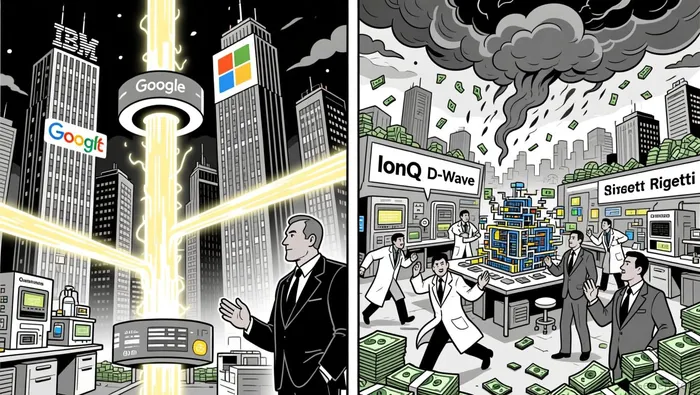
Pure-plays, by contrast, deliver higher upside but at the cost of volatility. D-Wave's stock surged 19% in early 2026, while IonQ and Rigetti gained 13% and 15%, respectively. However, these gains mask underlying fragility: Quantum Computing Inc. (QUBT) reported a net margin of -183.76% in 2024, despite a 49.98% 90-day share price rally. The sector's speculative nature is further highlighted by QUBT's 30-day return of 14.25%, a metric more reflective of retail trading frenzy than fundamental value.
Conclusion: Balancing Ambition and Prudence
The quantum computing landscape in 2026 reflects a classic tension between innovation and execution. Pure-play firms offer the allure of outsized returns if they can bridge the gap between lab breakthroughs and commercial viability. However, their survival hinges on sustained investor confidence and technical milestones. Big Tech, by contrast, provides a more measured path, leveraging quantum computing as a strategic enhancement to existing ecosystems rather than a standalone bet.
For investors prioritizing risk-adjusted returns, the latter approach appears more compelling. As one billionaire investor recently noted, "Quantum computing is a marathon, not a sprint. Big Tech's patience and scale give it an edge in a race where most pure-plays may not finish." That said, those with a high-risk tolerance and a long-term horizon may still find value in carefully selected pure-plays-provided they can stomach the volatility.





Comentarios
Aún no hay comentarios