
U.S. Quality Equities in a Low-Growth Macro Environment
The U.S. economy in 2025 is navigating a landscape of modest growth, persistent inflation, and tightening monetary policy. With real GDP projected to expand at 1.9% in 2025 and 1.8% in 2026, the path of economic activity remains below historical averages, shaped by tariff-driven inflation, constrained labor markets, and a Fed poised to pause its rate-cutting cycle until early 2026 according to Deloitte's outlook analysis. In this environment, investors are increasingly turning to defensive strategies, seeking equities with durable earnings and strong balance sheets to weather macroeconomic headwinds.
Macroeconomic Context: A Fragile Foundation
The 2025 macroeconomic backdrop is defined by a tug-of-war between inflationary pressures and slowing demand. Headline CPI inflation is expected to average 3.0% in 2025, with tariffs contributing an additional 1.0 percentage point to inflation by early 2026 according to Philadelphia Fed data. Meanwhile, the Federal Reserve's policy pivot-anticipating a 25-basis-point cut in January 2026 and a total of 50 basis points of easing over the year-reflects growing concerns about a softening labor market. Unemployment is projected to rise to 4.5% in 2026, as businesses scale back hiring amid rising input costs and immigration policy constraints according to JPMorgan analysis.
Recession indicators, though not yet flashing red, are signaling fragility. The Conference Board's Leading Economic Index (LEI) fell 2.1% between March and September 2025, driven by weak consumer expectations and soft new orders data according to Conference Board data. This contraction underscores the vulnerability of businesses reliant on discretionary spending, even as core sectors like healthcare and industrials demonstrate resilience.
Defensive Sectors: Underperformance and Rebalancing
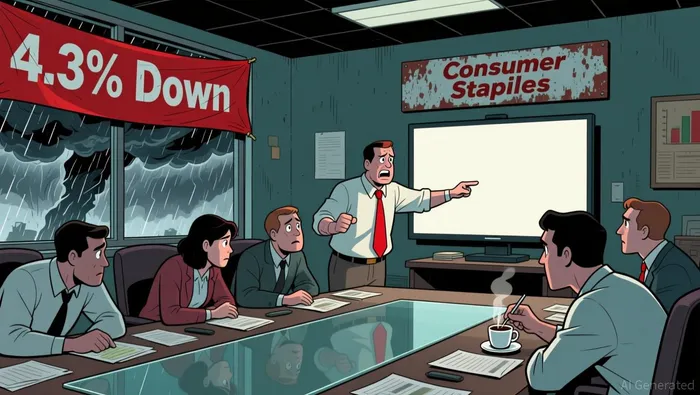 Defensive sectors, traditionally a haven in slowing economies, have underperformed in 2025 as capital flows into AI-driven growth equities. Consumer Staples, for instance, recorded a -4.3% decline in Q3 2025, reversing earlier gains and highlighting the sector's struggle to absorb inflation and tariff costs according to Spartan Capital Q3 overview. Similarly, utilities and industrials, while showing stable fundamentals, have faced pressure from shifting investor priorities.
This trend reflects a broader market reallocation. The S&P 500's 7.81% Q3 gain was fueled by AI-centric sectors like Information Technology and Communication Services, which have outpaced traditional defensives according to Schwab's sector analysis. However, this divergence raises questions about sustainability. As Schwab's Sector Views note, sectors with durable earnings-such as healthcare and industrials-are better positioned to withstand macroeconomic volatility according to SSGA equity outlook.
Quality Equities: A Hedge Against Uncertainty
Quality equities-defined by strong profitability, disciplined balance sheets, and stable earnings-have historically outperformed in low-growth environments. MSCI's analysis confirms that quality indexes, which emphasize companies with robust margins and consistent cash flow, tend to lead during periods of volatility according to MSCI research. In 2025, however, global trade uncertainties and weak international sales growth have muted their returns, particularly for export-sensitive firms according to MSCI research.
The coming months may offer a turning point. As AI-driven capital expenditure moderates and supply chains stabilize, quality equities could regain traction. Schwab highlights Communication Services, Industrials, and Healthcare as outperformers, citing their alignment with long-term trends like AI adoption and demographic-driven demand according to Schwab's sector outlook.
Sector-Specific Resilience: Utilities and Industrials in Focus
Within the quality equity universe, Utilities and Industrials stand out for their earnings resilience. Duke Energy Corporation (DUK), for example, exemplifies the sector's strength. With a Free Cash Flow margin of 28.3%, a 5.2% ROIC, and a forward dividend yield of 4.8%, the company's regulated utility model provides predictable cash flows and pricing power according to ValueSense analysis. Similarly, Korea Electric Power Corporation (KEP) has delivered a 149.4% one-year return, driven by its 60.9% gross margin and strategic positioning in a high-growth market according to ValueSense analysis.
Industrials, too, offer compelling opportunities. Companies with exposure to AI infrastructure and energy transition technologies are benefiting from sustained capital expenditure. For instance, firms with durable earnings and strong balance sheets are outperforming peers in cyclical sectors like Consumer Discretionary according to Schwab's sector outlook.
Conclusion: Strategic Allocation in a Fragmented Market
The 2025 macroeconomic environment demands a nuanced approach to equity selection. While growth sectors dominate headlines, quality equities in resilient sectors like Utilities and Industrials provide a counterbalance to volatility. Investors should prioritize companies with strong margins, stable cash flows, and pricing power-traits that Duke Energy and Korea Electric Power exemplify. As the Fed's easing cycle begins and global supply chains adjust, these equities may offer a path to both capital preservation and long-term growth.







Comentarios
Aún no hay comentarios