
Qualcomm's PC S-Curve: Assessing the Infrastructure Bet
Qualcomm is building the fundamental compute layer for the next PC paradigm. Its bet is on Arm-based Windows laptops, a shift that could disrupt the entrenched x86 duopoly. The company's recent moves show a deliberate strategy to accelerate adoption by expanding price point coverage, from premium flagships to the budget segment. The stock's trajectory hinges on how quickly this paradigm shift takes hold.
The technological foundation is now set. The flagship Snapdragon X2 Elite Extreme has demonstrated it can deliver desktop-class performance while maintaining all-day battery life. Benchmarks show it edges out Apple's M4 in single-core responsiveness and dominates in multi-core and AI workloads. This isn't incremental improvement; it's a performance leap that challenges the core trade-off between power and endurance.
To drive mass adoption, QualcommQCOM-- is aggressively lowering the entry barrier. The company has announced a new Snapdragon X processor targeting the $600 laptop segment. This tier joins the existing X Elite and X Plus lines, creating a full-stack offering. The strategy is clear: capture the student and budget-conscious market where price sensitivity is high, while still delivering the promised AI performance and superior battery life that differentiate ArmARM-- from x86.
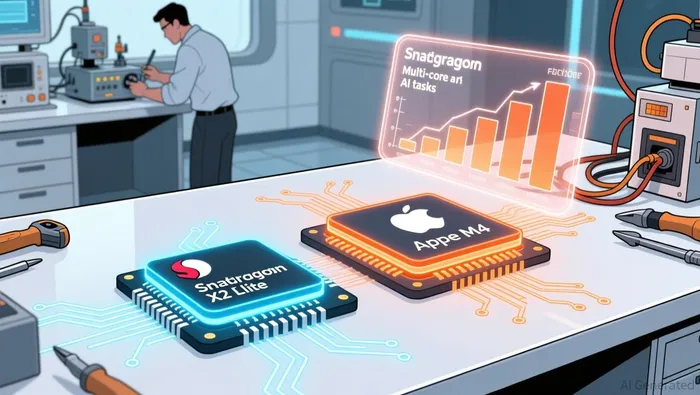
The core thesis is one of exponential adoption. Qualcomm's chips are designed to outperform rivals in both raw speed and power efficiency. Benchmarks claim the X2 Plus can deliver up to 3.1× higher multi-core CPU performance at the same power level as competing processors. This efficiency advantage is the key infrastructure benefit, enabling thinner, fanless designs and longer usage between charges. The company is building the rails for a new generation of always-connected, AI-native PCs.
The investment case is therefore a classic S-curve play. The technology is maturing and proving its capability at the high end. Now, the critical phase is crossing the chasm into mainstream adoption. The success of the new budget chip will be a major catalyst. If it drives volume and software ecosystem growth, it could accelerate the entire paradigm shift, turning Qualcomm's infrastructure bet into a dominant market position.
Performance Benchmarking the Paradigm Shift
The technological positioning of Qualcomm's new chips is now backed by concrete performance claims that directly challenge the x86 incumbents. The flagship Snapdragon X2 Elite Extreme can hit a 5.0GHz peak clock speed, a first for Arm-based processors. This performance ceiling, paired with a desktop-class Adreno GPU, signals Qualcomm is targeting the high-performance segment where Intel and AMD have long dominated. The benchmarks from Qualcomm's own reference designs show a clean sweep across CPU, GPU, and AI workloads, with the X2 Elite Extreme edging out Apple's M4 in single-core responsiveness.
The efficiency advantage is where the paradigm shift becomes most compelling. The X2 Plus variant claims up to 3.1× higher multi-core CPU performance at the same power level as competing processors. This isn't just about raw speed; it's about sustaining higher performance for longer periods without draining the battery or overheating. For the infrastructure play, this efficiency is the key differentiator. It enables thinner, fanless laptop designs and the all-day battery life that defines the always-connected PC promise. The company frames this as a fundamental win for everyday workloads, where lightly threaded tasks still dominate.
Gaming remains a niche limitation, with 13% of gamers preferring desktops over laptops. However, Qualcomm is addressing the core compatibility hurdle with its Prism emulation layer, which aims to run x86 applications smoothly. This is critical for software ecosystem growth, removing a major friction point for users and developers alike.
The bottom line is that Qualcomm is translating its architectural bets into measurable displacement. The performance benchmarks show it can match and exceed rivals in core PC tasks, while the efficiency metrics promise a superior user experience. The company is building the infrastructure layer not just for better laptops, but for a new generation of devices where performance and endurance are no longer a trade-off.
Market Share Trajectory and Adoption Rate
Qualcomm's initial market penetration is a classic case of exponential scaling. In just 12 months, the company has captured about 9% of the PC market for devices priced above $800. That's a staggering achievement, especially when compared to the slow, grinding adoption of Intel's Arc discrete graphics cards, which have managed only about 1% of the discrete graphics market despite years of effort. This isn't just growth; it's a scaling miracle that validates the infrastructure bet.
The company's goal is to compound this momentum. Qualcomm aims to grow its share to 12% of the PC market by 2029. That trajectory suggests a steady, multi-year climb. The key to achieving it lies in the multi-tiered strategy now in place. By launching a new Snapdragon X processor targeting the $600 laptop segment, Qualcomm is systematically removing price barriers across the entire adoption curve.
This price point coverage is the engine for exponential growth. The strategy creates a full-stack offering: the premium Snapdragon X Elite Extreme for power users, the mid-tier Snapdragon X Plus for professionals, and now the budget Snapdragon X for students and freelance workers. This approach enables the company to attack the market from multiple angles simultaneously, capturing volume at each tier.
The bottom line is that Qualcomm is building the rails for a paradigm shift. Its current 9% share above $800 is a foothold, not a ceiling. The multi-tiered rollout is designed to accelerate adoption across the entire user base-from the budget-conscious to the premium segment-by making the Arm-based, AI-native PC experience accessible at every price point. If execution holds, this could drive the market share toward that 12% target and beyond, turning a promising infrastructure play into a dominant market position.
Risks and Counterarguments: The Exponential Curve's Hurdles
The S-curve for Arm-based PCs is promising, but it faces steep competition and execution hurdles. Qualcomm's rapid 9% market share gain is a miracle, but it's up against entrenched rivals with their own radical moves. Intel and AMD are not standing still. The companies are launching new chips-Intel's Lunar Lake and AMD's Strix Point-that are fundamentally different products, designed to compete directly on performance and efficiency. This isn't a minor update; it's a full-scale response that could flatten the adoption curve Qualcomm has been riding.
A near-term catalyst for the broader semiconductor business is the resolution of the ARM licensing dispute. In December, a jury found that Qualcomm's AI-PC chips were properly licensed with Arm, clearing a major legal overhang. This win removes a significant headwind and gives the company the green light to aggressively grow its PC business, a central pillar of its IoT strategy. The legal clarity is a necessary condition for continued expansion.
Yet, the company's path is not without a major revenue wind-down. Qualcomm's relationship with Apple is set to phase out, with the company expecting to fully phase out its modem business by 2027. This is a known risk, but the company has been actively mitigating it. The automotive and Internet of Things (IoT) businesses have already grown to exceed the size of its Apple business. More importantly, Qualcomm expects these segments to grow much faster, with IoT revenues projected to increase by more than 20% and automotive by 50% in the coming quarter. The company sees combined growth in these areas exceeding 20% annually for the next several years, providing a powerful offset.
The bottom line is that Qualcomm's infrastructure bet is a high-stakes race. It must out-innovate and out-execute against new competitive products while navigating the planned reduction of a major revenue stream. The resolution of the ARM dispute is a positive step, and the diversification into automotive and IoT provides a strong growth buffer. But the exponential adoption of its PC chips will ultimately depend on whether it can maintain its technological lead and ecosystem momentum against a determined and well-resourced opposition.
The Strategic Takeaway: Investing in the Infrastructure Layer
The investment thesis for Qualcomm is no longer about a single product cycle. It is about betting on the infrastructure layer for the next computing paradigm. The company's recent performance and analyst sentiment confirm that the market is beginning to price in this long-term shift. Over the last 120 days, the stock has shown resilience, climbing 11.83%. This move suggests renewed investor confidence in the PC strategy, particularly after a turbulent period that saw shares plummet over 30% earlier in the year. The resolution of the ARM licensing dispute and the planned reduction of the Apple modem business have cleared major overhangs, allowing the core infrastructure bet to take center stage.
Wall Street's view aligns with this long-term perspective. Despite the stock's recent dip, the average analyst rating implies a 21% upside from current levels. This consensus sees the company's multi-tiered PC rollout-not just the premium flagships but the new Snapdragon X processor targeting the $600 segment-as the catalyst for exponential growth. The financial metrics support this view: the stock trades at a forward P/E of 16.6, a reasonable multiple for a company with a 11.58% rolling annual return and a clear path to expanding its market share from the current 9% in premium devices toward a 12% target by 2029.
The bottom line is that Qualcomm is building the fundamental compute rails for an AI-native world. Its chips are designed to deliver superior performance per watt, enabling the always-connected, fanless laptops that define the next generation. The company's bet is on the adoption rate of this new paradigm, not on short-term profitability. The multi-tiered strategy is the engine for that exponential scaling, systematically removing price barriers to drive volume and software ecosystem growth. If execution holds, this infrastructure layer could become as dominant as Qualcomm's position in mobile modems once was. For investors, the setup is clear: the stock's resilience and Wall Street's bullish call signal that the market is starting to see past the near-term noise and recognize the long-term S-curve potential.





Comentarios
Aún no hay comentarios