
Qualcomm's AI and Data Center Expansion: A Game Changer for Long-Term Growth
Qualcomm's strategic pivot from mobile-centric innovation to AI and data center infrastructure marks a pivotal shift in its corporate trajectory. As the semiconductor industry grapples with the transformative potential of artificial intelligence, QualcommQCOM-- is positioning itself as a formidable contender in the AI infrastructure race. This analysis examines how Qualcomm's strategic diversification and competitive positioning in AI hardware could redefine its long-term growth prospects, leveraging recent investments, partnerships, and product innovations.
Strategic Diversification: From Mobile to AI Infrastructure
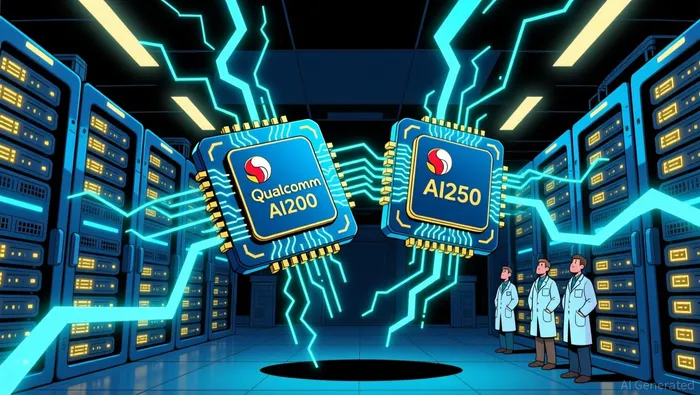
Qualcomm's diversification strategy is anchored in its ability to leverage its core strengths in power-efficient processing and AI integration. The company has unveiled two new AI chips-AI200 and AI250-specifically designed for data centers, with commercial availability slated for 2026 and 2027, respectively. These chips are part of a broader effort to reduce reliance on smartphone markets, where growth has plateaued, and instead capitalize on the surging demand for AI-driven infrastructure.
A critical component of this strategy is Qualcomm's acquisition of Alphawave Semi for $2.4 billion in June 2025. This move bolsters Qualcomm's semiconductor capabilities, particularly in high-speed connectivity and AI-specific hardware, enabling it to compete more effectively in the data center space. Additionally, the company has set ambitious revenue targets, aiming for $14 billion in non-handset business by FY2029, underscoring its commitment to diversification.
 Qualcomm's partnerships further amplify its strategic reach. In 2025, the company signed a memorandum of understanding with HUMAIN, a Saudi-based AI firm, to develop state-of-the-art AI data centers in Riyadh. This collaboration includes the deployment of 200 megawatts of data center capacity using Qualcomm's Cloud AI solutions, with operations commencing in 2026. Such partnerships not only expand Qualcomm's geographic footprint but also align with global trends toward localized AI infrastructure.
Competitive Positioning in AI Infrastructure
Qualcomm's entry into the data center market is a direct challenge to industry leaders like Nvidia, which has dominated AI hardware with its GPUs. To counter this, Qualcomm is re-entering the data center CPU market with custom central processing units designed to integrate seamlessly with Nvidia's GPUs and software ecosystems. This hybrid approach allows Qualcomm to offer complementary solutions while leveraging Nvidia's established AI frameworks, creating a competitive edge in a market where interoperability is key.
The company's emphasis on on-device AI further differentiates it. By enabling local data processing across edge and cloud environments, Qualcomm addresses critical concerns around latency and privacy. This strategy is highlighted in its Snapdragon Summit 2025 roadmap, which envisions AI convergence across mobile, PC, wearables, and automotive platforms. For instance, the Snapdragon 8 Elite Gen 5 and Snapdragon X2 chips are designed to deliver generative AI capabilities directly on devices, reducing dependency on cloud connectivity.
Qualcomm's hybrid AI architecture-spanning edge and cloud computing-positions it to capture a broader segment of the AI market. By optimizing hardware for both localized and distributed workloads, the company is addressing the scalability challenges faced by enterprises adopting AI at scale. This dual focus on efficiency and flexibility could disrupt traditional data center dynamics, where energy consumption and cost remain significant barriers.
Long-Term Growth Prospects
Qualcomm's long-term revenue targets reflect its confidence in the AI and data center markets. The company aims to achieve $8 billion in annual automotive revenue and aiming for $14 billion in non-handset businesses by FY2029. These figures are not merely aspirational; they are underpinned by tangible investments and partnerships. For example, the AI Engineering Center established with HUMAIN in Riyadh, set to launch in December 2025, will serve as a hub for developing AI solutions tailored to enterprise and governmental clients.
Moreover, Qualcomm's focus on total cost of ownership (TCO) for enterprises is a strategic differentiator. According to internal benchmarks, its AI inference accelerators and rack-scale systems are designed to reduce operational expenses by up to 30% compared to existing solutions. This cost advantage, combined with its power-efficient hardware, could attract cloud providers and hyperscalers seeking to optimize their AI infrastructure.
Conclusion
Qualcomm's AI and data center expansion represents a calculated and well-resourced bet on the future of computing. By diversifying its revenue streams, forming strategic partnerships, and innovating in hybrid AI architectures, the company is not only mitigating risks associated with its mobile-centric past but also positioning itself as a leader in the next phase of the AI revolution. For investors, Qualcomm's aggressive roadmap and execution capabilities suggest a compelling long-term opportunity, particularly as global demand for AI infrastructure accelerates.







Comentarios
Aún no hay comentarios