
Quaker Houghton's Leadership Appointments: Strategic Implications for ESG-Driven Growth
Quaker Houghton's recent leadership appointments in October 2025 signal a strategic pivot toward ESG-driven growth, aligning with its long-term sustainability goals and investor expectations. The promotion of Dr. André Frodl to Vice President, R&D – Metals and Metalworking, and the hiring of Christine Johnson as Senior Vice President and Chief Transformation Officer, underscore the company's commitment to embedding environmental, social, and governance (ESG) principles into operational and innovation frameworks. These moves are not merely administrative but reflect a calculated succession planning strategy to sustain investor value in an era where ESG performance increasingly dictates market competitiveness.
Leadership and ESG Synergy
Christine Johnson's appointment as Chief Transformation Officer brings expertise in digital engagement and process optimization, critical for scaling Quaker Houghton's sustainability initiatives. Her prior roles at McKinsey & Company and DuPont highlight a track record in driving systemic change, as noted in a PR Newswire release. Johnson's focus on operational excellence is expected to accelerate the company's use of renewable raw materials and reduce carbon footprints across its supply chain, as described in the 2024 Sustainability Report.
Dr. Frodl's leadership in R&D further strengthens Quaker Houghton's innovation pipeline. By overseeing product stewardship and fluid analysis, he is positioned to advance the development of environmentally responsible industrial solutions. This aligns with the company's 2030 carbon neutrality target and its emphasis on Green Chemistry guidelines, which prioritize renewability and safety, as outlined on Quaker Houghton's sustainability page. His role is pivotal in ensuring that Quaker Houghton's R&D efforts directly contribute to measurable ESG outcomes, such as waste reduction and water stewardship.
Succession Planning as a Strategic Lever
Quaker Houghton's succession planning framework is explicitly tied to its See Beyond™ sustainability strategy, which integrates ESG pillars like "Innovating together for a better tomorrow" and "Protecting our planet," as discussed in a Harvard Law School article. The 2024 Sustainability Report highlights that 76% of the company's electricity now comes from renewable sources, and over 70,000 metric tons of waste have been eliminated since 2022 through programs like QH FLUIDCARE™ (see the 2024 Sustainability Report). These achievements demonstrate that leadership continuity is not just about filling roles but about embedding ESG into the organizational DNA.
The alignment of new leaders with ESG priorities also addresses investor concerns about long-term value. According to a 2025 Harvard Business School analysis, 78% of global executives view climate risk as a top strategic challenge, with ESG performance directly influencing capital allocation decisions, per MarketBeat's sustainability page. Quaker Houghton's leadership appointments signal to investors that the company is proactively managing these risks while capitalizing on opportunities in sustainable industrial markets.
Investor Value and ESG Momentum
The financial implications of Quaker Houghton's ESG strategy are already materializing. The 2024 Sustainability Report notes a 75% increase in employee training hours compared to 2023, reflecting a workforce better equipped to drive innovation and compliance (see the 2024 Sustainability Report). Additionally, the company's progress in reducing Scope 2 emissions by 7% in 2024-against a backdrop of rising energy costs-suggests that ESG initiatives are not only ethical but economically prudent.
For investors, the integration of ESG into succession planning reduces operational volatility and enhances brand equity. A 2025 Bloomberg ESG Score analysis ranks Quaker HoughtonKWR-- in the top quartile of its industry, with its sustainability report's use of Scope 3 data by 2025 further solidifying transparency (see the PR Newswire release). This transparency is critical in an era where 62% of institutional investors prioritize companies with clear ESG roadmaps (see MarketBeat's sustainability page).
Conclusion
Quaker Houghton's leadership appointments and succession planning framework exemplify how ESG integration can drive both operational and financial resilience. By appointing leaders with deep ESG expertise and aligning their mandates with measurable sustainability goals, the company is positioning itself to outperform peers in a market increasingly defined by regulatory scrutiny and investor demand for responsible growth. For long-term investors, these strategic moves represent a calculated investment in future-proofing Quaker Houghton's value proposition.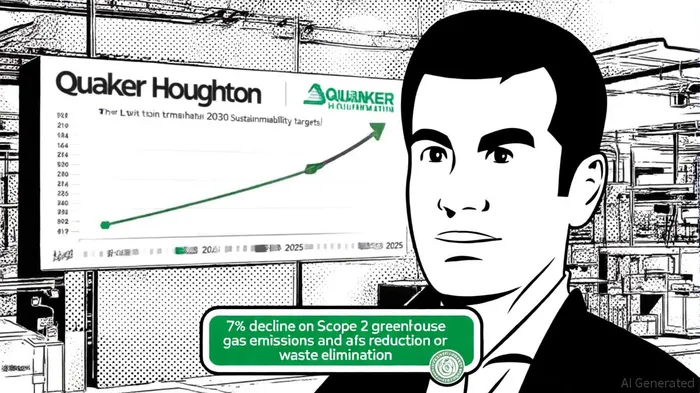





Comentarios
Aún no hay comentarios