
Quaker Chemical's Cyclical Turnaround and Undervaluation: A Strategic Investment Opportunity
The industrial chemicals sector has long been characterized by cyclical volatility, where companies must navigate shifting demand, raw material costs, and macroeconomic headwinds. Quaker Chemical CorporationKWR-- (KWR) appears to be at a pivotal inflection point in its cycle, balancing near-term challenges with structural opportunities that could unlock significant value for investors. A combination of strategic acquisitions, management confidence, and compelling valuation metrics suggests a cyclical turnaround is underway, even as the company grapples with legacy operational issues.
Cyclical Challenges and Strategic Resilience
Quaker Chemical's Q1 and Q2 2025 results underscored the pressures of a challenging operating environment. Net sales declined 5.7% year-over-year to $443 million in Q1 2025, with adjusted EBITDA falling 17.1% to $69 million and non-GAAP earnings per share dropping 24.6% to $1.58, according to the Q1 2025 results. The Q2 earnings report was even more dire, as the company swung to a net loss of $66.6 million, driven by an $88.8 million non-cash goodwill impairment charge in its EMEA segment, per the Q2 2025 report. These figures reflect broader industry headwinds, including inflationary pressures on raw materials and weaker demand in key markets.
However, the company's response to these challenges has been proactive. Quaker Chemical's acquisition of Dipsol Chemicals Co., Ltd. for $187 million in Q1 2025 demonstrates a strategic pivot to strengthen its portfolio in surface treatment solutions and metalworking fluids, a move that is critical in a sector where differentiation through specialized offerings can drive margin resilience. Additionally, CEO Joseph Berquist's decision to purchase shares at 10-year lows-a move that signals conviction in the company's long-term value-was reported in a Waiker.ai report.
Valuation Metrics and Analyst Optimism
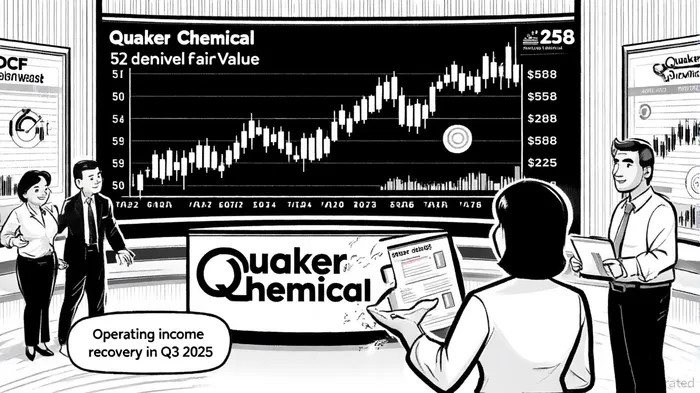
Despite the recent financial setbacks, Quaker Chemical's stock appears to be trading at a significant discount to its intrinsic value. A two-stage discounted cash flow (DCF) model estimates a fair value of approximately $258 per share, implying a 48% undervaluation relative to the current price of $135, per a DCF estimate. Analysts corroborate this view, with a Strong Buy consensus rating and an average price target of $148.60-13.32% above the current price. These valuations are further supported by the company's robust balance sheet, including a current ratio of 2.56 and a forward price-to-earnings (PE) ratio of 15.93, according to Yahoo Finance.
The disconnect between Quaker Chemical's fundamentals and its stock price may be attributed to short-term volatility. The company's beta of 1.42 indicates higher sensitivity to market fluctuations, and its 52-week price decline of -22.08% reflects broader investor caution, as noted by Yahoo Finance. Yet, the Q3 2025 earnings report-filed on October 30, 2025-reveals early signs of stabilization. Operating income for the trailing 12 months reached $180.28 million, while the 7% dividend increase underscores management's commitment to shareholder returns. Notably, historical data from 2022 to 2025 shows that KWR's stock has delivered an average cumulative return of +16% in the 30 days following earnings announcements, with all sampled events finishing in positive territory. This outperformance occurred despite a slightly negative S&P 500 during the same period, reinforcing the stock's relative strength around earnings events.
Risks and the Path Forward
Investors must remain cognizant of Quaker Chemical's ongoing challenges. The company's net income for the past 12 months remains negative at -$7.13 million, per Yahoo Finance, and its Q1 2025 gross profit declined by 11% due to higher restructuring costs and raw material expenses, according to Sahm Capital. These issues highlight the fragility of its recovery narrative. However, the strategic focus on cost discipline, joint venture synergies, and geographic diversification-particularly in high-growth markets like Asia-positions Quaker ChemicalKWR-- to capitalize on an eventual upturn in industrial demand.
The key question is whether management can execute its turnaround strategy effectively. The acquisition of Dipsol, coupled with the CEO's share purchases, signals a clear intent to rebuild value. If Quaker Chemical can stabilize its EMEA operations and leverage its expanded product portfolio to capture market share, the current valuation offers a compelling margin of safety.
Conclusion: A Cyclical Bet with Long-Term Potential
Quaker Chemical's journey reflects the classic arc of a cyclical company navigating a trough of its business cycle. While the near-term risks are real, the combination of strategic acquisitions, management confidence, and undervaluation metrics creates an attractive risk-reward profile. For investors with a medium- to long-term horizon, the company's discounted valuation and analyst optimism suggest that the worst may already be priced in, with upside potential tied to successful execution of its turnaround plan.





Comentarios
Aún no hay comentarios