
Quack AI (Q): The AI-Driven Catalyst Reshaping DeFi and Retail Participation
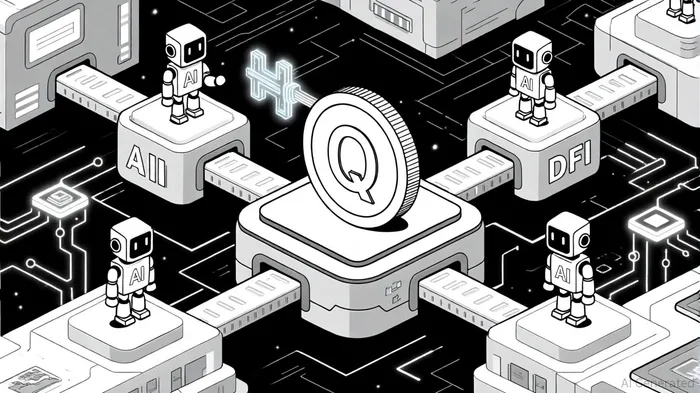
The convergence of artificial intelligence (AI) and decentralized finance (DeFi) is accelerating, with projects like Binance Wallet's Quack AI (Q) emerging as pivotal players in this transformation. Launched on September 2, 2025, Quack AI's Q token is notNOT-- merely a governance tool but a multifaceted utility asset designed to democratize DeFi participation and streamline decision-making across multiple blockchains. This analysis evaluates Q's role in catalyzing retail adoption, its expanding token utility, and its potential to redefine decentralized governance.
AI-Powered Governance: A New Paradigm for DAOs
Quack AI positions itself as an AI-native governance layer for Web3, enabling Decentralized Autonomous Organizations (DAOs) to automate proposal analysis, risk evaluation, and voting[1]. By integrating AI agents, the platform reduces human bias and delays, offering scalable, data-driven decision-making. For instance, Q's cross-chain compatibility with EthereumETH--, SolanaSOL--, BNB Chain, and ArbitrumARB-- allows DAOs to execute multi-chain governance workflows seamlessly[2]. This functionality is critical for protocols seeking to balance decentralization with efficiency, particularly as DeFi ecosystems grow in complexity.
The token's modular design further enhances its appeal. With 79% of the 10 billion Q token supply allocated to community and ecosystem development, the project prioritizes decentralized growth[3]. This structure aligns with broader trends in DeFi, where token holders increasingly demand tools that simplify participation without compromising autonomy.
Retail Participation: Airdrops, AlphaALPHA-- Points, and Incentives
Binance's strategic airdrop of 1.2 billion Q tokens (12% of the total supply) to Alpha users within 24 hours of the September 2025 launch exemplifies Quack AI's focus on retail engagement[4]. Users earned Alpha Points through trading, surveys, and social media activity, creating a gamified onboarding process. This approach mirrors successful airdrop campaigns by projects like UniswapUNI-- and AaveAAVE--, which leveraged token distribution to drive early adoption.
Retail adoption metrics further underscore Q's traction. By Q3 2025, Quack AI reported 3 million users via its Passport system, granting cross-chain governance identities[5]. This growth is amplified by Binance's global user base, which provides immediate liquidity and visibility for the token. Additionally, the 24-hour airdrop's first-come, first-served model incentivized rapid participation, a tactic proven effective in capturing retail interest during high-profile token launches.
Beyond Governance: DeFi and RWA Integrations
While governance remains Q's core use case, the token's utility extends into DeFi and real-world asset (RWA) applications. Quack AI's AI agents automate tasks such as yield optimization across lending protocols, risk assessment for treasury management, and dynamic loan-to-value (LTV) adjustments for tokenized assets[6]. For example, property owners tokenizing real estate could use Q-powered AI to collateralize assets on DeFi platforms, accessing liquidity without selling physical holdings[7].
The project's roadmap also highlights RWA governance pilots, where Q tokens will facilitate compliance-driven decision-making for tokenized commodities and real estate[8]. This aligns with the growing demand for AI in regulatory frameworks, as institutions seek tools to navigate compliance complexities in decentralized markets.
Market Dynamics and Investment Considerations
Quack AI's tokenomics and partnerships position it as a compelling investment. The token's initial price range of $0.01–$0.03[9] and subsequent listing on Binance Futures with 50x leverage[1] attracted speculative traders, while institutional interest in RWA integrations signals long-term potential. Analysts project Q could reach $0.8 by 2025, driven by its deflationary mechanics and expanding use cases[10].
However, risks persist. Alpha assets like Q carry volatility and withdrawal restrictions, as noted by Binance[1]. Retail investors must also navigate the nascent nature of AI-driven governance, where adoption rates and regulatory clarity remain uncertain.
Conclusion: A Catalyst for the Future of DeFi
Quack AI's Q token represents a significant step forward in AI-driven DeFi innovation. By combining governance automation, cross-chain interoperability, and RWA integrations, the project addresses key pain points in decentralized finance. Its airdrop-driven retail adoption and strategic partnerships with major blockchains further solidify its position as a catalyst for mass participation in Web3. For investors, Q's dual focus on utility and scalability offers a unique opportunity to engage with the evolving intersection of AI and DeFi.






Comentarios
Aún no hay comentarios