
QTUM: AI-Driven Momentum as Catalyst and Catalyst Killer in the Quantum Age
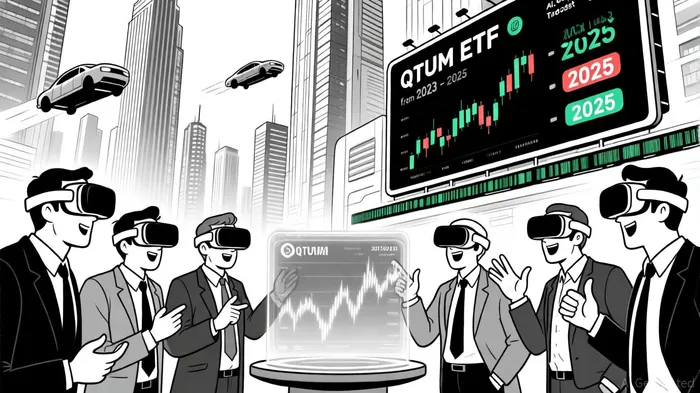
The Defiance Quantum ETF (QTUM) has emerged as a bellwether for the intersection of artificial intelligence and quantum computing in financial markets. By mid-2025, the ETF had ballooned from $200 million to over $500 million in assets, driven by its exposure to quantum computing and machine learning giants like NVIDIANVDA-- and IBM[1]. Yet this meteoric rise masks a duality: AI-driven trading strategies are both accelerating QTUM's momentum and amplifying its volatility, creating a high-stakes environment where technical fundamentals and speculative fervor collide[2].
AI as an Accelerant: Efficiency and Liquidity
AI-driven trading has undeniably turbocharged QTUM's performance. The ETF's 7.20% return in August-September 2025 and 75.62% total return over 12 months reflect the power of algorithmic strategies in parsing vast datasets and executing trades at millisecond speeds[3]. For instance, predictive analytics tools have optimized entry points for QTUM's holdings in semiconductor firms like AMDAMD--, which saw surges tied to AI infrastructure demand[4]. Similarly, natural language processing (NLP) models analyzing news sentiment around quantum breakthroughs—such as Google's Willow chip—have triggered rapid inflows into the ETF[5].
Technical upgrades on the QtumQTUM-- blockchain itself further fuel this momentum. The integration of BitcoinBTC-- Core upgrades and EVM enhancements in November 2024 reduced gas fees and improved interoperability, attracting developers and institutional capital[6]. Meanwhile, staking incentives have surged, with over 40,000 QTUM tokens minted in July 2025 alone, tightening supply and potentially driving upward price pressure[7].
AI as a Destabilizing Force: Volatility and Systemic Risks
However, the same AI tools that boost efficiency also introduce instability. The QTUM ETF's maximum drawdown of 38.45% in October 2022 underscores the risks of algorithmic herd behavior, where synchronized selling during market stress exacerbates declines[8]. A 2025 IMF report warns that AI-driven trading can amplify volatility through “flash crashes,” as algorithms react instantaneously to negative sentiment or technical indicators like RSI divergences[9]. For example, a 1901.14% price spike in QTUM followed by a 234.01% drop within 24 hours in 2025 highlights the fragility of AI-fueled euphoria[10].
The dual-edged nature of algorithmic trading is further evident in its mixed impact on volatility. While some studies suggest AI reduces intraday price swings by dampening herd behavior[11], others note that during downturns, liquidity withdrawal by high-frequency trading (HFT) algorithms can deepen declines, as seen in the 2010 Flash Crash[12]. This duality is particularly acute for QTUM, which balances exposure to stable, large-cap tech firms with speculative quantum startups like IonQIONQ--, whose extreme price swings contribute to the ETF's Sharpe ratio of below 0.65[13].
Technical Fundamentals: A Balancing Act
Qtum's blockchain roadmap offers a counterweight to speculative volatility. The planned Q4 2025 launch of a native stablecoin aims to reduce reliance on external stablecoins like USDTUSDT--, potentially enhancing DeFi utility and institutional adoption[14]. However, success hinges on regulatory clarity and competition with dominant stablecoins, which control $160 billion in market share[15].
Staking incentives, while boosting network participation, remain constrained by historical staking rates of only 20% of the supply. This limits the stabilizing effect of reduced sell pressure compared to rivals like ATOM, which offer higher yields[16]. Meanwhile, Qtum's 70–100 TPS throughput lags behind newer chains like SolanaSOL--, raising concerns about its ability to retain developers in a crowded Layer-1 market[17].
Conclusion: Navigating the Quantum Uncertainty
Investors in QTUM must navigate a paradox: AI-driven strategies are both the engine of growth and the source of instability. While technical upgrades and staking incentives provide a foundation for long-term value, the ETF's exposure to speculative quantum startups and algorithmic volatility demands caution. The coming months will test whether Qtum's blockchain innovations can outpace the turbulence of AI-fueled markets—or if the sector will remain a high-risk, high-reward gamble.





Comentarios
Aún no hay comentarios