
Qt Group and Infineon's AI Partnership: A Strategic Inflection Point for Embedded Intelligence
The convergence of artificial intelligence (AI) and edge computing is reshaping the embedded systems landscape, and Qt Group and Infineon Technologies' recent partnership marks a pivotal moment in this evolution. By combining Qt's lightweight graphics framework with Infineon's cutting-edge microcontroller (MCU) platforms, the two firms are addressing a critical gap in the market: the need for intelligent, low-power, and user-friendly edge devices. For investors, this collaboration represents not just a technological breakthrough but a strategic alignment with the explosive growth of edge computing ecosystems.
Technological Synergy: Bridging Hardware and Software Constraints
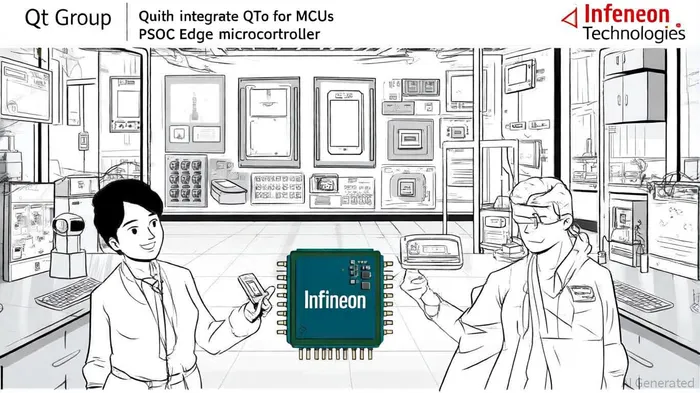
At the heart of the partnership is the integration of Qt for MCUs into Infineon's PSOC Edge microcontroller, a platform designed for AI-enabled consumer devices. Qt's framework, optimized for minimal memory usage and high-performance graphics, enables developers to create rich user interfaces (UIs) on hardware with limited processing power. According to an Inderes release, this integration delivers up to 5x more efficient RAM usage, 2x faster boot times, and 50% shorter time-to-market for developers. These metrics are particularly significant for edge computing, where real-time processing and low latency are non-negotiable.
The collaboration builds on prior success with Infineon's automotive TRAVEO T2G MCUs, where Qt's tools already demonstrated their ability to reduce resource consumption while maintaining high UI performance, as detailed in a 911Electronic report. Now, the partnership is expanding into consumer electronics, targeting markets like smart health wearables, smart home hubs, and synchronized human-machine interfaces (HMIs) with voice and gesture control, as noted in the Inderes release. This diversification underscores the versatility of the Qt-Infineon ecosystem and its potential to dominate multiple high-growth sectors.
Market Implications: A Booming Edge Computing Landscape
The global edge computing market is projected to grow from $23.65 billion in 2024 to $327.79 billion by 2033, at a compound annual growth rate (CAGR) of 33.0%, according to a Grand View Research report. This surge is driven by the increasing demand for real-time data processing, reduced cloud dependency, and AI-driven applications in industries ranging from healthcare to industrial automation. The software segment of this market, in particular, is expected to grow at the highest CAGR of 37%, fueled by the need for scalable frameworks that support AI/ML integration at the edge, as the Grand View Research report explains.
Qt and Infineon's partnership directly addresses these trends. By enabling developers to deploy AI models on low-power MCUs, the collaboration aligns with the rise of TinyML and edge AI, which are becoming cornerstones of next-generation embedded systems, as discussed in a Digitimes report. For instance, embedUR systems recently demonstrated real-world applications using Infineon's PSOC Edge platform, including voice-activated object recognition and facial recognition processed entirely on-device, in an Infineon community post. Such innovations highlight the potential for secure, low-power edge solutions that cater to both consumer and industrial markets.
Strategic and Financial Advantages for Investors
From an investment perspective, the Qt-Infineon partnership offers several compelling advantages. First, it reduces the technical barriers for developers entering the edge AI space. By providing a unified ecosystem that integrates Qt's design tools (e.g., Figma to Qt, Qt Design Studio) with Infineon's ModusToolbox™ framework, the partnership accelerates product development cycles, as the Inderes release highlights. This is critical in a market where time-to-market can determine competitive success.
Second, the collaboration positions both firms to capitalize on the $327 billion edge computing market by 2033, as detailed in the Grand View Research report. For Qt Group, this partnership strengthens its position as a leader in embedded software, while Infineon gains a competitive edge in MCU innovation. The financial benefits are already evident: Qt's integration with Infineon's TRAVEO T2G MCUs has enabled automotive clients to achieve cost savings through reduced memory footprints and enhanced security features, according to the Inderes release.
Risks and Considerations
While the partnership is promising, investors should remain cautious about potential challenges. The edge computing market is highly competitive, with players like NXPNXPI--, STMicroelectronics, and Texas InstrumentsTXN-- also investing heavily in AI-enabled MCUs. Additionally, the success of Qt and Infineon's ecosystem will depend on developer adoption and the availability of robust AI models optimized for low-power hardware. However, the firms' track record in automotive and industrial applications, coupled with their focus on user-centric design, mitigates some of these risks.
Conclusion: A Strategic Inflection Point
Qt Group and Infineon's AI partnership is more than a technological collaboration—it is a strategic inflection point for embedded intelligence. By addressing the hardware-software integration challenges that have long hindered edge AI adoption, the two firms are paving the way for a new generation of intelligent, low-power devices. For investors, this represents a high-conviction opportunity in a market poised for exponential growth. As edge computing becomes a cornerstone of digital transformation, the Qt-Infineon ecosystem is well-positioned to lead the charge.





Comentarios
Aún no hay comentarios