
The QMMM Collapse and the Systemic Risks in Digital Asset Custody
The collapse of QMMM in September 2025 has become a watershed moment for the digital asset custody sector, exposing critical vulnerabilities in the Digital Asset Treasury (DAT) model. The firm's stock surged 960% following its announcement of a $100 million plan to build reserves in BitcoinBTC--, EthereumETH--, and SolanaSOL--, only to collapse amid allegations of market manipulation and social media-driven hype from the U.S. Securities and Exchange Commission (SEC), which halted QMMM trading. The abandonment of QMMM's Hong Kong office further fueled speculation that executives had fled, eroding investor trust and underscoring the lack of transparency in managing crypto reserves, as CZ criticized the scandal. This incident has sparked urgent calls for reform, with Binance founder Changpeng Zhao (CZ) advocating for mandatory third-party custodial services and investor-audited account setups for all DAT firms, a position CZ demanded third-party custody. For institutional investors, the QMMM scandal is a stark reminder: without robust custody frameworks, the digital asset ecosystem remains prone to systemic fragility.
Systemic Risks in Digital Asset Custody
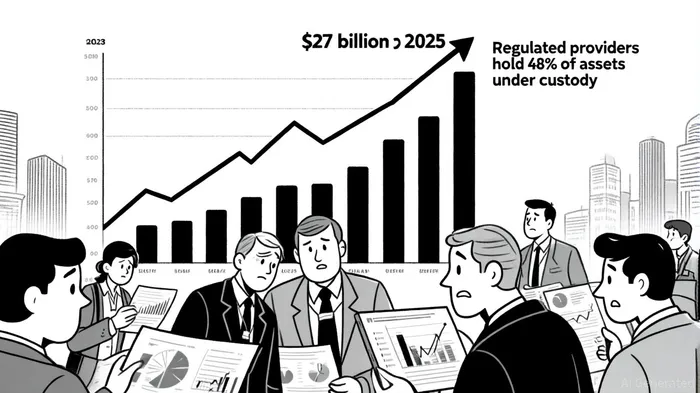
The QMMM collapse is not an isolated event but a symptom of broader systemic risks in digital asset custody. Institutional investors, now allocating over $220 billion to digital assets in 2025, face unique challenges in safeguarding these holdings, according to an Observer analysis. According to a 2025 CoinShares report, institutional inflows into digital asset investment products reached $27 billion year-to-date, yet this growth hinges on custody solutions that ensure full segregation of assets-both on-chain and off-chain-to prevent commingling or proprietary use, the Observer analysis found.
Current custody models each carry distinct risks. Exchange custody, exemplified by failures like FTX and Bybit, has proven vulnerable to misuse and hacking due to inadequate oversight, the Observer analysis notes. Self-custody, while theoretically secure, introduces operational complexity for institutions managing cryptographic keys at scale, and crypto-native custodians, though more secure, still grapple with technological vulnerabilities and operational failures, as highlighted in the same Observer piece. These risks are compounded by the decentralized and borderless nature of digital assets, which complicates regulatory oversight and amplifies contagion risks, particularly for stablecoins, as highlighted in a Digital Finance News report.
Regulatory Clarity and Institutional Strategies
The regulatory landscape is evolving to address these challenges. The Office of the Comptroller of the Currency (OCC) issued Interpretive Letter 1184 in May 2025, allowing national banks to provide custody services for crypto assets, thereby legitimizing institutional-grade custody, according to a Kroll briefing. Simultaneously, the SEC's repeal of Staff Accounting Bulletin 121 has reduced accounting burdens for custodians, encouraging broader participation in the market, the Kroll briefing adds. By Q2 2025, over $105 billion in institutional digital assets were held under custody by regulated providers, reflecting growing confidence in these frameworks, the Observer analysis reported.
Institutions are also adopting advanced strategies to mitigate risks. Hardware Security Modules (HSMs) and Multi-Party Computation (MPC) are now standard for securing private keys, while hybrid custody models combine cold storage with self-custody to balance security and operational flexibility, the Observer analysis describes. AI-driven risk assessment tools and real-time credit monitoring have become critical, with 65% of institutions implementing such solutions by 2025, according to that analysis. Regulatory alignment with frameworks like the EU's Markets in Crypto-Assets (MiCA) and AIFMD is also prioritized, emphasizing asset segregation and operational transparency.
The Case for Immediate Custody Reform
The QMMM collapse underscores an urgent need for institutional investors to prioritize custody reform. CZ's demand for third-party custodial audits and real-time verification is not merely a reaction to one scandal but a proactive measure to prevent future crises, a stance he publicized following QMMM's failure. Institutional investors must insist on custodians that enforce strict segregation of assets, provide transparent audit trails, and integrate with enterprise risk management systems. As of 2025, 84% of institutions emphasize alignment with regulatory frameworks like MiCA, recognizing that compliance is non-negotiable in a sector prone to volatility and fraud, the Observer analysis found.
Moreover, the rise of tokenized assets-such as real-world assets and stablecoins-demands custody solutions that can scale without compromising security. Hybrid models, which combine institutional-grade cold storage with self-custody, are gaining traction for their flexibility, the Observer analysis notes. However, these innovations must be paired with robust insurance coverage and cybersecurity protocols to address residual risks.
Conclusion
The QMMM collapse is a cautionary tale for the digital asset industry. While regulatory advancements and technological innovations are reshaping custody frameworks, systemic risks persist. For institutional investors, the path forward lies in prioritizing custody reform-demanding transparency, enforcing audits, and leveraging cutting-edge security solutions. As CZ aptly noted, "Without trust in custody, there is no trust in the ecosystem itself." In 2025, the stakes have never been higher, and the time to act is now.






Comentarios
Aún no hay comentarios